
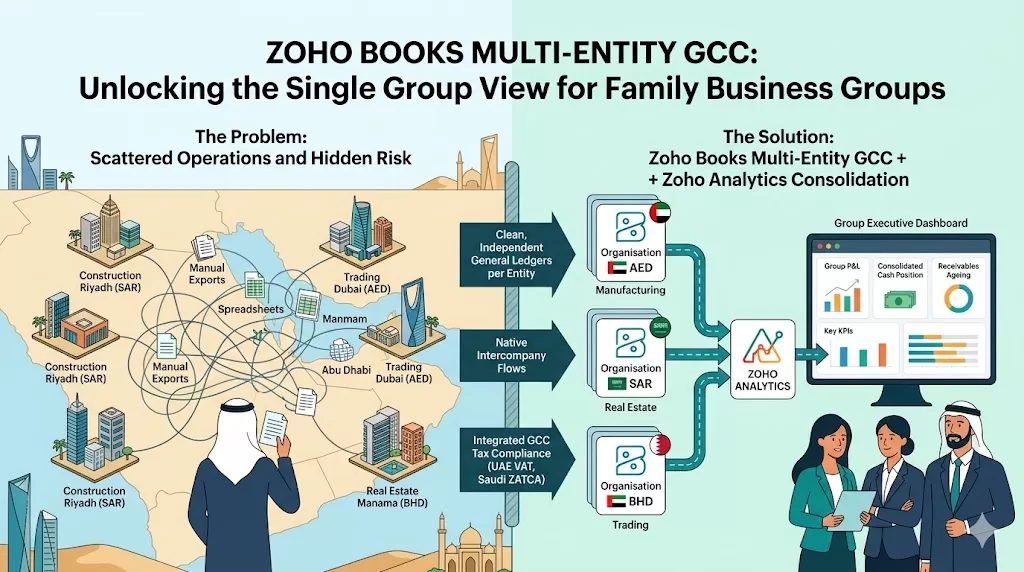
A family business group in GCC typically manages three to fifteen legal entities simultaneously.
Trading company in Dubai. Construction arm in Riyadh. Real estate holding in Abu Dhabi. A manufacturing operation in Dammam. All owned by the same family, all managed under different licences, all requiring separate accounting, but all needing to feed into a single group view for the Patriarch, the CFO, and the board.
Standard accounting software handles one company well. It handles a group of companies through spreadsheets, manual exports, and monthly reconciliation sessions that consume days of the finance team’s time.
Zoho Books multi-entity GCC capability changes that. This guide explains what Zoho Books actually supports for family business groups, where its natural limits are, and what a properly structured multi-entity Zoho implementation looks like.
Why Multi-Entity Management Is Hard for GCC Family Groups
The challenge is structural, not technical. GCC family business groups do not operate like Western corporate structures.
They typically have:
- Multiple legal entities in multiple jurisdictions: UAE mainland, UAE free zones, Saudi Arabia, Bahrain
- Different compliance obligations per entity: UAE VAT, UAE Corporate Tax, Saudi ZATCA, Bahrain VAT
- Mixed business types: trading, real estate, hospitality, construction, manufacturing, often within the same group
- Complex intercompany flows: the holding company funds subsidiaries, subsidiaries sell to each other, and shared services are charged across entities
- Different reporting audiences: operational managers need entity-level P&Ls, the CFO needs a consolidated group view, the board needs a KPI dashboard
No single off-the-shelf software produces all of this without configuration. The question for most GCC family groups is not whether to use software. It is about how to structure it correctly from the start.
How Zoho Books Handles Multiple Organisations
Zoho Books allows multiple organisations to be created and managed under a single account. Each organisation has its own ledger, its own reports, its own chart of accounts, and its own compliance configuration.
Switching between organisations is a single click from the top-right corner of the interface. A finance manager overseeing three entities can move between them without logging out, without separate browser sessions, and without disrupting their workflow.
What Each Organisation in Zoho Books Has
- Its own general ledger and chart of accounts
- Its own bank accounts, suppliers, and customer records
- Its own tax configuration: UAE VAT, Saudi ZATCA, Bahrain VAT, or UAE Corporate Tax
- Its own financial reports: P&L, balance sheet, cash flow statement
- Its own user access controls: entity-level staff see only their entity’s data
This structure means each legal entity operates as a clean, separate accounting environment. There is no bleed of data between entities. Each entity’s financials are accurate, auditable, and independently compliant.
The Key Limitation to Understand
Zoho Books supports multiple entities, but does not provide true consolidation across them. Group-level reporting, consolidated P&L, consolidated balance sheet, and intercompany eliminations require a dedicated consolidation layer that sits above the individual Zoho Books organisations.
This is not a weakness unique to Zoho Books. It is a characteristic of entity-level accounting platforms in general. Understanding this boundary upfront prevents the most common multi-entity implementation mistake in GCC: expecting one platform to do the work of two.
Intercompany Transactions in Zoho Books
Intercompany transactions are one of the most operationally complex areas in any multi-entity structure. A loan from the holding company to a subsidiary. A management fee charged from the shared services entity to an operating company. A sale between two group entities.
Each of these transactions must be recorded in both organisations, must net to zero at the group level, and must be eliminated when consolidated accounts are prepared.
How Intercompany Flows Are Handled in Zoho Books
Each side of an intercompany transaction is recorded manually in the respective Zoho Books organisation:
- The holding company records a loan payable in its ledger
- The subsidiary records a loan receivable in its ledger
- Both entries use matching values, dates, and reference numbers for reconciliation
The reconciliation step — confirming that the two entries match — is done outside Zoho Books, typically in a spreadsheet or a dedicated consolidation tool.
This works at two or three entities. It becomes a risk at five or more. The right approach for larger GCC family groups is introducing a structured consolidation layer, typically Zoho Analytics, alongside the Zoho Books multi-organisation setup.
Group-Level Reporting Using Zoho Analytics
Zoho Analytics group reporting is the layer that gives family business CFOs and boards the consolidated view that individual Zoho Books organisations cannot produce alone.
Zoho Analytics connects to multiple Zoho Books organisations simultaneously, pulling data from each entity’s general ledger, P&L, and balance sheet. Reports and dashboards are built on the combined dataset.
What Zoho Analytics Produces for GCC Family Groups
- Consolidated group P&L: total revenue, total cost, group EBITDA across all entities
- Entity-by-entity contribution: which business unit is performing, which is underperforming
- Group balance sheet: total assets, liabilities, and equity across the conglomerate
- Cash position dashboard: cash and bank balances across all entities in real time
- Intercompany balance schedule: outstanding balances between entities flagged for reconciliation
- Revenue by market: UAE versus Saudi Arabia versus Bahrain performance comparison
What Zoho Analytics Cannot Do Automatically
Zoho Analytics produces consolidated reports from the data it receives. It does not eliminate intercompany transactions automatically. A management fee charged from Entity A to Entity B appears in both entities’ revenue and cost lines until manually eliminated. This elimination step is a structured finance process, not a software function.
Documenting the intercompany elimination schedule as part of implementation design is standard practice for groups with five or more entities. The finance team then runs it consistently rather than ad hoc.
Building a Consolidated Dashboard for Your Business Group
The board dashboard is the most visible deliverable from a Zoho Books multi-entity GCC implementation. The CFO builds it once. The board reads it every month.
A well-designed group dashboard answers the questions that matter at the top of the family business:
What the Group Dashboard Should Show
Financial Performance
- Group revenue versus budget, by entity and in total
- Gross margin by business unit
- EBITDA trend over 12 months
- Cash conversion: revenue to cash received
Balance Sheet Health
- Total debt across entities
- Receivables ageing: which entities have overdue collections
- Inventory value across trading and manufacturing entities
- Intercompany balances: what entities owe each other
Market Performance
- Revenue by geography: Dubai versus Riyadh versus Manama
- Revenue by business type: trading versus real estate versus services
- Headcount cost by entity as a percentage of revenue
Compliance Status
- VAT return filed or pending per entity
- ZATCA compliance status for Saudi entities
- Corporate Tax filing status for UAE entities
For family business software, Dubai and Riyadh groups managing both UAE and Saudi operations, the compliance status layer is particularly important. A consolidated dashboard that shows one entity flagged for an outstanding ZATCA submission prevents a compliance gap from becoming a penalty.
Multi-Currency Management Across GCC Entities
GCC family business groups operate across AED, SAR, BHD, and often USD. Each Zoho Books organisation handles its own currency natively. The consolidation challenge emerges when group reporting requires translating all entities into a single reporting currency.
Zoho Books handles multi-currency at the entity level effectively. Each organisation records transactions in its operating currency and generates local currency reports.
At the group level, consistent FX translation methodology is required. Data is typically exported from multiple organisations, translated into a common reporting currency, and rebuilt into a consolidated output for management or board reporting. This process works, but creates rework every reporting cycle.
The FX translation layer within Zoho Analytics is structured using consistent rate sourcing and translation methodology, reducing manual rework and making the consolidated P&L reproducible month over month.
Managing Diverse Industry Portfolios on Zoho Books
A GCC family group with trading, real estate, and construction entities in the same structure does not have uniform accounting requirements. Each industry has different revenue recognition, different cost structures, and different compliance obligations.
How Zoho Books Handles Industry Diversity
Trading entities in conglomerate ERP UAE setups use the Zoho Books Inventory module for stock management, supplier payment terms, and customer credit limits. Revenue is recognised on an invoice.
Real estate entities use project-level tracking for development costs, revenue recognition aligned to completion percentage, and receivables management for installment-based payment schedules.
Construction entities use retention billing: invoicing a percentage of the contracted value at each project milestone and withholding a retention amount until project completion. Zoho Books handles retention billing through credit note configurations and staged payment terms.
Hospitality and F&B entities use POS integration and daily revenue reporting connected to Zoho Books through Zoho Creator or a third-party POS connector.
Each entity type requires a specific Chart of Accounts design and transaction configuration. A family business group that tries to use the same Chart of Accounts across all entity types produces financial statements that are internally inconsistent and difficult to audit.
Tailoring Zoho Views for CFOs, MDs and the Board
Different decision-makers in a GCC family business need different views of the same data.
The CFO needs entity-level accuracy, reconciliation schedules, and compliance status. Their primary tool is Zoho Books, entity by entity, with clean ledgers and audit-ready reports.
The Managing Director of each business unit needs operational performance metrics: revenue versus target, cost per transaction, team activity, and customer pipeline. Their primary tool is Zoho Analytics dashboards filtered to their entity.
The Patriarch or family board needs a single page showing group health: total revenue, cash position, net debt, and any compliance flags. Their primary tool is the group executive dashboard in Zoho Analytics.
Building these three views into the implementation design prevents the common outcome where the system serves the finance team well but delivers no visibility to the people making investment decisions.
Where Zoho Works Well and Where It Has Limits
A family business ERP GCC evaluation should be honest about where Zoho delivers and where it reaches its boundary.
Where Zoho Books Excels for GCC Family Groups
- Entity-level accounting accuracy across any number of organisations
- GCC tax compliance: UAE VAT, UAE Corporate Tax, Saudi ZATCA, Bahrain VAT configured per entity
- Seamless switching between entities under a single account
- Native integration with Zoho Analytics for group reporting
- Cost-effective multi-entity licensing compared to enterprise ERP alternatives
- Zoho CRM integration for sales-to-finance workflows across group entities
Where Zoho Books Reaches Its Limits
- Automated intercompany elimination: not natively supported, requires a consolidation layer
- Complex transfer pricing documentation: requires external processes alongside Zoho Books
- Real-time group P&L without a consolidation tool: requires Zoho Analytics setup
- More than 15–20 entities with complex intercompany structures: may require dedicated consolidation software above Zoho Books
The honest position for most GCC family groups with three to ten entities is clear. Zoho Books, combined with Zoho Analytics and a structured intercompany process, delivers more than 90% of what is needed at a fraction of enterprise ERP cost. The configuration investment is what determines whether that 90% becomes operational or theoretical.
What a Multi-Entity Zoho Books Implementation Involves
Zoho Books multi-entity GCC implementations delivered by Al Fahad IT Consulting span family business groups across Dubai, Riyadh, Abu Dhabi, Dammam, Manama, and Jeddah.
Every multi-entity engagement covers:
- Organisation structure design: how many Zoho Books organisations, how they map to legal entities
- Chart of Accounts design per entity type: trading, real estate, construction, hospitality
- Intercompany transaction process documentation and ledger configuration
- Tax configuration per entity: UAE VAT, UAE Corporate Tax, Saudi ZATCA, & Bahrain VAT
- Zoho Analytics connection and group dashboard build
- User access design: who sees which entities, at what level of detail
- Finance team training in Arabic and English across all entities
For Saudi entities within the group, the ZATCA Phase 2 e-invoicing configuration is included as standard. Our guide on Zoho Books ZATCA Phase 2 Saudi Arabia covers the Saudi compliance layer in detail.
Frequently Asked Questions
Can Zoho Books manage multiple companies under one account?
Yes. Zoho Books multi-entity GCC setups create separate organisations for each legal entity under a single account. Each organisation has its own ledger, tax configuration, and financial reports. Switching between organisations takes one click. Each entity’s data remains fully separate from the others.
Does Zoho Books produce consolidated financial statements automatically?
Zoho Books does not produce consolidated financial statements natively across multiple organisations. Group-level reporting requires Zoho Analytics, which connects to multiple Zoho Books organisations and produces consolidated dashboards and reports. Intercompany eliminations are a structured manual process that sits above the Zoho Books data layer.
How does Zoho Books handle intercompany transactions between entities in a GCC family group?
Each side of an intercompany transaction is recorded manually in the respective Zoho Books organisation. The reconciliation, confirming both entries match, is managed through Zoho Analytics or a structured offline process. Al Fahad documents the intercompany elimination schedule as part of every multi-entity implementation to ensure the finance team runs it consistently.
Can Zoho Books handle different tax regimes across UAE, Saudi Arabia, and Bahrain entities?
Yes. Each Zoho Books organisation is configured with the tax rules specific to its market: UAE entities at VAT 5% and Corporate Tax 9%, Saudi entities at ZATCA Phase 2 e-invoicing and VAT, and Bahrain entities at VAT 10% and NBR reporting.
Configurations are fully independent per entity.
How many entities can a GCC family business manage in Zoho Books?
There is no hard technical limit on Zoho Books organisations under a single account. Practically, multi-entity accounting GCC implementations with three to ten entities run smoothly.
Groups with fifteen or more entities and complex intercompany structures may benefit from dedicated consolidation tools above the Zoho Books layer. Al Fahad provides an honest assessment of this boundary at the start of every scoping conversation.
Build Your Group Accounting Structure the Right Way
Getting the Zoho Books multi-entity GCC structure right from the start prevents the compounding problems that come from adding entities to a poorly designed foundation.
Al Fahad IT Consulting is a Zoho Premium Partner with active multi-entity family business implementation experience across the UAE, Saudi Arabia, and Bahrain. Our engagements start with organisation structure design, not software installation.
Talk to our Zoho multi-entity team →
نتحدث العربية. تواصل معنا عبر واتساب للحصول على استشارة مجانية في إعداد زوهو بوكس للمجموعات متعددة الكيانات
Al Fahad IT Consulting is a Zoho Premium Partner and Oracle Partner Network member, providing Zoho Books multi-entity implementation services across UAE, Saudi Arabia, and Bahrain.


