
For businesses running payroll across Dubai, Riyadh, and Manama from the same HR team, this is not an academic problem. Contract types differ, resignation penalties differ, service thresholds differ, and the wage base used for the calculation differs from one jurisdiction to the next — while employees, auditors, and labour ministries in all three countries expect the number on the final settlement to be exactly right.
This guide breaks down exactly how end-of-service benefits (EOSB) are calculated in the UAE, Saudi Arabia, and Bahrain under each country’s current labour law, and shows how Zoho Payroll applies the correct country-specific formula automatically — inside the same platform, the same pay run, and the same final settlement process — so an EOSB figure never depends on which spreadsheet template an HR officer happened to open.
EOSB Across the GCC at a Glance: UAE, Saudi Arabia & Bahrain Compared
| Key Detail | UAE | Saudi Arabia | Bahrain |
| Governing Law | Federal Decree-Law No. 33 of 2021, Article 51 & 53 | Saudi Labour Law, Articles 84–87 | Bahrain Labour Law (Law No. 36 of 2012), Article 116 |
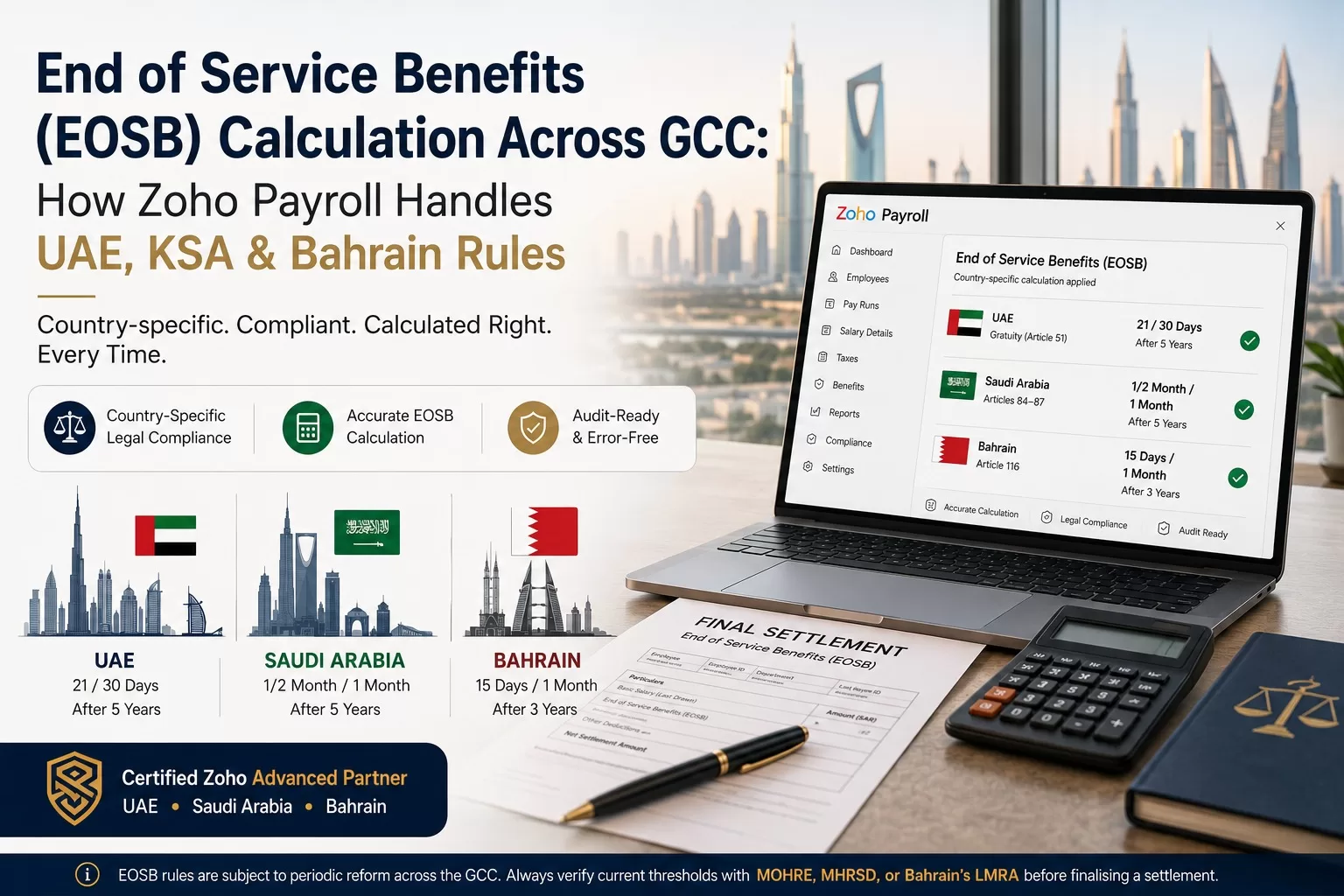
| Core Formula | 21 days’ wage per year (first 5 yrs) + 30 days’ wage per year (beyond 5 yrs) | Half a month’s wage per year (first 5 yrs) + one month’s wage per year (beyond 5 yrs) | 15 days’ wage per year (first 3 yrs) + one month’s wage per year (beyond 3 yrs) |
| Minimum Service to Qualify | 1 year of continuous service | Accrues from day one; payable at end of service, pro-rated for partial years | 1 year of continuous service |
| Wage Base Used | Last basic salary only (allowances excluded) | Last basic wage (some fixed allowances may apply per contract) | Last basic wage plus social allowance only |
| Resignation Impact | Full entitlement after 1 year for unlimited contracts; no reduction tiers since Feb 2022 reform | Reduced entitlement on resignation: roughly 1/3 (2–5 yrs), 2/3 (5–10 yrs), full (10+ yrs) | Generally payable in full on resignation once the 1-year threshold is met |
| Cap on Total Payout | 2 years’ total wage maximum | No statutory cap; capped in practice by total service and wage base | No statutory cap stated in Article 116 |
| National vs Expatriate Treatment | UAE nationals largely follow GPSSA pension rules instead of standard gratuity | GOSI applies alongside ESB for Saudi nationals; expatriates follow the standard Article 84/85 formula | Bahraini nationals mainly covered by SIO; non-Bahraini employees receive a gratuity-linked SIO contribution (4.2% under 3 yrs, 8.4% beyond 3 yrs) since the March 2024 reform |
Note: EOSB rules are subject to periodic reform across the GCC — including Bahrain’s phased Social Insurance changes and Saudi Arabia’s compulsory savings scheme timeline. Businesses should confirm current thresholds with MOHRE, the Saudi Ministry of Human Resources and Social Development (MHRSD), or Bahrain’s Labour Market Regulatory Authority before finalising a settlement.
Why EOSB Calculation Is Getting Harder for Multi-Country GCC Employers
A decade ago, most GCC businesses operated in a single country and calculated gratuity once, the same way, every time. That is no longer how the region works. Free zone growth, GCC-wide expansion, and cross-border hiring mean a single HR team in Dubai routinely manages final settlements for employees in Riyadh and Manama in the same week — using three different formulas, three different regulators, and three different definitions of what counts as “wage.”
The Same Job Title, Three Different Formulas
An account manager who resigns after four years in the UAE, Saudi Arabia, and Bahrain receives three different settlement calculations, built on three different day-rate multipliers, even if their basic salary and tenure are identical. A payroll officer who applies the UAE’s 21-day formula to a Bahrain exit — or Bahrain’s 15-day formula to a Saudi exit — produces a number that is simply wrong, and often only gets caught when the employee, or a labour authority, does the maths independently.
One Payroll Error, Three Different Regulators
A UAE gratuity dispute is handled by MOHRE. A Saudi ESB dispute goes through MHRSD and the Qiwa platform. A Bahrain gratuity claim is handled under the Bahrain Labour Law with its own complaint process. Multi-country employers cannot rely on a single compliance playbook — every miscalculation carries its own regulator, its own timeline, and its own exposure, which is exactly why the calculation needs to be correct at the point the pay run is processed, not corrected after a complaint is filed.
How End-of-Service Gratuity Is Calculated in the UAE
The UAE Gratuity Formula: 21 Days and 30 Days
Under Article 51 of Federal Decree-Law No. 33 of 2021, an employee who completes at least one year of continuous service is entitled to gratuity calculated as: 21 days’ basic wage for each of the first five years, plus 30 days’ basic wage for every year beyond five. The daily wage is the last basic salary divided by 30 — allowances such as housing, transport, and utilities are excluded from the calculation entirely.
For example, an employee on an AED 12,000 basic salary who completes eight years of service earns 21 days × 5 years at a daily rate of AED 400 (AED 42,000) plus 30 days × 3 years at the same daily rate (AED 36,000) — a total gratuity of AED 78,000.
UAE Gratuity Caps, Eligibility and Contract Type
Total gratuity is capped at two years’ total wage regardless of tenure, and unpaid leave days do not count toward the qualifying service period. Since the UAE moved to unified limited-term contracts in February 2022, the old reduced-entitlement tiers for early resignation on unlimited contracts have largely disappeared — the same 21/30-day formula now applies consistently once the one-year threshold is crossed. UAE nationals are generally covered under GPSSA pension rules rather than the standard expatriate gratuity scheme, and free zones such as DIFC and ADGM run separate frameworks, including DIFC’s DEWS savings scheme.
How End-of-Service Benefits Are Calculated in Saudi Arabia
The KSA Formula: Half-Month and Full-Month Wages
Articles 84 and 85 of the Saudi Labour Law set out a different accrual rate entirely: half a month’s wage for each of the first five years of service, plus one full month’s wage for every year beyond five. Partial years are pro-rated — an employee who completes 3 years and 4 months is credited for 3.33 years, not a flat 3. The wage base is the employee’s basic salary at the point of exit, which means long-serving employees benefit from any salary growth over their tenure, since earlier, lower salary periods are not used in the calculation.
A worked example: an employee on a SAR 10,000 basic salary with seven years of service accrues 5 × (SAR 10,000 ÷ 2) = SAR 25,000 for the first five years, plus 2 × SAR 10,000 = SAR 20,000 for the remaining two years — a total ESB of SAR 45,000 before any resignation-related reduction is applied.
Resignation vs Termination: Why the KSA Calculation Splits in Two
Saudi Arabia is the one GCC jurisdiction in this comparison where the reason for leaving materially changes the payout. Employer-initiated termination without cause generally entitles the employee to the full ESB calculated above. Voluntary resignation, however, is typically reduced on a tiered basis — roughly one-third of the full entitlement between two and five years of service, two-thirds between five and ten years, and the full amount beyond ten years. Employers should also apply Article 80 grounds for termination carefully, since dismissal for cause can affect entitlement, and final settlements must be paid within the statutory deadline — a week for termination or contract expiry, two weeks for resignation.
How End-of-Service Gratuity Is Calculated in Bahrain
The Bahrain Formula: 15 Days, Then a Full Month
Article 116 of the Bahrain Labour Law (Law No. 36 of 2012) sets the accrual rate at 15 days’ wage for each of the first three years of service, plus one full month’s wage for every year of service after the first three. The wage base is the employee’s last basic salary plus the social allowance only — other allowances are excluded, and partial years are pro-rated based on days actually worked.
Bahrain’s SIO Overlay for Bahraini Nationals
Bahrain is the clearest outlier among the three countries. Bahraini nationals are primarily covered by the Social Insurance Organisation (SIO) pension scheme rather than the standard employer-paid gratuity, so EOSB under Article 116 mainly applies to non-Bahraini employees, and to any service period a Bahraini national worked before their SIO coverage began. Following the reform effective March 2024, non-Bahraini employees are covered by a gratuity-linked SIO contribution structure — a lower rate for employees with under three years of service, rising once they cross the three-year mark — layered on top of the traditional gratuity framework rather than replacing it outright. Employers should confirm the current contribution bands directly with Bahrain’s Social Insurance Organisation, since this is one of the more frequently updated rules in the GCC.
Side-by-Side: Where the Three GCC EOSB Formulas Actually Diverge
| Divergence Point | UAE | Saudi Arabia | Bahrain |
| Accrual rate, first tier | 21 days per year | 15 days per year (half-month) | 15 days per year |
| Accrual rate, second tier | 30 days per year (after 5 yrs) | 30 days per year (after 5 yrs) | 30 days per year (after 3 yrs) |
| Tier changes after | 5 years | 5 years | 3 years |
| Resignation reduces payout? | No, once 1-year threshold is met | Yes, tiered by service length | Generally no, once threshold is met |
| Statutory payout cap | 2 years’ wage | None stated | None stated |
| National workforce treatment | GPSSA pension track | GOSI alongside ESB | SIO track, gratuity mainly for expatriates |
The practical risk is obvious once the numbers sit side by side: a payroll process built around one country’s tier structure will silently misapply the wrong day-rate or the wrong tier threshold the moment it is used for a different country — and the error is invisible until someone recalculates it by hand.
How Zoho Payroll Automates EOSB Across UAE, KSA & Bahrain
Zoho Payroll runs country-specific editions for the UAE, Saudi Arabia, Bahrain, and the wider GCC, and its end-of-service handling is built around a single principle: the formula applied to a final settlement is determined by the employee’s country and contract data already stored in the system — not re-entered, and not left to whichever formula a payroll officer remembers.
Country-Specific Formulas Built Into Every Pay Run
Zoho Payroll applies the UAE’s 21/30-day structure, Saudi Arabia’s half-month/full-month tiers, and Bahrain’s 15-day/30-day structure automatically, based on the employee’s registered country and contract type — so a business running all three editions from one Zoho account never has to manually select or verify which formula applies to a given exit.
Automatic Handling of Resignation, Termination & Contract End
Because Saudi Arabia’s ESB tiers depend on whether the employee resigned or was terminated, Zoho Payroll captures the separation reason as part of the exit workflow and applies the correct entitlement percentage automatically — removing the manual step where resignation-tier errors are most likely to occur.
GOSI, SIO and GPSSA Contributions Alongside Gratuity
Pension and social insurance contributions are calculated in parallel with the gratuity figure — GPSSA for UAE and GCC nationals, GOSI (including SANED unemployment insurance and occupational hazard contributions) for Saudi Arabia, and SIO contributions for Bahrain — so the final settlement reflects both the statutory gratuity and any applicable social insurance deduction in one consistent record.
Final Settlement as Part of the Normal Payroll Cycle
An employee exit is processed as an off-cycle pay run rather than a manual, offline calculation — pro-rated salary, leave encashment, and the country-correct EOSB figure are generated together, with a gratuity liability report available at any time to show accrued but unpaid entitlements across the entire workforce.
Zoho Payroll vs Manual EOSB Calculation Across GCC Branches
| Criteria | Manual / Spreadsheet Process | Zoho Payroll |
| Formula selection | Depends on which country’s template the officer opens | Applied automatically based on employee’s country and contract |
| Resignation vs termination tiers (KSA) | Calculated by hand, easy to misapply the wrong tier | Entitlement percentage applied automatically from the exit reason |
| Wage base exclusions | Allowances often mixed in with basic salary by mistake | Basic wage isolated automatically per country’s rule |
| Social insurance overlay | Tracked in a separate GOSI/SIO/GPSSA spreadsheet | Calculated alongside gratuity in the same pay run |
| Multi-country visibility | Separate files per country, difficult to consolidate | Single dashboard covering every GCC edition in use |
| Audit trail | Fragmented, hard to reconstruct for a labour authority | Full settlement and gratuity liability history retained |
Signs Your GCC EOSB Process Is at Risk
- Sign #1: Your HR team uses a different spreadsheet template for each GCC country, maintained separately.
- Sign #2: Resignation-tier calculations in Saudi Arabia are applied inconsistently, or not at all.
- Sign #3: Gratuity and social insurance (GOSI, SIO, GPSSA) are calculated in separate systems that don’t reconcile.
- Sign #4: A final settlement has been challenged or corrected after issue in the last 12 months.
- Sign #5: You cannot produce a gratuity liability report across all GCC entities on demand.
If two or more of these apply, it is worth reviewing how EOSB is calculated across your GCC operations before the next round of exits — not after a labour complaint is filed.
How Al Fahad IT Consulting Helps You Get EOSB Right Across the GCC
Al Fahad IT Consulting is a certified Zoho Premium Partner with offices in Dubai and Dammam, and more than a decade of experience implementing Zoho across the UAE, Saudi Arabia, and Bahrain. We configure Zoho Payroll around your actual employee base and contract mix in every country you operate — not a generic template — so EOSB is calculated correctly the first time, every time.
- Multi-Country Payroll Audit: We review your current EOSB process, contract types, and exit history across every GCC entity before configuring Zoho Payroll around it.
- Country-Specific EOSB Configuration: We set up the correct gratuity formula, resignation tiers, and wage-base rules for the UAE, Saudi Arabia, and Bahrain editions you run.
- GOSI, SIO & GPSSA Setup: We configure social insurance and pension contributions to match each country’s current requirements alongside your gratuity calculations.
- Zoho Books & Zoho People Integration: We connect payroll to your accounting and HR systems so every final settlement posts automatically, with no manual re-entry.
- Arabic + English Training: Full training for payroll and HR teams across your GCC locations, delivered locally, with ongoing post-go-live support.
Contact our team today for a free Zoho Payroll consultation tailored to your business — whether you are in Dubai, Abu Dhabi, Riyadh, or Manama.
Frequently Asked Questions
Q1. Is the end-of-service benefit formula the same across the UAE, Saudi Arabia, and Bahrain?
No. The UAE uses 21 days’ wage per year for the first five years and 30 days per year after that. Saudi Arabia uses half a month’s wage per year for the first five years and a full month per year after that. Bahrain uses 15 days’ wage per year for the first three years and a full month per year after that. Each is governed by its own labour law and calculated on its own wage base.
Q2. Does resigning reduce an employee’s end-of-service benefit?
It can in Saudi Arabia, where resignation triggers a tiered reduction based on years of service. In the UAE, the previous reduced-entitlement tiers have largely been phased out since the 2022 contract reforms, and in Bahrain, gratuity is generally payable in full once the one-year service threshold is met.
Q3. Can Zoho Payroll calculate EOSB correctly for employees in more than one GCC country?
Yes. Zoho Payroll offers country-specific editions for the UAE, Saudi Arabia, Bahrain, and the wider GCC, and applies each jurisdiction’s gratuity formula, resignation rules, and wage-base exclusions automatically based on the employee’s registered country and contract data.
Q4. How does Zoho Payroll handle GOSI, SIO, and GPSSA alongside gratuity?
Zoho Payroll calculates the relevant social insurance or pension contribution — GOSI for Saudi Arabia, SIO for Bahrain, GPSSA for UAE and other GCC nationals — in parallel with the gratuity figure, so the final settlement reflects both correctly in a single record.
Q5. What happens if EOSB is calculated using the wrong country’s formula?
The employee receives an incorrect settlement, which can be challenged through MOHRE in the UAE, MHRSD and Qiwa in Saudi Arabia, or Bahrain’s labour complaint process, depending on where the exit took place. Using a single payroll platform that applies the correct country-specific formula automatically is the most reliable way to avoid this.
Ready to Get EOSB Calculation Right Across the GCC?
End-of-service benefits are a statutory obligation in every GCC country your business operates in — and three different formulas mean three different ways to get it wrong. For most UAE, Saudi Arabia, and Bahrain businesses, Zoho Payroll delivers country-correct gratuity calculation, resignation-tier handling, and social insurance contributions inside the same platform you already use for payroll, accounting, and HR.
Whether you are in Dubai, Abu Dhabi, Riyadh, or Manama, Al Fahad IT Consulting brings the Zoho implementation experience to get your EOSB calculations right across every GCC entity you run. Contact our team today for a free, obligation-free Zoho Payroll consultation.
Disclaimer: This article is for informational purposes only and does not constitute professional legal, tax, or payroll advisory services. Always confirm current thresholds and formulas with MOHRE, MHRSD, or Bahrain’s Labour Market Regulatory Authority before finalising a settlement.
Talk to a Zoho Payroll Specialist
Al Fahad IT Consulting is a Zoho Premium Partner with active Zoho Payroll and Zoho People implementations across UAE, Saudi Arabia, and Bahrain.
We configure EOSB, GOSI, SIO, and GPSSA workflows aligned to your country mix and contract structure: not a generic template.
Book a free Zoho consultation →
نتحدث العربية. تواصل معنا للحصول على استشارة مجانية في حساب مكافأة نهاية الخدمة والرواتب
Al Fahad IT Consulting is a Zoho Premium Partner and Oracle Partner Network member, providing Zoho implementation services across UAE, Saudi Arabia, and Bahrain.


