
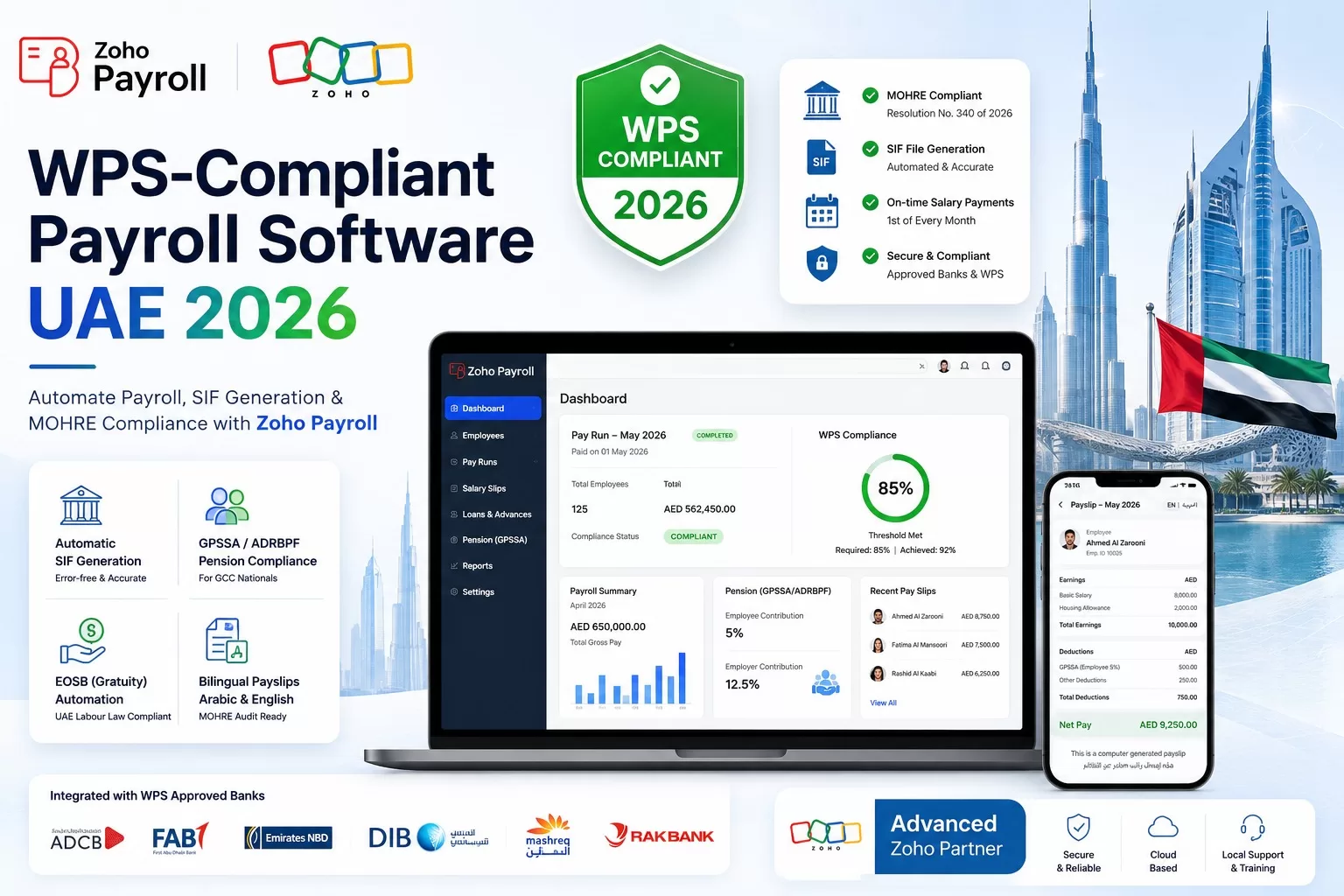
Payroll in the UAE stopped being a back-office formality the moment MOHRE tightened the Wage Protection System in 2026. Under Ministerial Resolution No. 340 of 2026, every private-sector establishment now works to a single, unified salary due date, a stricter compliance threshold, and an enforcement timeline that starts counting the moment a pay run is late. A payroll process built on spreadsheets, manual bank uploads, or disconnected HR tools is no longer a convenience gap — it is a compliance risk that can freeze your work permits within days.
This guide explains exactly what changed under the UAE’s 2026 WPS rules, what MOHRE expects from every registered employer, and how Zoho Payroll — configured correctly — turns WPS compliance from a monthly scramble into an automated step inside your normal pay run. It is written specifically for businesses operating across Dubai, Abu Dhabi, Sharjah, and the wider Emirates, where WPS, GPSSA pensions, and end-of-service gratuity all have to work together correctly, every single month.
This is not a generic payroll explainer. It is a practical, UAE-specific breakdown of the 2026 WPS framework and the exact features inside Zoho Payroll that keep a business compliant with it, from SIF file generation to bilingual payslips and multi-Establishment ID support.
UAE WPS 2026 at a Glance: The Key Facts Every Employer Must Know
| Key Detail | Requirement / Rule |
| Governing Regulation | Ministerial Resolution No. 340 of 2026, effective 1 June 2026 (repeals Resolution No. 598 of 2022) |
| Unified Salary Due Date | 1st day of every Gregorian month, for the previous month’s wages |
| Minimum Compliance Threshold | At least 85% of total wages due must be transferred within the required period |
| Maximum Payroll Deductions | Capped at 15% of monthly wage for WPS compliance purposes |
| Who Must Comply | All MOHRE-registered private-sector establishments; most free zones fall under mainland WPS rules |
| Key Exemptions | DIFC and ADGM (separate frameworks), banks and financial institutions, places of worship, individually owned public taxis |
| Submission Method | Salary Information File (SIF) submitted via an approved bank or exchange house |
| Penalty Escalation Start | Automated monitoring begins on Day 1–2 after the due date |
| Regulatory Authority | Ministry of Human Resources and Emiratisation (MOHRE), in coordination with the Central Bank of the UAE |
Note: WPS obligations sit alongside — not instead of — UAE Labour Law requirements on gratuity, leave, and end-of-service benefits. Businesses should confirm their Establishment ID setup and free zone status directly with MOHRE or a certified implementation partner.
What Is the Wage Protection System and Why It Changed in 2026
The Wage Protection System is the electronic salary transfer framework MOHRE introduced in 2009, developed jointly with the Central Bank of the UAE, to guarantee that private-sector employees are paid on time, in full, through traceable banking channels. It removed the option of paying staff in cash or through informal transfers, and it gave MOHRE a real-time database of every wage payment made across the private sector.
▌ Ministerial Resolution No. 340 of 2026: What Changed
Resolution 340, issued on 12 May 2026 and effective from 1 June 2026, restructured the timing, thresholds, and enforcement mechanics of WPS. The most significant change is the unified wage due date: salaries for the previous month are now due on the first day of every Gregorian month, replacing the more flexible cycle employers previously worked to. Any payment made after that date is legally treated as delayed, regardless of how the business has historically run its payroll calendar.
▌ The 85% Compliance Threshold and 15% Deduction Cap
Employers must transfer at least 85% of total wages due within the required period for a pay run to be treated as compliant. At the same time, the Resolution restricts lawful deductions to a maximum of 15% of an employee’s monthly wage for WPS purposes — a tighter limit than the general Labour Law allowance of up to 50% for combined deductions. For payroll teams, this means the arithmetic behind every pay run — basic salary, allowances, loan repayments, absence deductions — now has a hard compliance ceiling that cannot be exceeded without triggering a flag.
Who Must Comply with WPS in the UAE
WPS applies to every private-sector establishment registered with MOHRE that employs one or more staff under a MOHRE-issued work permit. This covers mainland LLCs and the large majority of free zone companies — DMCC, JAFZA, RAKEZ, IFZA, and similar jurisdictions generally fall under mainland WPS rules for their MOHRE-sponsored staff.
- Exempt: DIFC and ADGM, which run independent employment frameworks — DIFC uses the DEWS defined-contribution scheme in place of standard gratuity.
- Exempt: Banks and other financial institutions regulated separately by the Central Bank.
- Exempt: Places of worship and individually owned public taxis.
- Covered: Every other MOHRE-registered establishment, regardless of size — a company with a single employee is still obligated to run WPS-compliant payroll.
If your business straddles more than one emirate, note that WPS submissions are tied to your MOHRE Establishment ID — multi-location businesses typically need separate Establishment IDs for each branch, and your payroll software needs to handle that without manual workarounds.
The WPS Penalty Escalation Timeline for 2026
MOHRE’s enforcement under Resolution 340 is automated and progressive, which means the cost of a late or incomplete pay run compounds quickly if it isn’t caught early.
- Day 1–2: Electronic monitoring begins immediately; automated notifications and warnings are issued to non-compliant establishments.
- From Day 5: Suspension of new work permit applications for the non-compliant company.
- From Day 11: Administrative fines apply, and the company’s compliance classification can be downgraded.
- After Day 16: Employees may file formal labour complaints; restrictions apply to high-risk sectors.
- After Day 21: Repeated violations can be referred to public prosecution, alongside possible wage recovery orders.
Separately, mismatches between the payslip figures issued to staff and the SIF file submitted to the bank are treated as their own violation — MOHRE can block new work permit applications from the 17th of the month if the two do not reconcile, with fines reported as high as AED 5,000 per employee, per violation.
What Non-Compliant Payroll Actually Costs a UAE Business
▌ Blocked Work Permits and Downgraded Compliance Status
A single missed or partial pay run doesn’t just risk a fine — it stops your ability to hire. New work permit applications are frozen from Day 5 of non-compliance, which can derail hiring plans, visa renewals, and project mobilisation at exactly the moment a growing business needs them least.
▌ Payslip-to-SIF Mismatches Trigger Audits
When payroll figures are calculated in one system (spreadsheets, a generic accounting tool, or a payroll add-on bolted onto unrelated software) and the SIF file is prepared separately, small discrepancies creep in — a rounding difference, an unrecorded deduction, an outdated Establishment ID. MOHRE cross-references the SIF against actual bank transfer records in real time, so these mismatches are not quiet errors; they are the most audited field in the entire compliance framework.
▌ Manual GPSSA and Gratuity Calculations Are Where Errors Hide
For UAE and GCC national employees, pension contributions to GPSSA or ADRBPF must appear as a separate deduction line, typically 5% of the pensionable salary on the employee side. End-of-service gratuity calculations depend on contract type, tenure, and the exact reason for separation. Getting either wrong doesn’t just cause a WPS flag — it exposes the business to direct Labour Law liability.
How Zoho Payroll Works for UAE WPS Compliance
Zoho Payroll is built specifically for the UAE market, and its WPS handling is designed around one principle: the same data that produces your payslips is the data that produces your SIF file, so there is no second, disconnected step where errors can enter.
▌ Automatic SIF File Generation
Zoho Payroll generates the prefilled Salary Information File automatically as part of every pay run. Employee bank details, Emirates IDs, salary figures, and Establishment IDs are pulled directly from the same records used to calculate pay — not re-entered or exported separately — which removes the most common source of SIF rejections and payslip mismatches.
▌ GPSSA and ADRBPF Pension Contributions for GCC Nationals
For Emirati and other GCC national employees, Zoho Payroll calculates GPSSA and ADRBPF pension contributions automatically and reflects them as a distinct deduction line on the payslip. The platform also supports GOSI, SIO, PIFSS, PASI, and GRSIA for businesses running payroll across Saudi Arabia, Bahrain, and other GCC jurisdictions from the same account.
▌ End-of-Service Benefit (EOSB) Automation
Gratuity is calculated automatically based on contract type — limited or unlimited — and the specific reason for separation, whether that’s resignation, termination, or contract completion. Final settlements, including pro-rated salary, leave encashment, and gratuity, can be processed as an off-cycle pay run with their own SIF entry, so a mid-cycle departure never falls outside the compliance record.
▌ Bilingual Payslips in Arabic and English
Every payslip can be issued with bilingual English and Arabic headers, which MOHRE audits typically expect regardless of the makeup of your workforce. Because the payslip and the SIF file are generated from the same underlying pay run, the net pay figure that appears on the slip matches the figure submitted to the bank — the single most audited data point in the WPS framework.
▌ Multi-Establishment ID Support
Businesses operating across more than one emirate, or with more than one MOHRE Establishment ID, can manage every entity from a single Zoho Payroll account, with WPS submissions correctly tied to the relevant Establishment ID for each pay run.
▌ Native Integration with Zoho Books and Zoho People
Once a pay run is processed, journal entries post automatically into Zoho Books, so finance teams are not re-keying payroll costs into the accounting ledger. Attendance and leave data flow in from Zoho People, which means SIF accuracy doesn’t depend on a manual export step before every pay run — a common failure point when payroll and HR sit in separate, unconnected systems.
Zoho Payroll vs a Manual or Spreadsheet-Based Process
| Criteria | Manual / Spreadsheet Payroll | Zoho Payroll |
| SIF File Preparation | Manually built or exported separately from payslips — high risk of mismatch | Auto-generated from the same pay run data as the payslip |
| GPSSA / ADRBPF Calculation | Calculated by hand or in a separate template, easy to misapply the 5% rate | Automated for GCC nationals, shown as a distinct deduction line |
| Gratuity (EOSB) | Recalculated manually per employee at exit, contract-type errors common | Automated by contract type and separation reason |
| Bilingual Payslips | Usually requires a second manual template in Arabic | Built-in bilingual English/Arabic payslips |
| Multi-Establishment ID | Tracked in separate spreadsheets per branch or emirate | Managed from a single account, correctly tied per pay run |
| Accounting Sync | Manual re-entry into accounting software, delayed and error-prone | Journal entries post automatically into Zoho Books |
| Audit Trail | Fragmented across files, difficult to reconstruct for a MOHRE audit | Complete digital record for every pay run, ready for audit |
The gap widens as headcount grows: a five-person team can usually absorb a manual process, but a WPS violation at 50 or 100 employees carries proportionally larger fines and a much larger risk of a blocked permit backlog during a hiring push.
Setting Up Zoho Payroll for UAE WPS Compliance: Step by Step
- 1. Configure your organisation profile — company name, TRN, bank details, and the WPS reference number issued by your approved bank or exchange house.
- 2. Add employee profiles — Emirates ID, visa details, bank account numbers, salary structure, and contract type (limited or unlimited) for every employee.
- 3. Set pay schedules — align pay runs to the unified 1st-of-the-month due date, with automatic adjustment when payday falls on a weekend or public holiday.
- 4. Configure pension and gratuity rules — flag GCC national employees for GPSSA/ADRBPF contributions and confirm gratuity settings match UAE Labour Law.
- 5. Run a parallel pay cycle — process one cycle alongside your existing system to confirm SIF files generate correctly before decommissioning the old process.
- 6. Connect Zoho Books and Zoho People — so attendance, leave, and accounting stay synchronised with every pay run, without manual exports.
Signs Your Payroll Process Is Putting You at WPS Risk
- Sign #1: You still build or check the SIF file separately from the payslips you issue to staff.
- Sign #2: GPSSA, ADRBPF, or gratuity figures are calculated in a spreadsheet rather than by your payroll system.
- Sign #3: You have discovered a payslip-to-SIF mismatch only after a MOHRE query or a blocked permit application.
- Sign #4: You operate in more than one emirate and manage Establishment IDs manually across separate files.
- Sign #5: Your payroll and accounting systems don’t talk to each other, so journal entries are re-keyed by hand every month.
If two or more of these apply to your business, it is worth reviewing your payroll setup against the 2026 WPS rules before your next pay run — not after a warning notice arrives.
How Al Fahad IT Consulting Helps You Get WPS-Compliant with Zoho Payroll
Al Fahad IT Consulting is a certified Zoho Premium Partner with offices in Dubai and Dammam, and more than a decade of experience implementing Zoho across the UAE, Saudi Arabia, and Bahrain. We configure Zoho Payroll around how your business actually runs — not a generic template — so WPS compliance is built into your pay run from day one.
- Payroll Audit & Setup: We review your current payroll process, employee data, and Establishment ID structure before configuring Zoho Payroll around it.
- WPS Bank & SIF Configuration: We connect Zoho Payroll to your approved bank or exchange house and confirm SIF files generate correctly for every Establishment ID you operate.
- GPSSA, ADRBPF & Gratuity Setup: We configure pension contributions and end-of-service calculations to match UAE Labour Law and your specific contract types.
- Zoho Books & Zoho People Integration: We connect payroll to your accounting and HR systems so every pay run posts automatically, with no manual re-entry.
- Arabic + English Training: Full training for payroll and HR teams, delivered locally, with ongoing post-go-live support.
Contact our team today for a free Zoho Payroll consultation tailored to your business — whether you are in Dubai, Abu Dhabi, Sharjah, Riyadh, or Manama.
Frequently Asked Questions
Q1: Does every UAE business need to comply with WPS, even with one employee?
Yes. Any MOHRE-registered private-sector establishment with one or more employees under a MOHRE work permit must pay wages through WPS or another MOHRE-approved channel — company size does not create an exemption.
Q2: What is the new salary due date under the 2026 WPS rules?
Under Ministerial Resolution No. 340 of 2026, effective 1 June 2026, wages for the previous month are due on the first day of every Gregorian month. Payment after that date is treated as delayed.
Q3: Can Zoho Payroll generate the SIF file automatically?
Yes. Zoho Payroll builds the prefilled Salary Information File directly from the same data used to run payroll, so bank details, salary figures, and Establishment IDs stay consistent between the payslip and the SIF submission.
Q4: How does Zoho Payroll handle GPSSA and gratuity for UAE nationals?
Zoho Payroll automatically calculates GPSSA or ADRBPF pension contributions for GCC national employees and computes end-of-service gratuity based on contract type and separation reason, reflecting both correctly on payslips and final settlements.
Q5: What happens if my payslip figures don’t match my SIF file?
MOHRE cross-references submitted SIF files against actual bank transfers, and mismatches are heavily scrutinised — reports indicate work permit applications can be blocked from the 17th of the month, with fines reported as high as AED 5,000 per employee, per violation. Running payslips and SIF files from the same payroll system is the most reliable way to avoid this.
Ready to Make Your UAE Payroll WPS-Compliant?
The 2026 WPS rules turned payroll into a compliance system with real, escalating consequences — not a once-a-month administrative task. For most UAE SMEs and mid-market businesses, Zoho Payroll delivers automatic SIF generation, GPSSA and gratuity compliance, and bilingual payslips inside the same platform you already use for CRM, accounting, and HR.
Whether you are in Dubai, Abu Dhabi, Sharjah, or elsewhere in the UAE, Al Fahad IT Consulting brings the Zoho implementation experience to get your payroll WPS-compliant and keep it that way. Contact our team today for a free, obligation-free Zoho Payroll consultation.
Disclaimer: This article is for informational purposes only and does not constitute professional legal or HR compliance advice. UAE WPS regulations are subject to change. Always verify current requirements with MOHRE or a qualified UAE labour law advisor before making compliance decisions.
Talk to a Zoho Payroll WPS Specialist
Al Fahad IT Consulting is a Zoho Premium Partner with active Zoho Payroll WPS-compliance implementations across UAE, Saudi Arabia, and Bahrain.
We configure SIF generation, GPSSA/ADRBPF, and gratuity rules aligned to your Establishment ID structure and workforce: not a generic template.
Book a free Zoho consultation →
نتحدث العربية. تواصل معنا للحصول على استشارة مجانية حول الامتثال لنظام حماية الأجور في الإمارات
Al Fahad IT Consulting is a Zoho Premium Partner and Oracle Partner Network member, providing Zoho implementation services across UAE, Saudi Arabia, and Bahrain.


