
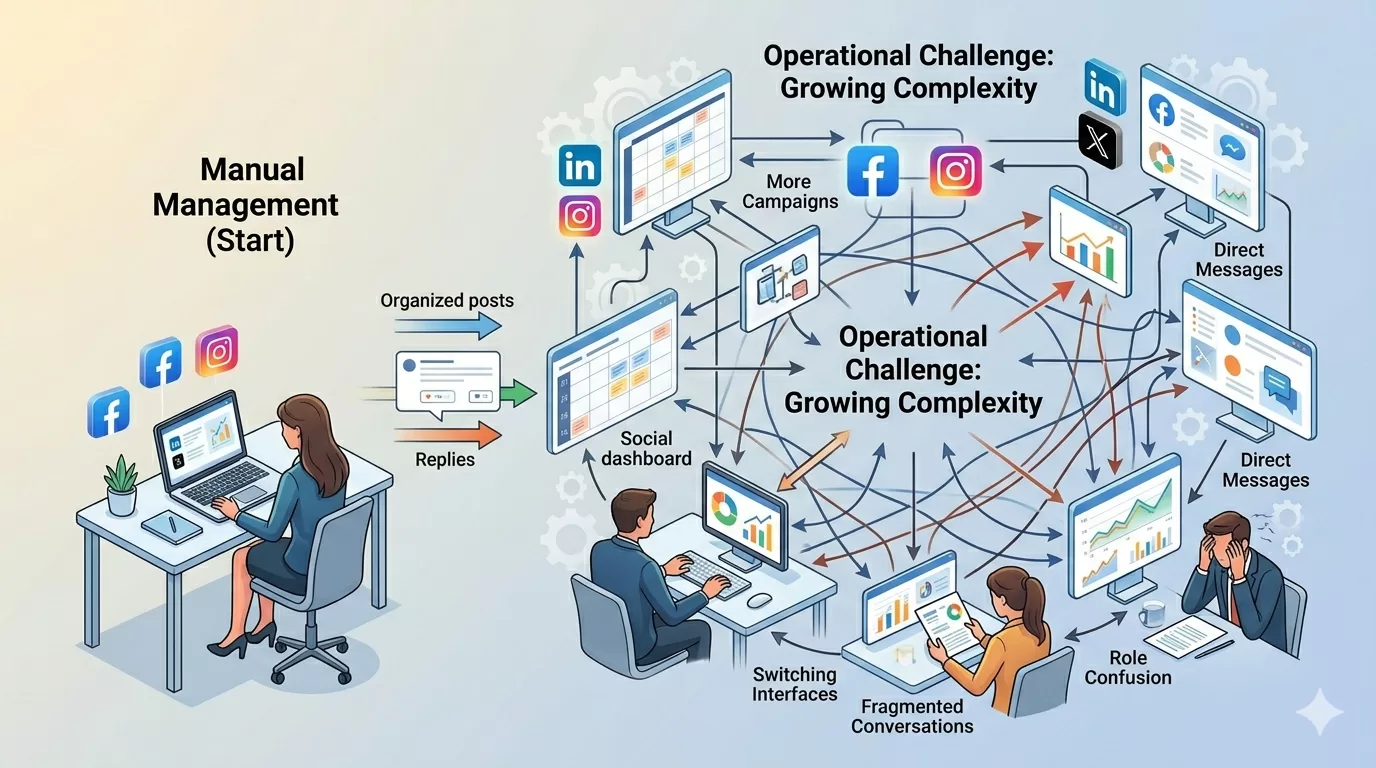
Many businesses begin social media in a simple way. A marketer creates a few accounts, publishes posts when needed, and replies to comments directly on each platform.
This approach works at the start. But as the business grows, social media activity grows with it. More platforms appear. More campaigns run at the same time. Customers send more messages and comments.
Soon the marketing team is switching between dashboards, trying to track conversations, and manually collecting performance data.
At this point, social media management becomes an operational challenge rather than a simple marketing task. This article explains why that happens and why many organisations eventually move toward structured social media management systems.
The Growth of Social Media Channels in Business Marketing
Social media has become a core marketing channel for most organisations, used for brand awareness, customer engagement, lead generation, and customer support. Businesses operating in competitive markets such as the UAE, where social media marketing in Dubai has become a significant commercial activity, rarely operate on just one platform.
Businesses operating across multiple platforms
Many organisations maintain accounts on several platforms at the same time. Common examples include LinkedIn for professional audiences, Instagram for visual content, Facebook for community engagement, and X for announcements and conversations. Each platform has its own posting style, audience behaviour, and content format. Marketing teams must adapt content for every network while keeping messaging consistent.
Increasing frequency of content publishing
Social media platforms reward consistent activity. Brands that post regularly are more likely to remain visible to their audiences. Because of this, marketing teams often manage daily posts, campaign announcements, product updates, promotional content, and ongoing audience engagement. Publishing occasionally is no longer enough.
Operational Challenges of Managing Multiple Social Media Accounts
When social media activity increases, the operational workload grows quickly. Marketing teams begin facing structural challenges that slow down daily work.
Switching between multiple platform interfaces
Each social network has its own dashboard. Marketers often switch between LinkedIn company pages, Instagram accounts, Facebook business dashboards, and X posting interfaces. This constant switching consumes time and interrupts workflow. Simple tasks like publishing a campaign post can require logging into several platforms separately, which slows down marketing operations considerably.
Fragmented communication with audiences
Customers interact with brands across many channels. They may comment on a LinkedIn post, send a direct message on Instagram, tag the brand on X, or ask a question in a Facebook comment. When these interactions are spread across different platforms, some messages receive quick responses while others remain unanswered, creating inconsistent customer experiences.
Lack of coordination within marketing teams
As marketing teams grow, more people participate in social media activity. One person writes posts, another designs graphics, a manager approves campaigns, and someone else monitors engagement. Without a structured system, posts may be published without approval, campaigns may overlap, and messaging can become inconsistent.
The Productivity Cost of Manual Social Media Management
Manual social media management does not only create confusion. It also affects marketing productivity.
Time spent publishing content manually
Publishing content across several networks often requires repeating the same steps. A marketer may need to log into LinkedIn, publish a post, log into Facebook, publish the same post, and repeat the process for Instagram and X. These repetitive tasks consume time that could be used for strategy or content development.
Difficulty maintaining consistent posting schedules
Consistency is important in social media marketing. However, maintaining regular posting schedules becomes difficult when teams rely on manual publishing. Posts may be delayed, forgotten, or published at inconsistent times. Campaign coordination becomes harder when several posts need to go live across multiple platforms simultaneously.
Limited visibility into campaign performance
Each social platform provides its own analytics dashboard. This means marketers must collect performance data from multiple sources and combine it manually. The result is fragmented reporting that makes it difficult to compare results across platforms or give leadership a clear view of what is working.
Collaboration Challenges for Growing Marketing Teams
Social media management becomes even more complex when multiple team members are involved.
Content approval processes
Marketing teams often require approval before publishing important posts, including campaign launches, brand announcements, and promotional offers. Without structured approval workflows, content may be published too early or without proper review.
Role clarity within marketing teams
Growing teams must clearly define responsibilities. Typical roles include content creation, publishing, audience monitoring, and campaign analysis. When roles are not clearly defined, tasks may be duplicated or ignored. Structured systems help teams organise responsibilities more effectively.
When Businesses Begin Looking for Social Media Management Platforms
Most organisations reach a point where manual social media management is no longer sustainable. Several signals often appear.
Increasing campaign complexity
Marketing teams start managing multiple campaigns at the same time, including product launches, promotions, and brand awareness initiatives running across several platforms. Manual coordination becomes difficult when these campaigns overlap.
Growing marketing teams
As more people join the marketing team, collaboration becomes harder without structured tools. Teams need systems that support shared workflows and clear responsibilities.
Demand for centralised reporting and analytics
Leadership teams often ask which campaigns are performing best, which platforms generate the most engagement, and how social media contributes to leads. Answering these questions becomes difficult without centralised reporting.
How Social Media Management Platforms Address These Challenges
Social media management platforms are designed to solve the operational problems created by manual processes. These platforms allow businesses to publish content across multiple platforms from one dashboard, monitor conversations and audience interactions in one place, coordinate content creation and approval workflows, and track performance using unified analytics.
Preparing Your Business for Structured Social Media Management
Before adopting a social media management platform, businesses should prepare their internal processes.
Defining marketing workflows
Teams should clearly define how content moves from idea to publication. This includes writing, reviewing, approving, and scheduling posts.
Establishing publishing calendars
Content calendars help teams plan campaigns and maintain consistent posting schedules. They also improve coordination between campaigns running simultaneously across different channels.
Assigning clear team responsibilities
Marketing teams should define who is responsible for content creation, publishing posts, monitoring engagement, and analysing campaign results. Clear responsibilities reduce confusion and improve productivity.
Why Businesses Move Toward Platforms Like Zoho Social
As social media activity grows, businesses need tools that provide structure and visibility for their marketing operations. It explains how the platform addresses each of these operational challenges, including publishing and monitoring, team collaboration, and analytics.
For businesses that have decided to proceed, a Zoho Premium Partner can provide detailed coverage of the platform’s core functions. Al Fahad IT Consulting walks businesses in the UAE, Saudi Arabia & Bahrain through the full Zoho implementation process.
Frequently Asked Questions
Why is managing multiple social media accounts difficult?
Managing multiple accounts becomes difficult because each platform has its own dashboard, analytics tools, and communication channels. Marketing teams must switch between platforms and track interactions manually.
How many social media accounts can a business realistically manage manually?
Small teams may manage two or three accounts manually. As the number of platforms, campaigns, and interactions increases, manual management becomes inefficient.
What problems do marketing teams face when managing social media?
Common problems include fragmented communication, inconsistent posting schedules, manual reporting, and difficulty coordinating multiple team members.
When should a business use a social media management platform?
Businesses usually begin looking for these platforms when social media activity increases, campaigns become more complex, and marketing teams require better coordination.
Do social media management tools improve marketing productivity?
Yes. These tools reduce repetitive tasks, centralise communication, and provide unified reporting, allowing marketing teams to focus more on strategy and content creation.
Conclusion
Social media marketing becomes more complex as businesses grow. Managing multiple platforms, campaigns, and audience interactions manually creates operational challenges for marketing teams.
Structured social media management systems help businesses organise publishing, communication, collaboration, and performance reporting. As digital marketing continues to expand, many organisations adopt these systems to maintain control and efficiency across their social media operations.
| Related Reading |


