
Your Oracle ERP project will either run smoothly or it will not.
The difference is rarely the software. It is almost always the process behind the implementation.
Most Oracle projects in GCC run over time, over budget, or both. Not because Oracle is difficult. Because the methodology was poor, the phases were rushed, or the partner disappeared after go-live.
This guide walks you through exactly what a well-run Oracle ERP implementation methodology looks like, phase by phase, with the GCC compliance and operational context that most guides leave out.
What Is an Oracle ERP Implementation Methodology?
A methodology is the structured process that takes your business from “we have signed the Oracle licence” to “the system is live, and our team is using it confidently.”
Without a methodology, an Oracle ERP implementation becomes a series of reactive decisions. Things get built before they are designed. Data gets migrated before it is cleaned. Users go live before they are trained.
A proper methodology prevents all of that. It creates a sequence. Each phase has a defined input, a set of activities, and a signed-off output. Nothing moves forward until the previous stage is done.
The Six Phases of Oracle ERP Implementation
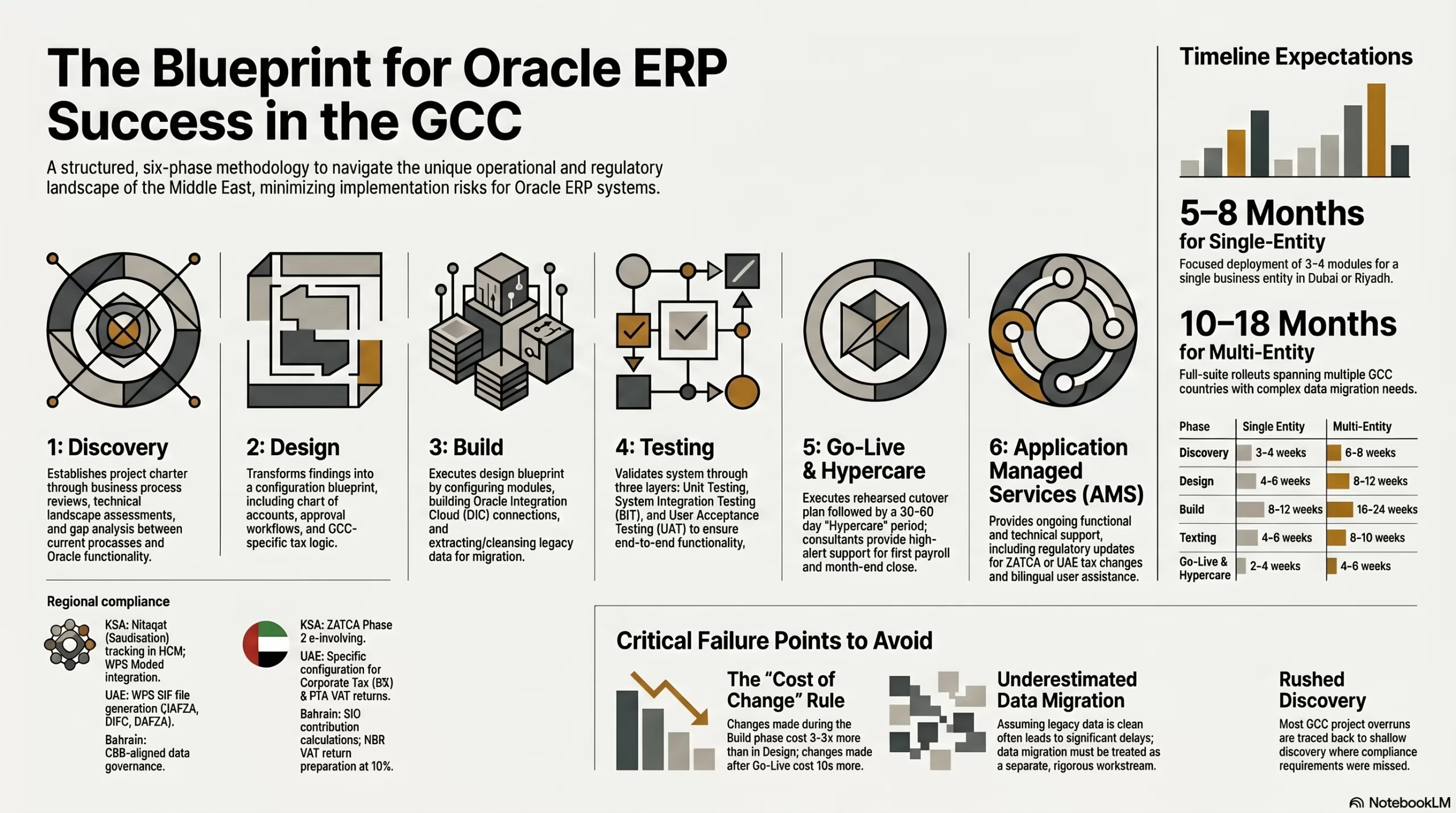
Oracle implementations at Al Fahad follow six defined phases. The same structure applies whether the project is a single-module Oracle Financials deployment in Dubai or a full Oracle Fusion suite rollout across Riyadh, Jeddah, and Dammam.
| Phase | Name | Primary Output |
| 1 | Discovery | Agreed scope, compliance checklist, project charter |
| 2 | Design | Configuration blueprint, integration architecture |
| 3 | Build | Configured system, tested integrations, migration scripts |
| 4 | Testing | Signed UAT, validated payroll runs, ZATCA clearance testing |
| 5 | Go-Live | Live system, cutover complete, hypercare active |
| 6 | AMS Support | Ongoing managed services, compliance updates, and user support |
Phase 1: Discovery
Discovery is the most undervalued phase in any Oracle ERP implementation methodology.
Most project overruns can be traced back to a Discovery phase that was too short, too shallow, or skipped entirely.
What Happens in Discovery
- Business process review across every function that the system will support
- Compliance requirements audit for UAE, Saudi Arabia, or Bahrain regulations
- Technical landscape assessment of existing systems, integrations, and data sources
- Gap analysis between your current processes and Oracle’s standard functionality
- Scope definition with module list, user counts, and entity structure
What Comes Out of Discovery
A signed project charter. This document defines exactly what is being built, what is out of scope, who is responsible for what, and the project’s cost. Nothing moves to Design until both sides sign.
The GCC Discovery Difference
Discovery in GCC markets covers compliance requirements that do not exist in standard Oracle global implementations.
A business in Riyadh needs ZATCA Phase 2 e-invoicing scoped from the start. A business in Dubai needs a UAE Corporate Tax entity configuration on the project plan. A business in Manama needs the CBB regulatory requirements documented before any configuration begins.
Miss these in Discovery, and you’ll add them under pressure during Build, or worse, after go-live.
Phase 2: Design
Design is where the Discovery findings become a configuration blueprint.
Every decision made in an Oracle ERP system is documented here. Chart of accounts structure. Approval workflow logic. Payroll rule design. Integration architecture. Reporting requirements.
What Good Design Looks Like
- The organisation structure modelled in Oracle before a single screen is configured
- GCC-specific tax configuration designed per market: UAE VAT (5%), UAE CT (9%), ZATCA, Bahrain VAT (10%)
- Integration architecture mapped between Oracle and local systems: WPS providers, banking platforms, ZATCA Fatoorah portal
- Data migration strategy defined: what data moves, in what format, and in what sequence
- User role and access design completed before Build starts
Why Design Sign-Off Matters
Design must be reviewed and signed off by your internal stakeholders before Phase 3 begins.
Changes made during Build cost three to five times as much as those made during Design. Changes made after go-live cost ten times more.
The design sign-off gate is not bureaucracy. It is cost protection.
Phase 3: Build
Build is where the system takes shape.
The configuration blueprint from Design is executed across Oracle’s modules. Integrations are developed and tested in isolation. Data migration scripts are written and run against sample data.
What Happens in Build
- System configuration: Oracle modules configured to match the design blueprint exactly
- Integration development: Oracle Integration Cloud (OIC) connections built between Oracle and GCC-local systems
- Data migration preparation: Legacy data extracted, cleansed, mapped to Oracle’s data model, and loaded into a test environment
- Custom development: Any reports, BI Publisher templates, or workflow extensions required by the design
The Most Common Build Mistake in GCC
Rushing data migration.
Businesses in Dubai and Riyadh routinely underestimate the time required to clean legacy data. Years of inconsistent master data, duplicate supplier records, and mismatched chart of accounts entries do not clean themselves.
Data migration at Al Fahad is treated as a separate workstream with its own timeline and sign-off gates. The Oracle ERP modules configured in Build are only as good as the data loaded into them.
Phase 4: Testing
Testing is where the system proves it works, not just in theory, but under real operational conditions.
Businesses that rush testing are the ones that call their implementation partner in a panic two weeks after go-live.
Three Layers of Testing
The following are Al Fahad’s 3 layers of rigorous testing to ensure your setup is implemented without problems.
Unit Testing
Each module is tested in isolation. Financials, Procurement, HCM, and SCM are each validated before integrated testing begins.
System Integration Testing (SIT)
The full system is tested end-to-end. A purchase order flows through Procurement into Payables into the General Ledger. A payroll run generates a WPS file and updates Financials. An invoice triggers ZATCA clearance.
User Acceptance Testing (UAT)
Your team tests the system against real business scenarios. UAT is not a technical sign-off. It is your business to confirm that the configured system matches what was agreed in Design.
GCC-Specific Testing Requirements
| Market | What Must Be Tested Before Go-Live |
| Saudi Arabia (Riyadh, Jeddah, Dammam) | ZATCA Phase 2 e-invoice generation, clearance, and status response |
| UAE (Dubai, Abu Dhabi) | UAE CT entity reporting, VAT return preparation, WPS SIF file generation |
| Bahrain (Manama) | NBR VAT return output, SIO contribution calculation, CBB-aligned payslip format |
No Oracle implementation UAE, Saudi Arabia, or Bahrain projects at Al Fahad proceeds to go-live without all market-specific tests passing.
Phase 5: Go-Live
Go-live is the moment your business switches from the old system to Oracle.
A poorly planned cutover can leave your finance team unable to process invoices. Your HR team cannot run payroll. Your procurement team cannot raise purchase orders. This is the highest-risk point in the entire project.
Oracle ERP implementation in Dubai and Abu Dhabi businesses faces the added complexity of UAE Corporate Tax entity cutover alongside standard financial go-live activities.
The Cutover Plan
A good cutover plan answers three questions:
- What is the exact sequence of steps to move from the old system to Oracle?
- Who is responsible for each step, and what is their contact information if something goes wrong?
- What is the fallback if a critical step fails?
A detailed cutover runbook is prepared for every Oracle ERP implementation go-live. The runbook is rehearsed in a dress rehearsal before the actual cutover weekend.
Hypercare: The First 30 Days
Hypercare is the period immediately after go-live when the implementation team remains on high alert.
Al Fahad consultants are available during hypercare with defined response SLAs, not the standard “we will get back to you” of a general support arrangement.
The first payroll run. The first month-end close. The first ZATCA invoice submission. These are the moments that stress-test the system under real conditions, and they happen within days of go-live.
Phase 6: Application Managed Services
AMS is what happens after hypercare ends.
Oracle’s own support covers platform uptime and quarterly updates. It does not cover the functional and technical support your team needs to operate the system effectively day to day.
AMS tiers at Al Fahad cover:
- Monthly payroll run support and WPS file validation
- ZATCA compliance updates when Oracle releases regulatory patches
- User management, role changes, and new employee onboarding configuration
- Custom report development as your business reporting needs evolve
- Functional query resolution in Arabic and English
The gap between a well-supported Oracle environment and an unsupported one grows wider every month. Businesses that invest in AMS avoid the painful retrofits that businesses without support eventually face.
A full breakdown of the Oracle ERP system services that cover post-implementation support, including EBS and Fusion support options, is available on our Oracle ERP services page.
How Long Does Each Phase Take?
There is no universal answer. Scope, complexity, and data quality all affect the timeline.
But here is a realistic guide for GCC businesses:
| Phase | Single Entity, 3–4 Modules | Multi-Entity, Full Suite |
| Discovery | 3–4 weeks | 6–8 weeks |
| Design | 4–6 weeks | 8–12 weeks |
| Build | 8–12 weeks | 16–24 weeks |
| Testing | 4–6 weeks | 8–10 weeks |
| Go-Live and Hypercare | 2–4 weeks | 4–6 weeks |
| Total | 5–8 months | 10–18 months |
For a full breakdown of what these timelines mean for your budget, see our guide on Oracle ERP system cost in the UAE.
GCC-Specific Implementation Considerations
The standard Oracle implementation methodology does not account for the regulatory and operational realities in the UAE, Saudi Arabia, and Bahrain.
Here is what changes when the methodology is adapted for GCC:
Saudi Arabia
Oracle ERP implementation projects in Saudi Arabia carry the highest level of compliance complexity in the GCC.
ZATCA Phase 2 e-invoicing requires a dedicated integration workstream. Nitaqat (Saudisation) tracking must be configured in HCM before go-live. The Saudi Wage Protection System requires WPS Mudad integration and the generation of compliant pay files. These are not items to scope later. They must be on the project plan from Phase 1.
Every Oracle ERP implementation engagement in Riyadh and Jeddah at Al Fahad includes all of these as standard workstreams, not optional line items added later.
Oracle ERP Implementation in the UAE
UAE implementations carry a different compliance layer from Saudi Arabia. The key requirements are UAE Corporate Tax entity configuration, FTA VAT return preparation, and WPS SIF file generation. None of these exist in Saudi Arabia in the same form.
Businesses in Oracle ERP implementation in Dubai, Abu Dhabi, and the UAE free zones face additional complexity. JAFZA, DIFC, and DAFZA each have specific employment and compliance structures that affect how Oracle Financials and HCM are configured. Getting this right requires someone who has configured these environments before, not someone working from Oracle documentation.
Bahrain
Oracle ERP implementation projects in Bahrain’s Manama financial district require CBB-aligned data governance, SIO contribution configuration, and NBR VAT return preparation at 10%.
Financial services firms in Bahrain often require additional audit trail and access control configuration that standard Oracle setups do not include.
The Five Most Common Oracle Implementation Mistakes in GCC
These are not theoretical risks. They are patterns Al Fahad sees repeatedly when businesses come to us after a failed or stalled implementation.
1. Skipping or rushing discovery
The scope is not defined clearly. Compliance requirements are discovered mid-Build. The project expands, the budget blows, and nobody is sure what was originally agreed.
2. Signing off on the design without reading it
Stakeholders approve the design document without understanding what it commits them to. When Build produces exactly what was designed, they are surprised.
3. Under-resourced data migration
Legacy data is assumed to be cleaner than it is. The migration takes three times longer than planned. Go-live is delayed.
4. Compressing testing to meet a deadline
UAT is shortened when the Build phase runs over. The system goes live with known issues. The first month is a crisis.
5. No hypercare plan
The implementation team disappears after cutover. The client is left with a live system, undertrained users, and no escalation route when things break.
Understanding what a good Oracle partner network in the UAE looks like helps you avoid all five of these mistakes before the project starts.
Oracle ERP Methodology: EBS vs Fusion Cloud
The six-phase methodology applies to both Oracle E-Business Suite and Oracle Fusion Cloud. The phases are the same. The content of each phase differs.
A detailed breakdown of how these two platforms compare is available in our guide on Oracle Fusion Cloud vs Oracle EBS.
The key methodological differences are:
| Factor | Oracle EBS | Oracle Fusion Cloud |
| Build complexity | Higher: deeper customisation possible | Lower: configuration-first approach |
| Data migration | Complex if moving from legacy EBS | Structured migration tools available |
| Testing scope | Broader: customisations need regression testing | Narrower: standard quarterly updates reduce regression risk |
| Go-live risk | Higher for heavily customised environments | Lower for standard deployments |
| Post-go-live updates | Manual patching required | Automatic quarterly updates from Oracle |
What to Expect When Working With Al Fahad
Al Fahad’s Oracle ERP implementation methodology is structured around one principle: no surprises.
Clients know the scope before the build starts. They know the timeline before Testing begins. They know the go-live plan before the Cutover weekend.
Here is what every client receives:
- A named project manager responsible for delivery from Discovery to AMS
- A signed scope document before any billable work begins
- Weekly status reports with RAG ratings on timeline, budget, and risk
- A dedicated escalation path to both Al Fahad leadership and Oracle support
- Bilingual delivery: Arabic and English across all phases
Whether you are starting a new Oracle Fusion implementation services project, adding modules to an existing Oracle HCM cloud implementation, or planning a full ERP rollout across multiple GCC entities, the process is the same.
Frequently Asked Questions
How long does an Oracle ERP implementation take in the UAE or Saudi Arabia?
A focused Oracle ERP implementation covering three to four modules for a single-entity business in Dubai or Riyadh typically takes five to eight months. Multi-entity projects spanning UAE and Saudi Arabia run ten to eighteen months. The biggest variable is data quality, not system complexity.
What is the biggest risk in an Oracle ERP implementation?
Poor Discovery is the root cause of most Oracle implementation failures in GCC. If the scope, compliance requirements, and data migration strategy are not locked in during Phase 1, the problems compound through every subsequent phase. Fixing a Discovery gap during Build costs three to five times more than addressing it in Phase 1.
What does hypercare mean in an Oracle implementation?
Hypercare is the period of intensive post-go-live support, typically 30 to 60 days, during which the implementation team remains on high alert. The first payroll run, the first ZATCA submission, and the first month-end close all happen during this window. A partner without a structured hypercare offer is a partner who disappears when you need them most.
Is the Oracle ERP implementation methodology different for Bahrain?
The six-phase Oracle ERP implementation methodology is the same across all GCC markets. The phases are identical: Discovery, Design, Build, Testing, Go-Live, and AMS.
What changes between markets are the compliance content within each phase?
An Oracle ERP implementation Bahrain engagement includes CBB regulatory requirements, NBR VAT at 10%, SIO contributions, and Bahrainisation tracking as standard workstream components. These are scoped in Discovery and configured in Build.
How do I know if my Oracle implementation partner is following the right methodology?
- Ask for the project charter from Phase 1.
- Request to see the Phase 2 design document.
- Ask who is on the project team and what their Oracle certifications cover.
A partner following a proper Oracle ERP implementation methodology will have documented outputs at every phase. A partner who cannot show you these is operating without a methodology.
Start Your Oracle ERP Implementation the Right Way
A structured methodology is not overhead. It is what separates a successful Oracle project from an expensive one.
Al Fahad IT Consulting delivers Oracle consulting engagements across UAE, Dubai, Saudi Arabia, Riyadh, Jeddah, Dammam, Bahrain, and Manama. Every project begins with a structured Discovery session: a fixed-scope conversation about your current system, your requirements, and what the right implementation plan looks like.
Talk to our Oracle consultants →
نتحدث العربية. تواصل معنا عبر واتساب للحصول على استشارة مجانية في تطبيق أوراكل
Oracle ERP implementation services are delivered by Al Fahad IT Consulting across UAE, Saudi Arabia, and Bahrain. Al Fahad holds Oracle Partner Network membership and Zoho Premium Partner status.


