
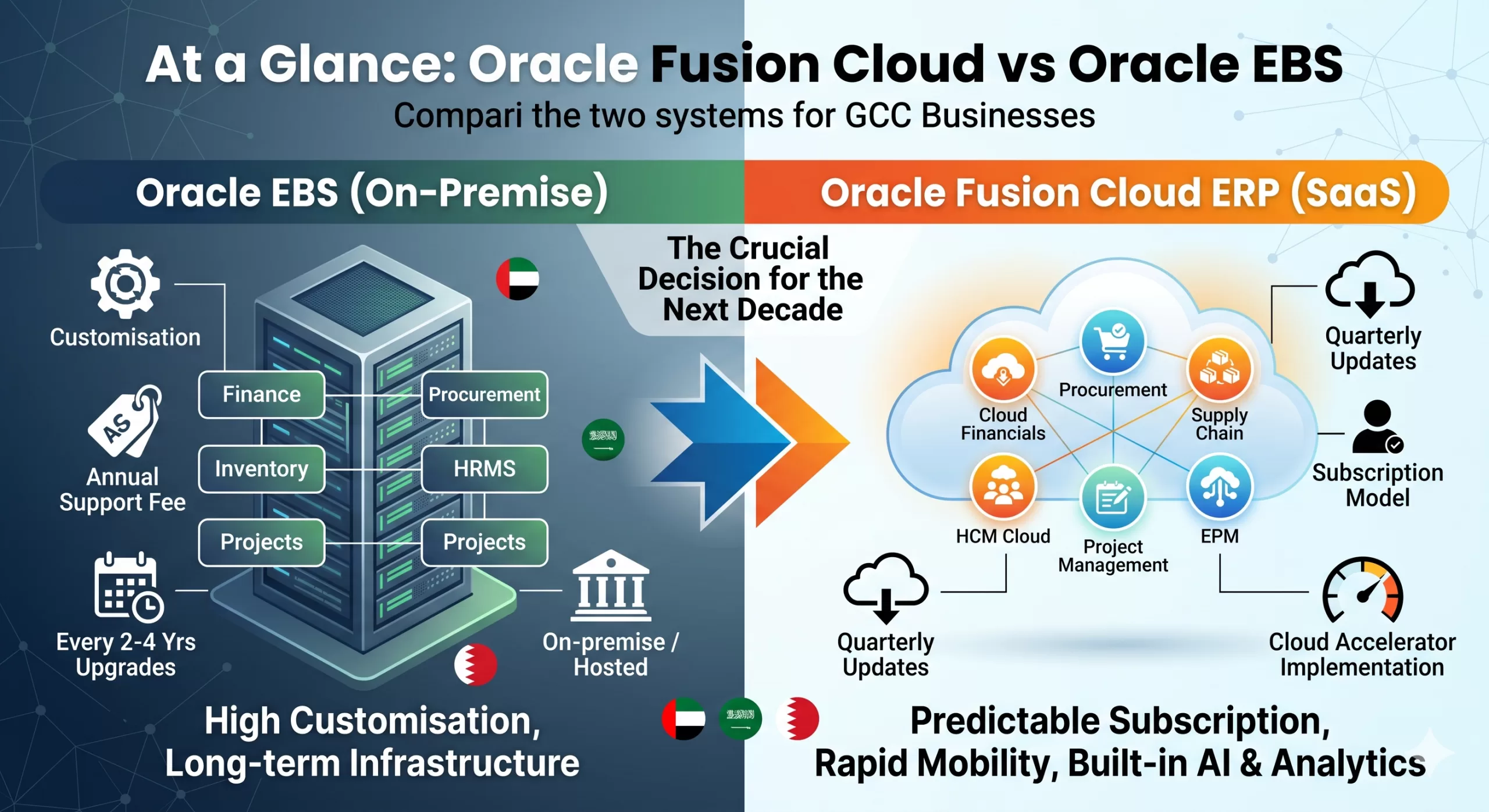
Two Oracle products. Fundamentally different architectures. One decision that will shape your finance, operations, and HR infrastructure for the next decade.
Businesses across the UAE, Saudi Arabia, and Bahrain running on Oracle E-Business Suite frequently arrive at the same crossroads: stay on EBS, invest in extending it, or migrate to Oracle Fusion ERP. The wrong choice costs millions — in licensing, in failed migrations, and in lost productivity. The right choice depends entirely on where your business is today and what it needs to become.
This guide cuts through the marketing and gives GCC decision-makers a practical framework for choosing between the two.
At a Glance: Oracle Fusion Cloud vs Oracle EBS
| Factor | Oracle E-Business Suite (EBS) | Oracle Fusion Cloud ERP |
|---|---|---|
| Architecture | On-premise or hosted | True SaaS, cloud-native |
| Deployment Model | Customer-managed infrastructure | Oracle-managed cloud |
| Licensing Model | Perpetual licence + annual support | Subscription (per user or per module) |
| Upgrade Frequency | Major releases every 2–4 years | Quarterly auto-updates |
| Customisation Flexibility | High — deep technical customisation | Moderate — configuration-first approach |
| Implementation Timeline | 12–24 months (large scope) | 6–18 months (cloud accelerator) |
| Support Lifecycle | Premier Support ends 2030 | Continuous cloud support |
| Best-Fit Company Size | Mid-market to large enterprise | SME to large enterprise |
| GCC Localisation | Mature Arabic/GCC tax configuration | Strong and improving — VAT, ZATCA-ready |
| Total Cost of Ownership | Higher long-term (infrastructure + support) | Predictable subscription — lower infra cost |
What Is Oracle E-Business Suite?
Oracle E-Business Suite, commonly known as EBS or Oracle Applications, is Oracle’s flagship on-premises ERP suite. First released in the 1990s, it has been extended and enhanced across decades into one of the most feature-rich enterprise systems available.
Core EBS Modules
- Oracle Financials: General ledger, accounts payable, accounts receivable, fixed assets
- Oracle Purchasing: Procurement, purchase orders, supplier management
- Oracle Inventory: Stock management, costing, lot and serial tracking
- Oracle Order Management: Sales order processing, fulfilment, shipping
- Oracle HRMS: Core HR, payroll, absence management
- Oracle Projects: Project costing, billing, resource management
Where EBS Excels
Many organisations running EBS in UAE and Saudi Arabia have spent years — sometimes decades — customising it to match their exact operational processes. These are not minor tweaks. They are deep workflow integrations, custom reports, and business logic baked into the system at a technical level.
EBS delivers that level of depth because it was designed for it. The system can be modified at a fundamental code level, which no cloud ERP allows. For businesses in industries with complex operational requirements, such as the oil and gas supply chain, large-scale construction, and government contracting, that flexibility has genuine value.
What Is Oracle Fusion Cloud ERP?
Oracle Fusion Cloud ERP is Oracle’s current-generation, cloud-native enterprise platform. Built from the ground up on modern architecture, it replaces both Oracle EBS and Oracle’s legacy PeopleSoft and JD Edwards suites over the long term.
Core Oracle Fusion Modules
- Oracle Financials Cloud: Full financial management suite with embedded analytics
- Oracle Procurement Cloud: Self-service procurement, supplier qualification, contract management
- Oracle Supply Chain Management Cloud: Demand planning, logistics, inventory optimisation
- Oracle Human Capital Management Cloud: Global HR, payroll, talent management, workforce planning
- Oracle Project Management Cloud: Project planning, costing, billing, integration with finance
- Oracle Enterprise Performance Management: Budgeting, forecasting, consolidated reporting
Where Oracle Fusion Cloud Excels
Oracle Fusion Cloud delivers what EBS cannot: automatic quarterly updates, no infrastructure management, native mobile access, and embedded AI across the finance and HR modules. Quarterly releases mean businesses always access the latest compliance features — a significant operational advantage given the pace of regulatory change in UAE and Saudi Arabia.
The platform’s analytics are built in, not bolted on. Oracle Fusion’s reporting layer is native, which eliminates the separate data warehouse configurations that EBS implementations typically require.
The Five Deciding Factors
Here are the 5 major deciding factors that help bussinesses in UAE, Saudi Arabia and Bahrain between the two solutions.
1. Where Your Business Sits in Its Growth Cycle
EBS is typically the right choice if:
- The organisation has been running EBS for more than 5 years and has significant customisations
- The technical team has deep EBS expertise in-house
- The business operates in a single country with stable, predictable processes
- A full migration is not financially viable in the current planning cycle
Oracle Fusion Cloud is typically the right choice if:
- The business is implementing an ERP for the first time
- Growth plans include multi-country or multi-entity expansion
- The IT team is limited and cannot manage on-premise infrastructure
- The business needs genuine mobility — field teams, remote finance operations, executive dashboards on the go
2. The Total Cost of Ownership Reality
Cost comparisons between oracle fusion cloud vs oracle EBS require clarity on what is actually being compared.
EBS cost structure:
- Perpetual licence (already paid for existing EBS customers)
- Annual Oracle Support fees, typically 22% of licence value
- Infrastructure: servers, storage, networking, database licences
- Internal IT team or managed hosting partner
- Customisation, development, and maintenance costs
Oracle Fusion Cloud cost structure:
- Annual subscription, typically per-user or per-module
- Implementation consulting fees (Al Fahad provides fixed-scope engagements)
- Data migration and integration work
- Training and change management
- No infrastructure costs, Oracle manages the environment
For a mid-sized business in the UAE with 150 ERP users, the five-year total cost of ownership is often comparable between the two options. The difference is where the cost sits: EBS costs are concentrated in infrastructure and IT resources; Oracle Fusion costs are concentrated in subscription and initial implementation.
3. GCC Regulatory Compliance
Both platforms support UAE VAT and Saudi ZATCA e-invoicing requirements — but the path to compliance differs.
| Compliance Requirement | Oracle EBS | Oracle Fusion Cloud |
|---|---|---|
| UAE VAT (5%) | Configured — mature and well-tested | Native configuration — maintained by Oracle |
| UAE Corporate Tax (9%) | Requires manual configuration update | Delivered via quarterly update cycle |
| Saudi ZATCA Phase 2 | Available via certified third-party connectors | Oracle-delivered ZATCA integration roadmap |
| Bahrain VAT (10%) | Configurable — manual setup required | Supported in configuration layer |
| Arabic Language Interface | Supported | Supported and improved in recent releases |
| Multi-currency and multi-entity | Strong — particularly for group structures | Strong — improved consolidation |
For businesses specifically managing oracle erp modules under Saudi Arabia’s ZATCA Phase 2 mandate, Oracle Fusion’s quarterly update model means Oracle delivers compliance patches automatically. EBS customers require manual intervention or an upgrade cycle to achieve the same.
4. Customisation vs Configuration
This is the most technically significant difference between the two platforms.
EBS customisation approach:
- Full access to the application layer — custom forms, workflows, reports, integrations
- Modifications are persistent across upgrades (though they require testing)
- Technical consultants can extend the system in ways the vendor never intended
- This is both a strength and a liability: complex customisations make upgrades expensive
Oracle Fusion configuration approach:
- Business rules, workflows, and approval hierarchies are configured — not customised
- Personalisation is available at the interface level but does not touch the underlying code
- Quarterly updates apply cleanly without breaking configurations
- Bespoke requirements require Oracle Integration Cloud (OIC) or a separate application layer
5. The Migration Path
Oracle has been clear: oracle fusion cloud vs oracle EBS is not a choice Oracle intends to sustain indefinitely. Oracle EBS Premier Support runs through 2030, after which only Sustaining Support is available.
| Phase | Activity | Typical Duration |
|---|---|---|
| Assessment | Gap analysis, customisation inventory, data audit | 4–8 weeks |
| Design | Future-state process mapping, configuration design | 6–10 weeks |
| Build | System configuration, integration development | 10–16 weeks |
| Testing | UAT, parallel run, regression testing | 6–8 weeks |
| Go-Live | Cutover, hypercare, stabilisation | 4–6 weeks |
Which ERP Does Your Business Actually Need?
To decide between the two in 2026 is simple using the following points.
Choose Oracle EBS if:
- You are an existing EBS customer with substantial customisations and no immediate business case for migration
- Your industry requires deep on-premise customisation that cloud configuration cannot replicate
- Your IT team has strong Oracle DBA and technical capabilities in-house
- You are 3+ years from a natural renewal or upgrade cycle
Choose Oracle Fusion Cloud ERP if:
- You are implementing a new ERP system
- You require multi-entity or multi-country consolidation
- The business is scaling and needs a platform that scales with it
- You need quarterly compliance updates without IT intervention
- Infrastructure management is not a core internal competency
Frequently Asked Questions
Is Oracle EBS being discontinued?
Oracle has committed to Premier Support for EBS through 2030. Sustaining Support continues beyond that but does not include new compliance updates or regulatory patches.
Can an Oracle EBS customer migrate to Oracle Fusion Cloud without losing historical data?
Yes — data migration is a standard component. Al Fahad’s oracle erp implementation methodology includes a dedicated data migration workstream.
How long does an Oracle Fusion Cloud implementation take for a mid-sized business in UAE?
A mid-market implementation covering 3–5 modules typically runs 6–9 months from project kick-off to go-live.
Does Oracle Fusion Cloud support Arabic language and ZATCA e-invoicing for Saudi Arabia?
Yes, it supports Arabic language interface and is on Oracle’s active roadmap for ZATCA Phase 2 integration.
Making the Right Call for Your Business
The oracle fusion cloud vs oracle EBS decision is not purely technical — it is a business strategy question. The right answer depends on where your business is today and what your growth trajectory looks like.
Al Fahad IT Consulting is an Oracle Partner Network member with experience across both platforms.
Get a free ERP readiness assessment →
Al Fahad IT Consulting is an Oracle Partner Network member and a Zoho Premium Partner. This article is for informational purposes only. Licensing terms and support dates are subject to change.


