
Haseeb Khalid2026-04-14T13:49:23+00:00
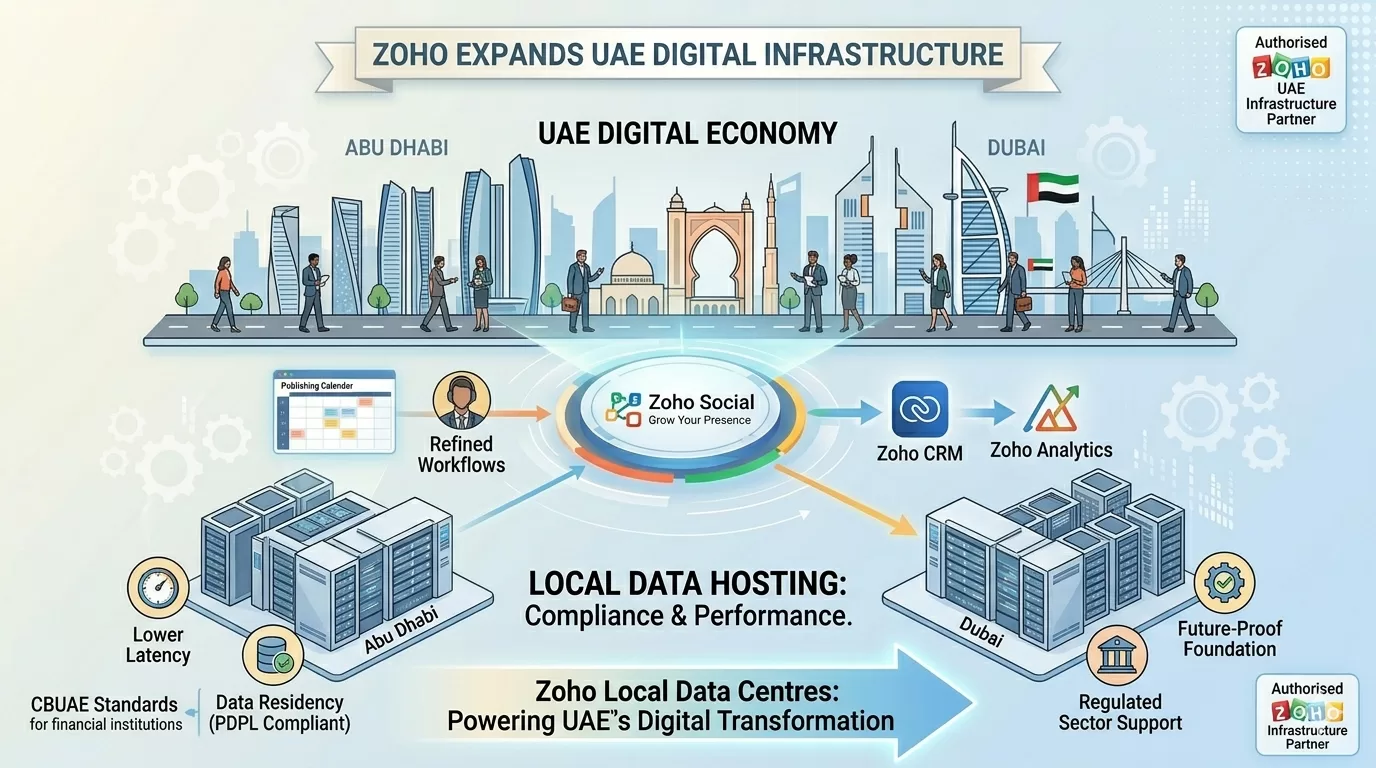
Businesses across the United Arab Emirates are increasingly turning to cloud technologies as they modernise systems and move away from legacy infrastructure. In response to rising demand for secure, compliant, and high-performance digital platforms, Zoho has strengthened its regional presence through local data centres in Abu Dhabi and Dubai.
The development reflects a broader trend in the region, where organisations are prioritising data residency and regulatory alignment as they adopt cloud-based business systems.
Regional shift toward local data hosting
Across the Middle East, companies and government agencies are accelerating digital initiatives while evaluating how cloud infrastructure fits within regional regulatory frameworks.
Under the UAE’s Personal Data Protection Law (PDPL), organisations must ensure that personal data is handled in accordance with national standards. For many companies, hosting data locally has become a practical approach to meeting these requirements while simplifying procurement and compliance processes.
Local infrastructure also reduces reliance on cross-border data transfers, which can involve additional legal approvals and operational complexity.
Performance gains for businesses
Technology leaders say the location of data centres can directly affect application performance.
Systems that process data closer to users experience lower latency, which improves responsiveness for cloud applications. For businesses using operational platforms such as finance systems or customer relationship management tools, this can lead to faster internal workflows and better user experiences.
Small and medium enterprises are expected to benefit significantly from local hosting, which allows them to access enterprise-grade infrastructure without investing in physical servers or large IT environments.
Public sector organisations also rely on consistent system performance to support digital services delivered to citizens.
Compliance considerations for regulated sectors
The move toward local hosting is particularly relevant for regulated industries such as financial services, healthcare, and government agencies.
Licensed Financial Institutions in the UAE must comply with the Central Bank of the United Arab Emirates (CBUAE) standards governing cloud computing and auditability. These rules require organisations to maintain oversight of the storage and processing of sensitive financial data.
Non-compliance with regulatory obligations can lead to administrative penalties of up to AED 5 million, making infrastructure selection an important strategic decision for many institutions.
Local data centres allow organisations to operate under the same regulatory framework as national authorities, thereby simplifying audit and governance requirements.
Data location influencing future systems
Industry observers also point to the concept of “data gravity,” where the physical location of stored data influences where future applications are deployed.
As companies accumulate large volumes of operational data, moving it across regions becomes more costly and technically challenging. Keeping data within the UAE can make it easier for organisations to integrate with emerging national digital services or artificial intelligence platforms.
Supporting the UAE’s digital economy
The expansion of local infrastructure aligns with the UAE’s broader strategy to build a secure and reliable digital economy.
Government initiatives have emphasised strong data governance, cybersecurity standards, and advanced digital services across both public and private sectors.
By enabling organisations to host their information within the country, local data centres are expected to support continued growth in cloud adoption while strengthening trust among businesses, regulators, and customers.
Key takeaways
- Local data hosting supports compliance with regulations such as the UAE PDPL.
- Regional infrastructure improves system performance and reduces latency.
- Regulated industries benefit from easier alignment with governance standards.
- Hosting data locally provides a foundation for future digital services and innovation.
As digital adoption continues to expand across the Gulf region, analysts say local data infrastructure will play an increasingly central role in how organisations deploy cloud technologies and manage sensitive information.


