
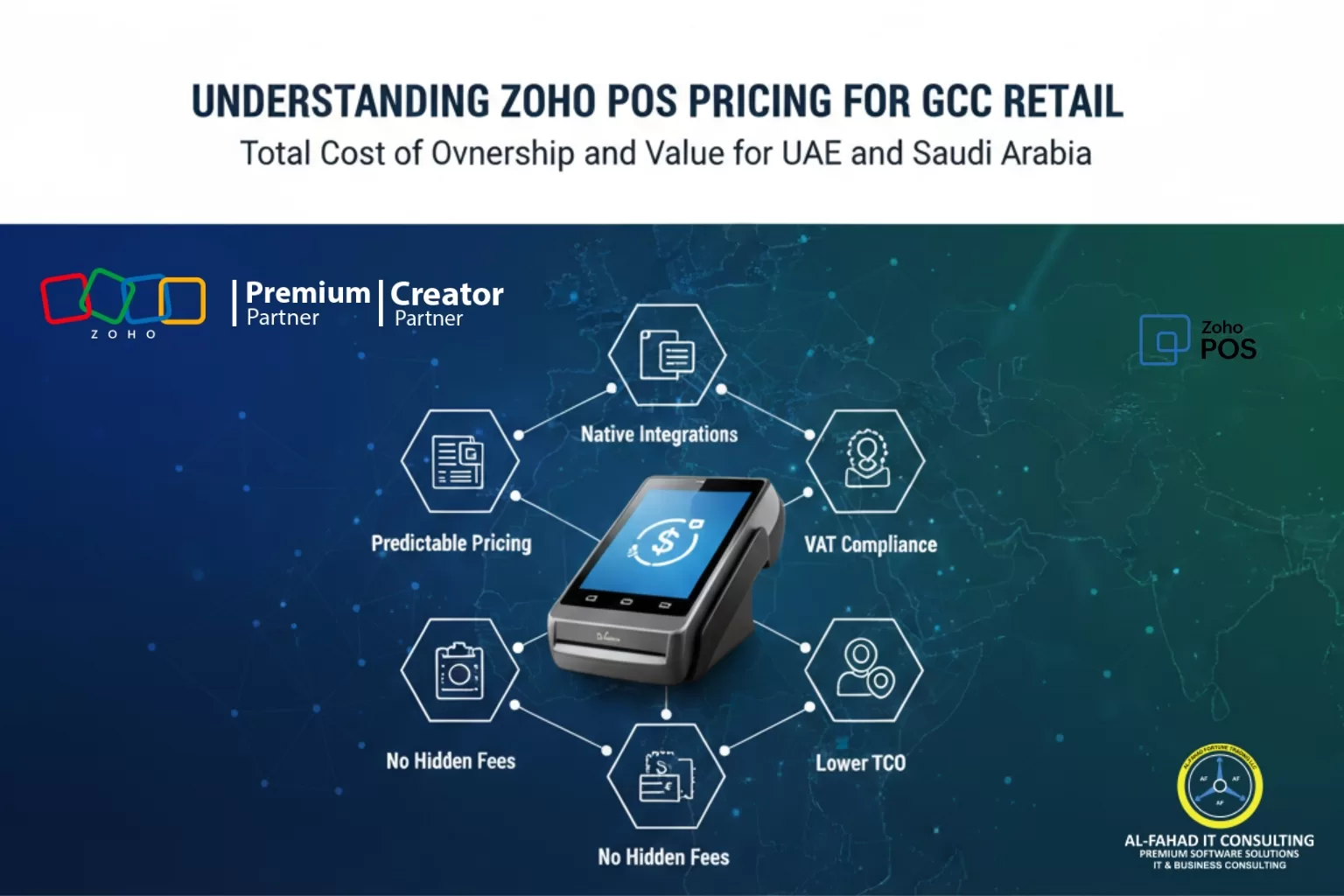
Retailers often underestimate POS pricing because hidden costs surface only after implementation, through add-ons, integrations, rework, and compliance gaps.
In the GCC retail environment, POS pricing decisions directly affect operational efficiency, accounting accuracy, VAT compliance, and scalability. Evaluating price without understanding the total cost of ownership frequently leads to higher long-term spend.
This guide explains how Zoho POS pricing works for retail businesses in the UAE and Saudi Arabia, what drives real cost over time, and how to assess value beyond the subscription fee.
How Zoho POS Pricing Is Structured
Zoho POS is typically priced on a subscription basis. Costs vary depending on operational scale, including the number of locations, registers, and users required to support daily retail activity.
Rather than bundling unnecessary functionality into rigid plans, Zoho lets retailers pay for only what they use. This modular approach supports cost control while enabling gradual expansion as business requirements evolve.
Pricing generally covers:
- POS access per store or register
- Core billing and sales functionality
- Basic reporting and inventory synchronization
Additional Zoho cloud solutions extend capability only when required, avoiding forced upgrades.
What Influences the Total Cost of Zoho POS
Subscription pricing represents only one component of the overall investment. Several operational factors influence the total cost of ownership.
Store Count and Scale
Single-location retailers typically incur lower costs. Multi-branch operations require additional registers and user licenses, increasing subscription fees in a predictable manner.
Zoho POS scales linearly, allowing retailers to add locations without restructuring existing systems or incurring disproportionate cost increases.
Integration With Other Zoho Applications
Traditional Retail POS systems rarely operate in isolation. They integrate with other Zoho applications to provide a holistic view of retail insights under one roof.
- Zoho Inventory to streamline inventory
- Zoho CRM to consolidate your customer management
- Zoho Books for automatic cloud accounting
- Zoho Analytics to give deeper and richer insight into your operations
This extends your market functionality without reliance on third-party connectors. Why? Native integrations reduce recurring plugin fees, simplify maintenance, and improve data consistency across operational systems.
Customisation and Implementation
Initial configuration, workflow design, and integration setup influence upfront investment. Retailers that implement Zoho POS correctly from the start typically avoid rework, inefficiencies, and additional software costs later.
A certified Zoho implementation partner helps align POS configuration with operational and compliance requirements in the UAE and Saudi Arabia.
Zoho POS Versus Traditional POS Cost Models
Traditional POS systems often appear affordable at the outset. Over time, hidden costs emerge through maintenance contracts, upgrade charges, hardware dependency, and limited scalability.
Zoho POS operates in the cloud, reducing infrastructure costs. Software updates are deployed automatically at no additional cost, and expansion does not require replacing existing systems.
Retailers benefit from predictable subscription costs rather than fluctuating maintenance and upgrade expenses.
Cost Benefits of Native Accounting and Inventory Integration
Accounting and inventory management introduce significant cost when handled through disconnected systems.
Zoho POS integrates directly with Zoho Books for accounting and VAT reporting, while Zoho Inventory manages stock across stores and warehouses. These native integrations reduce dependence on paid third-party tools.
Retailers gain cleaner data, fewer reconciliation hours, and lower operational overhead over time.
VAT Compliance Without Additional Software
VAT compliance often increases POS costs through specialised tax modules or external reporting tools.
Zoho POS supports VAT configuration aligned with regulations in the UAE and Saudi Arabia. Integration with Zoho Books ensures accurate tax reporting without the need for a separate compliance software solution.
This built-in capability reduces compliance risk and long-term expense.
Evaluating Value Beyond Subscription Fees
Retailers assessing POS pricing should focus on value delivered rather than cost alone.
Key considerations include:
- Reduction in manual operational work
- Elimination of third-party subscriptions
- Ability to scale without major reinvestment
- Support for regional compliance requirements
Zoho POS delivers stronger long-term value by operating within a unified Zoho ecosystem rather than as a standalone billing tool.
Pricing Predictability for Growing Retailers
Growth introduces uncertainty around system costs. POS platforms that rely heavily on add-ons often become expensive as operational complexity increases.
Zoho POS pricing remains predictable because extended functionality is delivered through native Zoho applications. Retailers can add capabilities incrementally while maintaining budget control.
When deployed as part of Zoho One, POS pricing fits into a broader, cost-efficient business platform.
Why Implementation Impacts Pricing Efficiency
Incorrect implementation increases long-term cost. Poor configuration leads to inefficiencies, rework, and unnecessary software purchases.
Zoho POS delivers greater pricing efficiency when implemented correctly from the outset. A certified Zoho premium partner ensures workflows, integrations, and compliance settings align with real operational requirements.
Retailers achieve faster return on investment and lower total cost of ownership through disciplined implementation.
Why Choose Al Fahad IT Consulting for the Best Zoho POS Pricing
Choosing Zoho POS pricing is not just about selecting a plan; it is about ensuring the platform is implemented in a way that controls cost over time.
- Cost-efficient system design: POS configuration is aligned with actual retail workflows to avoid unnecessary licenses, add-ons, and rework.
- Integration-led pricing optimisation: Native Zoho integrations eliminate third-party software costs and recurring connector fees.
- Compliance-first setup: VAT and regulatory requirements are built into workflows upfront, reducing audit risk and future correction costs.
- Scalable pricing governance: Store expansion, user growth, and feature adoption are planned to keep pricing predictable as operations grow.
- ROI-focused implementation discipline: Configuration and validation are structured to reduce operational friction and accelerate return on investment.
Al Fahad IT Consulting helps GCC retailers achieve the lowest practical total cost of ownership from Zoho POS through disciplined implementation and long-term pricing governance. Solving the most common retail problems faced by businesses in Saudi Arabia, the UAE and Bahrain.
Final Thoughts
Zoho POS pricing offers a flexible, transparent model suited to high-footfall areas in the GCC. Subscription costs remain competitive, while native integrations reduce hidden expenses over time.
Retailers in Saudi Arabia benefit most when evaluating Zoho POS as part of a connected ecosystem rather than as a standalone billing tool. Long-term value, operational efficiency, and scalability ultimately matter more than the initial price tag.
Frequently Asked Questions (FAQs)
Is Zoho POS pricing different for UAE and Saudi Arabia retailers?
Zoho POS pricing follows a consistent structure, but the total cost may vary based on VAT requirements, the number of locations, and the integrations needed in each country.
Does Zoho POS pricing include inventory and accounting features?
Core POS pricing covers billing and sales operations. Inventory and accounting capabilities are delivered through native Zoho applications such as Zoho Inventory and Zoho Books.
Are there hidden costs with Zoho POS?
Zoho POS avoids many hidden costs common to traditional POS systems, such as upgrade fees and third-party connector costs. Poor implementation, however, can increase long-term cost.
Can Zoho POS pricing scale predictably as retail businesses grow?
Yes. Zoho POS pricing scales linearly with stores, registers, and users, allowing retailers to forecast costs accurately as operations expand.
Why does implementation affect Zoho POS pricing efficiency?
Incorrect configuration often leads to inefficiencies, rework, and additional software purchases. Proper implementation ensures pricing remains predictable and the total cost of ownership stays low.


Leave a Reply