
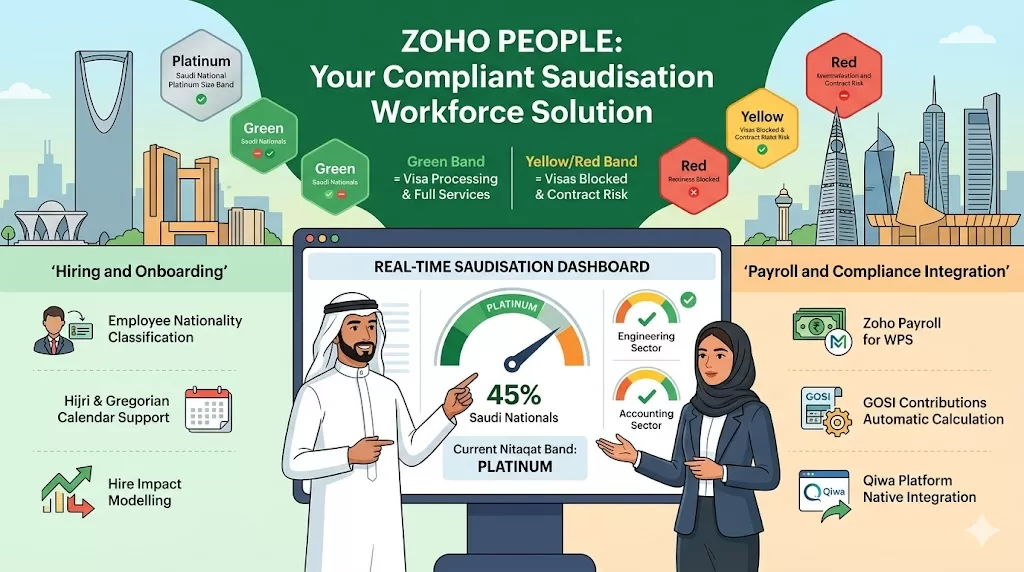
Your Nitaqat band determines what your business can do in Saudi Arabia.
A Platinum or Green band gives you access to government services, the ability to hire expatriates, and the right to renew work permits without restriction. A Yellow or Red band restricts visa issuance, blocks work permit renewals, and can ultimately lead to your business being barred from government contracts.
The percentage of Saudi nationals in your workforce determines your band. And if you do not have a system tracking that percentage in real time, you are managing Nitaqat on hope rather than data.
Zoho People Saudisation Saudi Arabia compliance capabilities, combined with Zoho Payroll, give HR directors and compliance managers a structured system for tracking Nitaqat status, processing Saudi-compliant payroll, and integrating with the government platforms that enforce the rules.
What Saudisation and the Nitaqat System Actually Require
Saudisation, formally known as the Saudi nationalisation of the workforce, mandates that private sector employers hire Saudi nationals at prescribed ratios. The Nitaqat system, introduced in 2011 by the Ministry of Human Resources and Social Development (MHRSD), is the operational enforcement mechanism.
Nitaqat classifies companies into colour-coded bands based on their Saudisation percentage:
| Band | Description | Key Implications |
| Platinum | Highest compliance tier | Full government services, expedited visa processing and maximum operational flexibility |
| High Green | Meets required targets | Can apply for new visas, renew work permits and request job role changes |
| Medium Green | Meets minimum targets | Standard government services, with some restrictions |
| Low Green | Near minimum threshold | Limited new visa access, closer monitoring |
| Yellow | Below minimum threshold | Restricted visas, blocked work permit renewals and limited services |
| Red | Significantly non-compliant | Severe restrictions, risk of government contract exclusion, potential penalties |
Companies with fewer than 10 employees are exempt from Nitaqat percentage requirements but must still employ at least one Saudi national. Companies with more than 100 employees must maintain a Saudisation rate of at least 30%, though this varies by sector.
2025 Sector-Specific Saudisation Updates
The scope of Nitaqat has expanded significantly in 2025, with several sectors seeing increased quota requirements:
- Dentistry: Clinics with three or more dental professionals must meet a 45% Saudisation rate, rising to 55% by January 2026
- Engineering: Firms with five or more engineers must meet a 30% Saudisation requirement
- Accounting: Businesses with at least five accountants require a 40% Saudisation target, increasing by 10% annually until 2028
- Hospitals: 65% Saudisation rate required
- Community Pharmacies: 35% required, with pharmacy-related businesses at 55%
These are not future aspirations. They are current legal requirements. A business in Riyadh operating an engineering consultancy with ten engineers and no tracked Saudisation data is almost certainly non-compliant.
Why Manual Nitaqat Tracking Fails
Most Saudi businesses manage Nitaqat through a combination of spreadsheets, HR manager estimates, and quarterly checks on the Qiwa portal. This approach has three structural failures.
It is always lagging. By the time a spreadsheet is updated and reviewed, new hires and departures have already changed the Saudisation percentage. A resignation that pushes the band from Green to Yellow is invisible until the next manual review.
It does not model scenarios. A hiring manager in Jeddah asking, “Can we hire an expatriate engineer?” needs an answer before making the offer. A spreadsheet cannot model the Nitaqat impact of a proposed hire without someone manually recalculating the percentage.
It is not connected to payroll. Nitaqat compliance and WPS payroll compliance are related but managed separately when the tools do not talk to each other. An employee who is not on WPS does not count correctly toward Nitaqat either.
Zoho People Saudi Arabia addresses all three failures by keeping Saudisation tracking live, scenario-modelling future hires, and integrating directly with Zoho Payroll for WPS compliance.
How Zoho People Tracks Nitaqat Compliance
Zoho People’s workforce module is configured with Saudi Arabia’s Nitaqat classification rules at the organisation and department level.
What Zoho People Covers for Saudisation
Zoho People covers a wide range of problems for Saudi Businesses.
Employee Nationality Classification
Every employee record includes nationality. Saudi nationals are counted toward the Saudisation percentage automatically. Zoho People distinguishes Saudi nationals from expatriate employees in all workforce reports.
Real-Time Saudisation Dashboard
The HR manager dashboard shows the current Saudisation percentage by department, business unit, and legal entity. The dashboard updates automatically when a new hire is onboarded, a resignation is processed, or an employee’s contract status changes.
Nitaqat Band Visibility
The current Nitaqat band is visible within the dashboard based on the configured percentage thresholds for the organisation’s activity sector and company size. When the Saudisation percentage approaches a band boundary, the system generates an alert.
Hire Impact Modelling
Before creating a new job requisition, HR managers can model the Nitaqat impact of the proposed hire. Adding a Saudi national improves the percentage. Adding an expatriate reduces it. The dashboard shows the projected band after the hire is reflected.
MHRSD and Qiwa Reporting
Zoho People generates Saudisation reports in the format required for MHRSD submissions. Integration with the Qiwa platform automates contract management, Saudisation ratio tracking, and employee transfer workflows directly from the HR system.
Zoho Payroll Saudi Arabia: WPS and GOSI Compliance
Saudisation compliance and payroll compliance are not separate topics in Saudi Arabia. A Saudi national who is not paid correctly through the Wage Protection System does not fully count toward Nitaqat compliance for certain government service calculations.
Zoho Payroll Saudi Arabia handles every element of Saudi payroll compliance:
Saudi Wage Protection System (WPS)
Zoho Payroll integrates with Saudi WPS Mudad. Salaries are deposited quickly and safely via WPS, and Zoho Payroll generates the WPS wage file in the required format automatically. After payroll processing, the file is submitted to the Mudad platform. Confirmation of successful submission is tracked within the system.
Failure to report wage data via the WPS can lead to labour licence suspensions, directly impacting Nitaqat band status and the ability to hire or transfer employees.
GOSI Contributions
Zoho Payroll automatically manages GOSI (General Organisation for Social Insurance) contributions for every employee. The contribution rates differ between Saudi nationals and expatriates:
- Saudi nationals: 9% employee contribution, 9% employer contribution on base salary and housing allowance
- Expatriates: 2% employer contribution only on basic salary
GOSI contribution files are generated automatically as part of the monthly payroll run. Zoho Payroll connects contribution data to Zoho Books for financial provisioning entries.
End of Service Benefits (EOSB)
Zoho Payroll calculates EOSB accruals based on Saudi Labour Law. Calculation rules differ between resignation and termination, and between employees with less than two years of service and those with longer tenures. Accruals are tracked automatically and provisioned in Zoho Books.
Hijri Calendar Support
Leave management and certain payroll calculations in Saudi Arabia reference the Hijri calendar. Zoho People supports both Gregorian and Hijri calendars simultaneously. Islamic public holidays, Hajj leave entitlements, and leave accrual periods tied to the Hijri calendar are all configured within the platform.
Qiwa Platform Integration: Labour Contracts and Workforce Mobility
The Qiwa platform is Saudi Arabia’s centralised digital system for labour market management. Integration with Qiwa’s APIs automates workflows, including contract generation, Saudisation ratio tracking, and employee grievance resolution.
What Zoho People Handles Through Qiwa Integration
Let’s look into the features Zoho People offers for businesses in KSA.
Labour Contract Registration
New employee contracts are submitted to Qiwa digitally from within the HR system. Contract details, employment terms, and job classification are transmitted directly without manual data re-entry in the Qiwa portal.
Employee Transfer Requests
When an employee transfers between entities or between sponsors, the transfer request is managed through Qiwa. Zoho People tracks transfer status and updates the employee record when MHRSD approval is confirmed.
Saudisation Ratio Submission
Qiwa’s real-time Saudisation tracking is updated through the integration. HR teams across Saudi Arabia avoid the manual Qiwa data entry that previously consumed hours of administration time every month. Contract status updates and Saudisation ratios now flow into the system automatically and in real time without requiring anyone to log in to the Qiwa portal separately. Zoho HR software Riyadh deployments, and those across the Kingdom, handle this through the native Qiwa API integration.
Labour Dispute Management
If an employee raises a labour dispute through the MHRSD portal, the dispute is flagged in Zoho People against the relevant employee record. HR managers can track dispute status and required response deadlines from within the system.
Saudisation Strategy: Using Zoho People Data to Stay Compliant
Nitaqat compliance is not a one-time audit task. It is a continuous workforce management discipline. Zoho People gives HR directors the data to manage it proactively rather than reactively.
Building a Compliant Hiring Plan
The most effective Saudisation strategy starts with a rolling 12-month hiring plan that maps every planned hire against its Nitaqat impact before recruitment begins.
Using Zoho Workforce Saudi Arabia analytics:
- Current Saudisation percentage by department and legal entity
- Minimum Saudi hires required to maintain or improve the current band
- Planned expatriate hires and their projected band impact
- Roles exclusively reserved for Saudi nationals in the organisation’s sector
- Attrition risk among Saudi national employees, flagging where replacements must be Saudi
For Zoho HR Dammam and Eastern Province businesses in the oil and gas supply chain, the planning challenge is particularly acute: high-skill technical roles where Saudi national supply is limited must be balanced against the percentage requirement in the overall workforce.
Remote Saudi Employee Inclusion
As of recent MHRSD updates, Saudi employees working remotely are now included in the company’s Saudisation quota. Zoho People tracks remote work status for every employee, ensuring remote Saudi nationals are counted correctly in the Nitaqat calculation and not inadvertently excluded due to an incorrect employment type classification.
Zoho People vs Oracle HCM for Saudi Arabia Saudisation
Saudi Arabian businesses evaluating HR platforms often compare Zoho People against Oracle Fusion HCM. Both platforms support Saudisation tracking, WPS, and GOSI. The choice depends on the scale and complexity of the organisation.
| Factor | Zoho People + Zoho Payroll | Oracle Fusion HCM |
| Saudisation tracking | Real-time dashboard, Qiwa integration | Advanced Workforce Planning module |
| WPS integration | Mudad integration via Zoho Payroll | Oracle Payroll WPS module |
| GOSI management | Automatic calculation and file generation | GOSI module within Oracle HCM |
| Implementation timeline | 2–4 months for mid-market | 6–18 months for enterprise |
| Best for | SMEs and mid-market (50–500 employees) | Enterprise (500+ employees, multi-entity) |
| Cost position | Lower total cost of ownership | Higher: enterprise licensing model |
Enterprise businesses with complex multi-entity Saudisation requirements across Riyadh, Jeddah, and Dammam will find the Oracle HCM approach covered in our guide on Oracle Fusion HCM modules in Saudi Arabia.
Businesses needing Saudisation tracking connected to their accounting system benefit from the native Zoho People and Zoho Payroll integration with Zoho Books. The finance compliance layer that sits alongside the HR system is covered in our guide on Zoho Books ZATCA Phase 2 Saudi Arabia.
What a Zoho People Saudi Arabia Implementation Involves
Zoho People Saudisation Saudi Arabia implementations delivered by Al Fahad IT Consulting span Riyadh, Jeddah, and Dammam. Every engagement covers:
- Organisation setup with Saudi Arabia edition configuration
- Nitaqat band configuration per activity sector and company size
- Employee nationality classification and Saudisation dashboard setup
- Zoho Payroll setup: WPS Mudad integration, GOSI calculation, EOSB accrual
- Hijri calendar configuration for leave and public holiday management
- Qiwa platform integration for contract management and ratio reporting
- HR team training in Arabic and English
Frequently Asked Questions
Does Zoho People support Nitaqat compliance tracking for Saudi Arabia?
Yes. Zoho People Saudi Arabia configuration includes Saudisation percentage tracking by department and entity, Nitaqat band visibility based on configured thresholds, hire impact modelling, and MHRSD-ready reporting output. The system connects to Zoho Payroll for WPS and GOSI compliance as part of the same workflow.
How does Zoho Payroll handle Saudi WPS requirements?
Zoho Payroll Saudi Arabia integrates with the Saudi WPS Mudad platform. Payroll runs generate WPS wage files in the required format. Files are submitted to Mudad, and confirmation status is tracked within the system. Zoho Payroll automatically manages social security contributions for every employee and ensures accurate GOSI calculations for both Saudi nationals and expatriates.
What are the 2025 Nitaqat updates I need to be aware of?
Significant changes took effect in 2025. Engineering firms with five or more engineers must meet 30% Saudisation. Accounting businesses with five or more accountants face a 40% target, rising by 10% annually until 2028. Dentistry clinics with three or more dental professionals must reach 45% now, rising to 55% by January 2026. Hospitals face a 65% requirement. These are current legal obligations, not future targets.
Can Zoho People integrate with Qiwa for labour contract management?
Yes. Zoho People integrates with the Qiwa platform for labour contract registration, employee transfer requests, Saudisation ratio tracking, and labour dispute management. Contract details flow from Zoho People to Qiwa without manual re-entry. Saudisation tracking software connected directly to Qiwa eliminates the manual portal updates that consume HR administration time.
Is Zoho People suitable for large Saudi enterprises or only for SMEs?
Zoho People and Zoho Payroll serve Saudi businesses from around 50 employees up to mid-market scale, typically up to 500 employees. Above that scale, particularly for multi-entity organisations with complex intercompany workforce structures, Oracle Fusion HCM provides deeper Nitaqat workforce planning capability. Al Fahad advises on the right platform at the start of every engagement.
Get Nitaqat Under Control
Zoho People Saudisation Saudi Arabia compliance is not a reporting task. It is a workforce management discipline that runs through every hire, departure, and payroll cycle.
Al Fahad IT Consulting is a Zoho Premium Partner with active Saudi Arabia HR implementation experience. Our team configures and supports Zoho People and Zoho Payroll for businesses across Riyadh, Jeddah, and Dammam.
نتحدث العربية. تواصل معنا عبر واتساب للحصول على استشارة مجانية في نظام زوهو للموارد البشرية والسعودة
Al Fahad IT Consulting is a Zoho Premium Partner and Oracle Partner Network member, providing Zoho People HR and payroll implementation services across Saudi Arabia, UAE, and Bahrain.


