
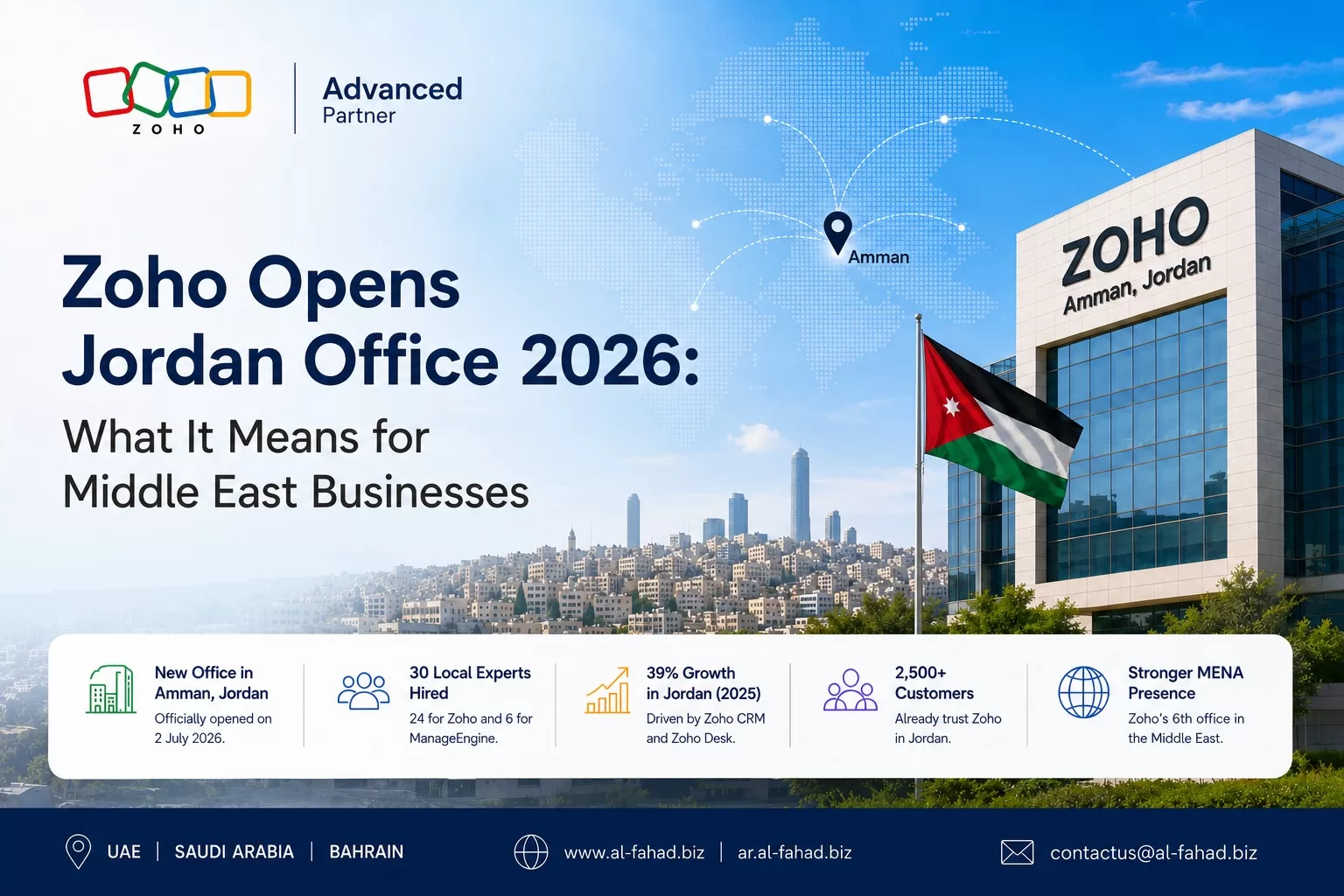
Zoho has spent the better part of a decade building its business the way most GCC family businesses would recognise: quietly, profitably, and one market at a time, without chasing headlines for their own sake. So when the company formally opened a dedicated office in Amman on 2 July 2026, it was not a symbolic ribbon-cutting for a market it barely understood. It was the visible result of two years of groundwork, a local team already hired, and a regional growth story that most software vendors in the Middle East cannot match.
For a business owner in Dubai, Riyadh, or Manama, a new Zoho office in Jordan might look like distant news that has little to do with day-to-day operations. It is not. Zoho now runs dedicated offices across the UAE, Saudi Arabia, Egypt, Qatar, Bahrain, and now Jordan — and every one of those offices feeds the same product roadmap, the same Arabic-language investment, and the same regional support network that GCC customers already rely on. A stronger Zoho presence in Amman means faster localisation, more Arabic-first product development, and a company that is doubling down on the region rather than treating it as an afterthought to its US and Indian operations.
This guide explains exactly what Zoho announced with its new Jordan office, why the company chose Amman specifically, what the expansion signals about Zoho’s broader commitment to the Middle East, and what it practically means for businesses in the UAE, Saudi Arabia, and Bahrain that are already running — or considering — Zoho One.
Zoho’s Jordan Office 2026: Key Facts at a Glance
| Key Detail | What Was Announced |
| Office location | Amman, Hashemite Kingdom of Jordan |
| Official opening date | Thursday, 2 July 2026 |
| Brands housed on-site | Zoho (business applications) and ManageEngine (enterprise IT management and security) |
| Functions based in Amman | Sales, marketing, partner enablement, and customer support, with a strong local-hiring focus |
| Local team hired so far | 30 employees — 24 for Zoho and 6 for ManageEngine — nearly all recruited locally in Jordan |
| Existing Zoho customers in Jordan | Around 2,500 businesses, ahead of the office opening |
| Jordan growth in 2025 | 39% year-on-year growth, driven largely by Zoho CRM and Zoho Desk |
| MENA regional growth | 41% compound annual growth rate (CAGR) over the past five years — Zoho’s second fastest-growing region globally |
| Government alignment | Jordan’s National Digital Transformation Strategy 2026–2028 and the Economic Modernization Vision (EMV) |
| Other MENA offices | UAE, Saudi Arabia, Egypt, Qatar, and Bahrain |
Note: Figures above are drawn from Zoho’s official announcement and regional press coverage at the time of the Amman office opening. Customer counts, hiring numbers, and growth figures may be updated by Zoho over time — always confirm current details on Zoho’s official newsroom or with a certified Zoho partner before citing them in a business proposal.
Why Zoho Chose Jordan for Its Next MENA Office
Zoho does not open offices the way many technology vendors do — announced first, staffed later. The Amman office followed the opposite sequence, and understanding that sequence explains why Jordan was chosen at all.
Two Years of Groundwork Before the Announcement
Hyther Nizam, President of Zoho’s Middle East and Africa (MEA) business, described the Amman launch as the result of nearly two years spent training local talent and building regional capacity before the office itself was ever opened. That sequencing matters: Zoho was already serving roughly 2,500 customers in Jordan and recording 39% growth in the market during 2025, entirely before a physical office existed there. The office formalises a presence that was already working — it does not create one from scratch.
Jordan’s Position as a Gateway to Arabic-Speaking Markets
Jordan sits at a strategic crossroads for Arabic-language business software — bordering Saudi Arabia, close to the Gulf, and home to a workforce with strong bilingual and technical skills. Zoho has positioned the Amman office to serve as a regional base supporting customers across wider Arabic-speaking markets, not just Jordan itself, which is precisely why the office houses sales, marketing, partner enablement, and support functions rather than a single narrow role.
Government Backing Through Jordan’s Digital Transformation Strategy
Jordan’s Minister of Digital Economy and Entrepreneurship, Sami Smeirat, framed the announcement as a direct validation of the Kingdom’s National Digital Transformation Strategy 2026–2028, describing the investment as exactly the kind of private-sector confidence the strategy is designed to attract. The office opening also aligns with Jordan’s Economic Modernization Vision (EMV), which targets high-value technology jobs and stronger digital infrastructure for local SMEs — giving Zoho’s expansion political and economic backing well beyond a single company’s growth plan.
What the Amman Office Actually Does
Unlike a small satellite office handling a single function, Amman has been set up as a working hub for two of Zoho’s core businesses, with real operational teams rather than a symbolic regional address.
A Shared Home for Zoho and ManageEngine
The Amman facility houses both of Zoho Corporation’s primary technology brands under one roof: Zoho, covering business applications such as CRM, Books, and the wider Zoho One suite, and ManageEngine, covering enterprise IT management and security. For businesses already using both product families, that shared presence means localisation, support, and partner enablement are coordinated from a single regional base rather than two disconnected teams.
Localisation, Support, and Partner Enablement — Not Just Sales
The Amman office was built to deliver direct localisation support, alongside dedicated teams for sales, marketing, partner enablement, and customer support. That combination is deliberate: localisation work — Arabic-language product content, right-to-left interface support, and region-specific compliance features — tends to move faster when the team doing it sits close to the market it is building for, rather than operating out of a headquarters thousands of kilometres away.
Building Local Tech Talent, Not Just a Local Sales Team
Zoho has hired 30 employees for the Amman office so far — 24 for Zoho and six for ManageEngine — with nearly all of them recruited locally in Jordan. That local-hiring emphasis mirrors how Zoho has approached other MENA markets: rather than flying in staff from India or the US, the company trains and employs people from the market it is entering, which tends to produce support teams that understand the region’s language, business culture, and regulatory context first-hand.
What This Means for Middle East Businesses Outside Jordan
A new office in Amman is Jordan-specific news on the surface, but Zoho’s regional operating model means the impact reaches every market the company serves — including the UAE, Saudi Arabia, and Bahrain.
Faster, More Localised Support Across the Wider Region
Zoho’s MENA offices do not operate as isolated silos. A regional hub in Amman, working alongside existing offices in the UAE, Saudi Arabia, Egypt, Qatar, and Bahrain, adds capacity to the same regional support network that GCC customers already draw on. For a business running Zoho One across multiple GCC entities, a stronger regional bench typically means shorter response times and deeper product expertise available closer to home, rather than routing every complex query back to a headquarters time zone.
Continued Investment in Arabic-Language and RTL Product Development
Zoho has already built Arabic-language support and right-to-left user experience into its top products, including Zoho One, Zoho Workplace, and Zoho Books. A regional office explicitly tasked with localisation — serving Arabic-speaking markets beyond Jordan’s own borders — signals that this investment is continuing, not slowing down. For GCC businesses that operate in Arabic, English, or both simultaneously, that is a meaningful product-roadmap signal, not just a hiring announcement.
A Vote of Confidence in MENA as a Growth Market, Not an Afterthought
MENA is now Zoho’s second fastest-growing region globally, recording a 41% compound annual growth rate over the past five years. Opening a sixth dedicated regional office — after the UAE, Saudi Arabia, Egypt, Qatar, and Bahrain — is not the behaviour of a vendor treating the Middle East as a secondary market served remotely. It is the behaviour of a company committing further headcount, further localisation spend, and further leadership attention to a region it expects to keep growing.
What UAE, Saudi, and Bahrain Businesses Should Actually Take From This
For a business already on Zoho One, the practical takeaway is continuity and expanding depth: the same platform, the same regional support ecosystem, now backed by a larger and more localised team. For a business still evaluating Zoho against legacy accounting software or a patchwork of disconnected tools, the Jordan office is a reasonable data point in that evaluation — it reflects a vendor expanding its regional commitment at a time when many software providers are cutting regional investment, not adding to it.
Zoho’s Wider MENA Expansion in Context
The Amman office is easier to understand once it is placed alongside the rest of Zoho’s regional footprint rather than viewed as a standalone event.
From Single-Country Presence to a Connected Regional Network
Zoho’s MENA offices in the UAE, Saudi Arabia, Egypt, Qatar, and Bahrain were each built up individually over the years, but they increasingly function as a connected regional network rather than separate outposts. Jordan’s addition strengthens that network specifically for Arabic-speaking markets and gives Zoho a base positioned close to both the Levant and the wider Gulf, which is a deliberate expansion pattern rather than a one-off market entry.
Why This Matters if You Are Weighing Zoho Against Legacy Systems in 2026
GCC family businesses and SMEs currently running Tally, QuickBooks Desktop, or a mix of spreadsheets are typically weighing more than feature lists when they evaluate a platform migration — they are also weighing whether the vendor will still be investing in their region five years from now. A vendor opening its sixth dedicated MENA office, hiring locally, and posting a 41% regional CAGR is answering that question with actions rather than a sales pitch.
How Al Fahad IT Consulting Helps Businesses Get More From Zoho’s Growing MENA Presence
Al Fahad IT Consulting is a certified Zoho Premium Partner with offices in Dubai and Dammam, and more than a decade of experience implementing Zoho across the UAE, Saudi Arabia, and Bahrain. As Zoho continues to expand its regional footprint and roll out deeper Arabic-language and localisation features, staying current on what is actually available — and configuring it correctly — is where a certified partner adds the most value.
- Zoho One Implementation: We design and roll out the full Zoho One suite across finance, HR, sales, and operations for multi-entity GCC businesses.
- Arabic & RTL Configuration: We configure Arabic-language interfaces, bilingual workflows, and right-to-left layouts correctly across CRM, Books, and Workplace.
- Multi-Country Compliance Setup: We configure UAE VAT and corporate tax, Saudi Zakat and VAT, and Bahrain VAT rules correctly inside Zoho Books and Zoho Payroll.
- Migration from Legacy Systems: We move businesses off Tally, QuickBooks Desktop, and disconnected spreadsheets onto a single unified Zoho environment.
- Ongoing Support & Optimisation: We provide continued support as Zoho rolls out new regional features, so your setup keeps pace with the platform.
Contact our team today for a free Zoho consultation tailored to your GCC business — whether you operate in Dubai, Abu Dhabi, Riyadh, or Manama.
Frequently Asked Questions
Q1. Does Zoho’s new Jordan office change anything for businesses already using Zoho in the UAE, Saudi Arabia, or Bahrain?
Not directly in terms of your existing setup, but it strengthens the regional support and localisation network your business already draws on. Zoho’s MENA offices work as a connected regional operation, so added capacity in Amman contributes to faster localisation and support capability across the wider region, including the GCC.
Q2. Is the Amman office only for Jordanian customers?
No. While the office directly serves Jordan’s roughly 2,500 existing Zoho customers, it has also been positioned by Zoho’s MEA leadership as a regional base supporting customers across wider Arabic-speaking markets, working alongside Zoho’s existing UAE, Saudi Arabia, Egypt, Qatar, and Bahrain offices.
Q3. Does this office handle both Zoho and ManageEngine products?
Yes. The Amman facility houses dedicated teams for both of Zoho Corporation’s primary technology brands — Zoho, covering business applications, and ManageEngine, covering enterprise IT management and security.
Q4. What does Zoho’s MENA growth rate actually mean for a business evaluating the platform in 2026?
A 41% five-year compound annual growth rate makes MENA Zoho’s second fastest-growing region globally, which is a reasonable signal of sustained investment. For a business comparing vendors, ongoing regional investment — new offices, local hiring, continued localisation — is a useful indicator of long-term platform support, alongside feature comparisons.
Q5. How can a GCC business get help evaluating or implementing Zoho as the platform expands regionally?
Working with a certified Zoho Premium Partner that operates directly in the GCC, such as Al Fahad IT Consulting, ensures implementation and localisation decisions are made by a team with hands-on experience in UAE, Saudi, and Bahrain compliance requirements, rather than relying on generic global documentation alone.
Ready to Make the Most of Zoho’s Growing Middle East Presence?
Zoho’s decision to open a dedicated office in Amman is one more data point in a clear regional pattern: the company is investing further into the Middle East, not pulling back from it. For businesses in the UAE, Saudi Arabia, and Bahrain, that means a platform backed by growing local expertise, deepening Arabic-language investment, and a regional support network that keeps expanding alongside the businesses that rely on it.
Whether you are in Dubai, Abu Dhabi, Riyadh, or Manama, Al Fahad IT Consulting brings certified Zoho implementation experience to help your business get the most out of Zoho’s expanding regional platform, from day one.
Contact our team today for a free, obligation-free Zoho consultation.
Talk to a Zoho Specialist
Al Fahad IT Consulting is a Zoho Premium Partner with active Zoho implementations across UAE, Saudi Arabia, and Bahrain.
We configure Zoho workflows aligned to your compliance structure, Arabic-language requirements, and operational scale: not a generic template.
Book a free Zoho consultation →
نتحدث العربية. تواصل معنا للحصول على استشارة مجانية في تطبيقات زوهو
Al Fahad IT Consulting is a Zoho Premium Partner and Oracle Partner Network member, providing Zoho implementation services across UAE, Saudi Arabia, and Bahrain.
Disclaimer: This article is for informational purposes only and does not constitute professional business or IT consulting advice. Figures relating to office openings, hiring numbers, and regional growth are based on public statements and press coverage at the time of publication and may be updated by Zoho Corporation — always confirm current details directly with Zoho before citing them in a business decision.


