
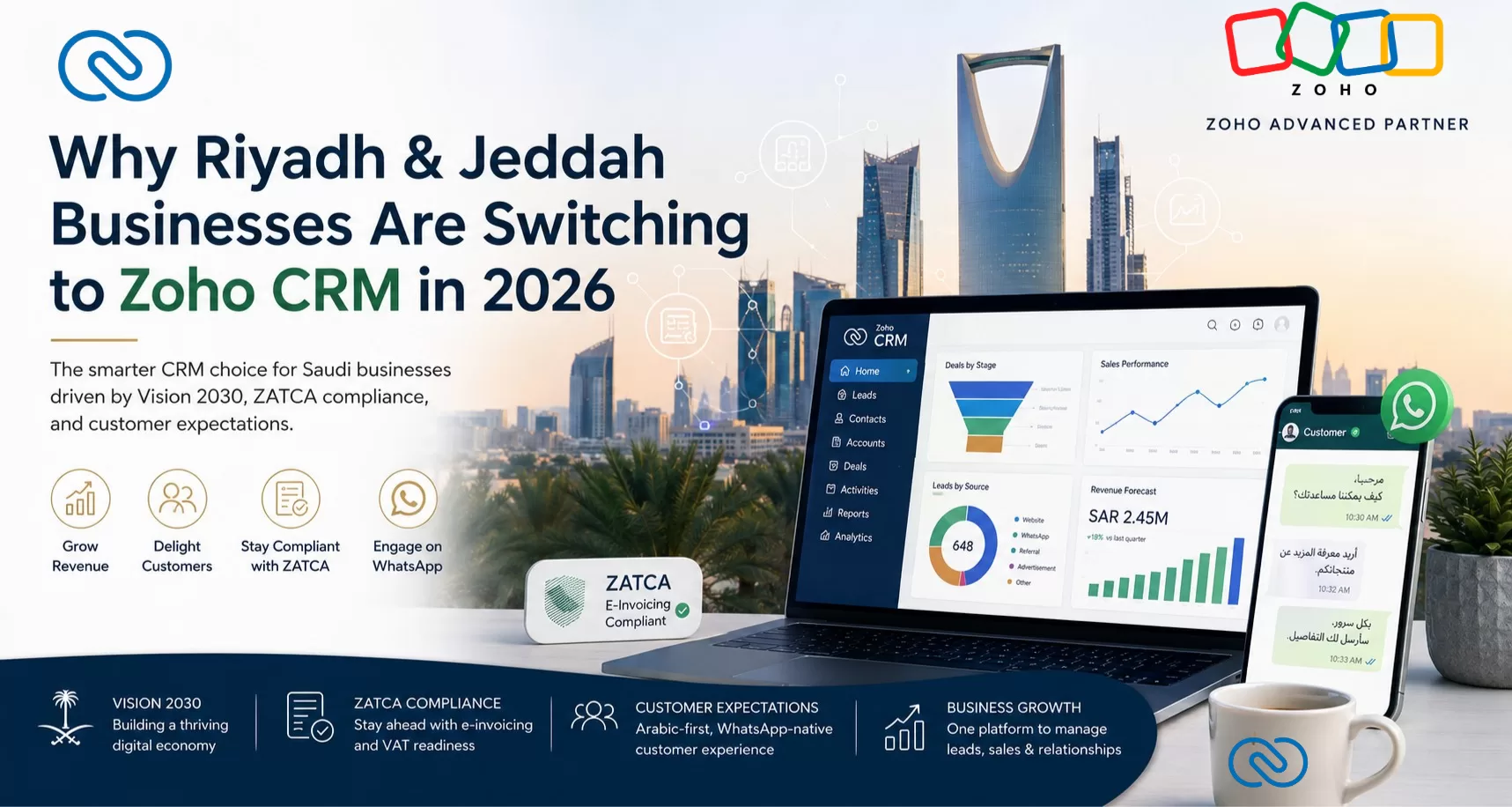
Zoho CRM Saudi Arabia: The 2026 Shift in Riyadh and Jeddah
Something has shifted in how Riyadh and Jeddah businesses talk about their sales systems in 2026. Two years ago, most conversations were about whether a CRM was worth the investment at all. Today, the conversation is different. It is about why the spreadsheet, the WhatsApp-and-Excel workaround, or the legacy on-premise system a business has run for a decade can no longer keep up. And specifically, it is about why Zoho CRM Saudi Arabia keeps coming up as the system businesses are switching to, rather than switching away from. Our own experience with Zoho CRM implementation across the Kingdom shows exactly why.
That shift is not happening in isolation. Vision 2030 has pushed ICT investment past USD 10 billion a year. ZATCA’s e-invoicing mandate is pulling nearly every formally registered Saudi business into a connected digital compliance ecosystem. And the Kingdom’s CRM market alone is now valued at roughly USD 741 million, growing toward an estimated USD 1.79 billion by 2035. Riyadh and Jeddah businesses are not adopting CRM because it is fashionable. They are adopting it because the surrounding regulatory and competitive environment has made spreadsheets and disconnected tools an active liability.
This guide draws on our own experience implementing Zoho CRM for businesses across Riyadh, Jeddah, and the wider Kingdom. We combine that experience with current 2026 market data on Saudi Arabia’s digital transformation drivers. It covers exactly why Saudi businesses are making the switch now, what makes Zoho CRM specifically well suited to the Kingdom’s requirements, and what a business should plan for when making the move.
| Key TakeawaysSaudi Arabia’s CRM market reached roughly USD 741 million in 2025. It is projected to grow toward USD 1.79 billion by 2035, driven directly by Vision 2030 digital transformation mandates. ZATCA’s e-invoicing rollout is exposing operational friction behind the compliance layer. Businesses need their CRM and finance systems properly connected, not just compliant invoices. Arabic RTL interface support, WhatsApp Business integration, and ZATCA-aligned invoicing compatibility are the three factors Saudi CRM buyers consistently treat as non-negotiable in 2026. Zoho CRM is positioned as one of the strongest value options for Saudi SMEs. It offers native Arabic support, competitive pricing, and deep integration across the wider Zoho suite. |
The Three Forces Pushing Zoho CRM Adoption in Saudi Arabia
1. Vision 2030’s Digital Transformation Mandate
Vision 2030 has made digital transformation a competitive necessity rather than a discretionary upgrade for Saudi businesses. ICT investment is climbing past USD 10 billion annually, and non-oil GDP continues to expand. Businesses across Riyadh and Jeddah are under direct pressure to modernise how they track customers, forecast revenue, and manage growth. That pressure increasingly comes from clients and partners who simply expect a modern, responsive sales process.
2. ZATCA E-Invoicing Exposing Operational Gaps
ZATCA’s e-invoicing programme has become one of the most advanced tax digitisation initiatives globally. More than 8.2 billion electronic invoices were processed through the Fatoora platform in 2025 alone. But an organisation can be fully compliant on the invoicing side while remaining operationally disconnected everywhere else. Saudi businesses still average more than five months from invoicing to cash collection — the longest working-capital cycle in the region. A Zoho CRM with ZATCA integration through Zoho Books is one of the most direct ways to close that gap.
3. Customers Who Expect Arabic-First, WhatsApp-Native Service
Saudi buyers, whether B2B or consumer-facing, increasingly expect to be served in Arabic, on WhatsApp, without friction. A CRM that treats Arabic as a translation layer bolted onto an English-first product creates exactly the kind of friction Saudi businesses are trying to eliminate. This is precisely where several widely used CRMs fall short.
Note: Market size figures, regulatory timelines, and ICT investment data reflect publicly reported 2026 industry analysis and are subject to revision. Confirm current ZATCA compliance requirements directly with ZATCA or a qualified compliance advisor before making a system decision based on regulatory deadlines.
Why Zoho CRM Specifically Fits Saudi Arabia’s Riyadh and Jeddah Businesses
| Saudi Business Requirement | Why It Matters Locally | How Zoho CRM Addresses It |
| Arabic RTL interface | Most sales and support staff work primarily in Arabic. An English-only interface slows adoption. | Full right-to-left interface support across the CRM, not just in customer-facing emails |
| WhatsApp-native engagement | WhatsApp is the dominant channel for both B2B and consumer communication in Saudi Arabia | Native integration through Zoho SalesIQ, keeping WhatsApp conversations tied to the same CRM record |
| ZATCA-aligned invoicing | Nearly all VAT-registered businesses now fall under ZATCA Phase 2 integration requirements | Connects to Zoho Books for invoicing workflows that align with Saudi VAT and e-invoicing needs |
| Competitive, transparent pricing | SMEs need predictable software costs as they scale, especially as compliance spend also rises | Published per-user pricing with a genuine free tier, avoiding a sales-negotiated enterprise contract for smaller teams |
| Multi-entity, multi-city operations | Many Saudi businesses operate across Riyadh, Jeddah, and Dammam simultaneously | Centralised CRM data across branches and entities, with role-based visibility by location or team |
Note: Feature availability can vary by Zoho CRM plan and edition. Confirm current Arabic-language coverage, WhatsApp integration requirements, and Zoho Books connectivity for your specific plan on Zoho’s official documentation or with a certified Zoho partner in Saudi Arabia.
What Riyadh and Jeddah Businesses in Saudi Arabia Are Actually Switching From
Legacy On-Premise Systems
Many established Saudi enterprises are still running older on-premise CRM or ERP-adjacent systems. These systems cannot meet real-time reporting, multi-entity consolidation, or ZATCA integration requirements without extensive custom middleware. That middleware itself becomes a maintenance burden as compliance requirements continue to evolve.
Spreadsheets and WhatsApp-Based Tracking
For smaller Riyadh and Jeddah businesses, the more common switch is away from a patchwork of spreadsheets, personal WhatsApp threads, and manual follow-up reminders. That setup works until the business crosses a size where nothing about the sales pipeline is visible to anyone except the person holding the phone.
CRMs Without Genuine Arabic or Regional Support
A number of Saudi businesses adopted an international CRM early on. They discovered its Arabic support was a surface-level translation rather than a genuinely right-to-left, Arabic-first experience. Now they are switching to a platform where that support was built in rather than added later.
What to Plan for When Making the Switch
- Data migration from spreadsheets or a legacy system: Plan for data cleaning before migration, not just a direct import. Stale or duplicate records carry forward otherwise.
- Connecting CRM to your ZATCA-compliant invoicing setup: Map out how Zoho CRM should connect to Zoho Books or your existing ZATCA-integrated system before go-live, not after.
- Arabic and English field configuration: Decide up front which fields, templates, and reports need to work bilingually versus which can remain single-language.
- Role-based access across branches: If you operate across Riyadh, Jeddah, and Dammam, structure territory and permission rules before your teams start entering live data.
- Team training built around real Saudi sales scenarios: Generic CRM training rarely covers WhatsApp-first follow-up or Arabic quote generation. Both matter here.
5 Signs Your Riyadh or Jeddah Business Is Ready to Switch
- Your sales pipeline lives in someone’s head, not in a system. If losing one salesperson means losing visibility into their entire pipeline, that risk needs addressing now.
- ZATCA compliance projects have exposed how disconnected your systems really are. A compliant invoice does not mean a connected business.
- Customers are asking for Arabic and WhatsApp service faster than your team can currently deliver it. That is a sign your current tools are working against your team, not with them.
- You operate across more than one Saudi city and can’t see a consolidated view. Multi-branch visibility is a basic requirement a modern CRM should solve on day one.
- Your current CRM’s Arabic support feels like an afterthought. If your Arabic-speaking staff quietly prefer working in English inside the system, that is a signal worth acting on.
How Al Fahad IT Consulting Helps Saudi Arabia Businesses Switch to Zoho CRM
Switching CRM systems in the middle of Saudi Arabia’s compliance and digital transformation push needs to be handled carefully. Done well, it closes operational gaps. Done poorly, it adds a new system on top of old friction. As a certified Zoho Premium Partner in Saudi Arabia, we help Riyadh and Jeddah businesses with:
- Migration Planning and Data Cleanup: Moving cleanly from spreadsheets, legacy systems, or a poorly fitted CRM without carrying old problems forward.
- ZATCA-Aligned CRM-to-Finance Integration: Connecting Zoho CRM to Zoho Books or your existing invoicing setup for a genuinely connected compliance and sales workflow.
- Arabic-First Configuration: Full RTL layouts, Arabic templates, and WhatsApp integration configured properly from day one, not bolted on later.
- Multi-Branch Territory Setup: Role-based access and reporting structured for businesses operating across Riyadh, Jeddah, Dammam, and beyond.
- Scenario-Based Team Training: Training built around how your Saudi sales team actually works, not a generic product walkthrough.
Frequently Asked Questions
Is Zoho CRM fully compliant with ZATCA e-invoicing requirements?
Zoho CRM itself is a sales and customer-management platform, not an invoicing system. But it connects to Zoho Books, which is built to align with Saudi VAT and e-invoicing requirements. For full ZATCA Phase 2 integration, the connection between your CRM and your invoicing or ERP system needs to be configured correctly. Always confirm current ZATCA compliance requirements directly with ZATCA or a qualified compliance advisor.
How does Zoho CRM’s Arabic support compare to other CRMs used in Saudi Arabia?
Zoho CRM offers full right-to-left interface support. It is frequently cited as offering genuine Arabic-first usability, rather than a translated English interface. Arabic RTL support is one of the deciding factors for Saudi CRM buyers in 2026, alongside WhatsApp integration and e-invoicing compatibility.
Is Zoho CRM affordable for a Saudi SME compared to enterprise platforms?
Yes, generally. Zoho CRM is commonly positioned as one of the strongest value options for Saudi SMEs. It offers published per-user pricing and a genuine free tier, compared to enterprise platforms that typically require a custom sales quote and significantly higher per-seat costs.
How long does it take to switch from a legacy CRM to Zoho CRM in Saudi Arabia?
A typical Saudi SME migration — data cleanup, core configuration, and initial training — is often completed within four to eight weeks with a certified Zoho partner managing the process. Timelines vary with data volume, the number of integrations, and how many branches or entities are involved.
Does switching CRM systems create any ZATCA compliance risk?
Switching your CRM itself does not directly affect ZATCA compliance, since e-invoicing obligations sit with your invoicing or ERP system rather than your CRM. The practical risk is operational, not regulatory. A poorly planned migration can temporarily disconnect your sales and finance data — which is exactly why migration planning and integration mapping should happen before go-live, not after.
Ready to Make the Switch to Zoho CRM in Saudi Arabia?
Riyadh and Jeddah businesses are not switching to Zoho CRM because of a single feature. They are switching because Vision 2030’s pace of change has made disconnected, English-first, spreadsheet-backed sales processes a genuine competitive liability. Making the switch properly, with ZATCA-aligned integration and real Arabic-first configuration, is what turns that decision into an actual advantage.
Whether you are based in Riyadh, Jeddah, or Dammam, Al Fahad IT Consulting’s Zoho CRM services bring certified Zoho Premium Partner experience to help you switch to Zoho CRM the right way.
Contact our team today for a free, no-obligation Zoho CRM consultation.
Related Reading on the Al Fahad IT Consulting Blog
This post is part of a broader series on Zoho CRM adoption and configuration across the GCC. For related reading:
- Zoho CRM Mobile: Managing Sales On the Go for UAE Field Teams
- Zoho CRM AI Agents 2026: How Zia Qualifies Leads, Books Meetings & Updates Pipeline Automatically
Talk to a Zoho CRM Specialist in Saudi Arabia
Al Fahad IT Consulting is a Zoho Premium Partner with active Zoho CRM implementations across Saudi Arabia, UAE, and Bahrain.
We configure Zoho CRM workflows aligned to your Saudi sales process, ZATCA requirements, and multi-branch operations. This is not a generic template.
Book a free Zoho consultation →
نتحدث العربية. تواصل معنا للحصول على استشارة مجانية في تطبيق Zoho CRM للشركات في الرياض وجدة والمملكة العربية السعودية
Al Fahad IT Consulting is a Zoho Premium Partner and Oracle Partner Network member, providing Zoho CRM implementation services across Saudi Arabia, UAE, and Bahrain.
Disclaimer: Market size figures, regulatory timelines, and CRM feature information reflect publicly available data as of 2026. Always confirm current ZATCA compliance requirements with ZATCA or a qualified compliance advisor. This article is for informational purposes only.


