
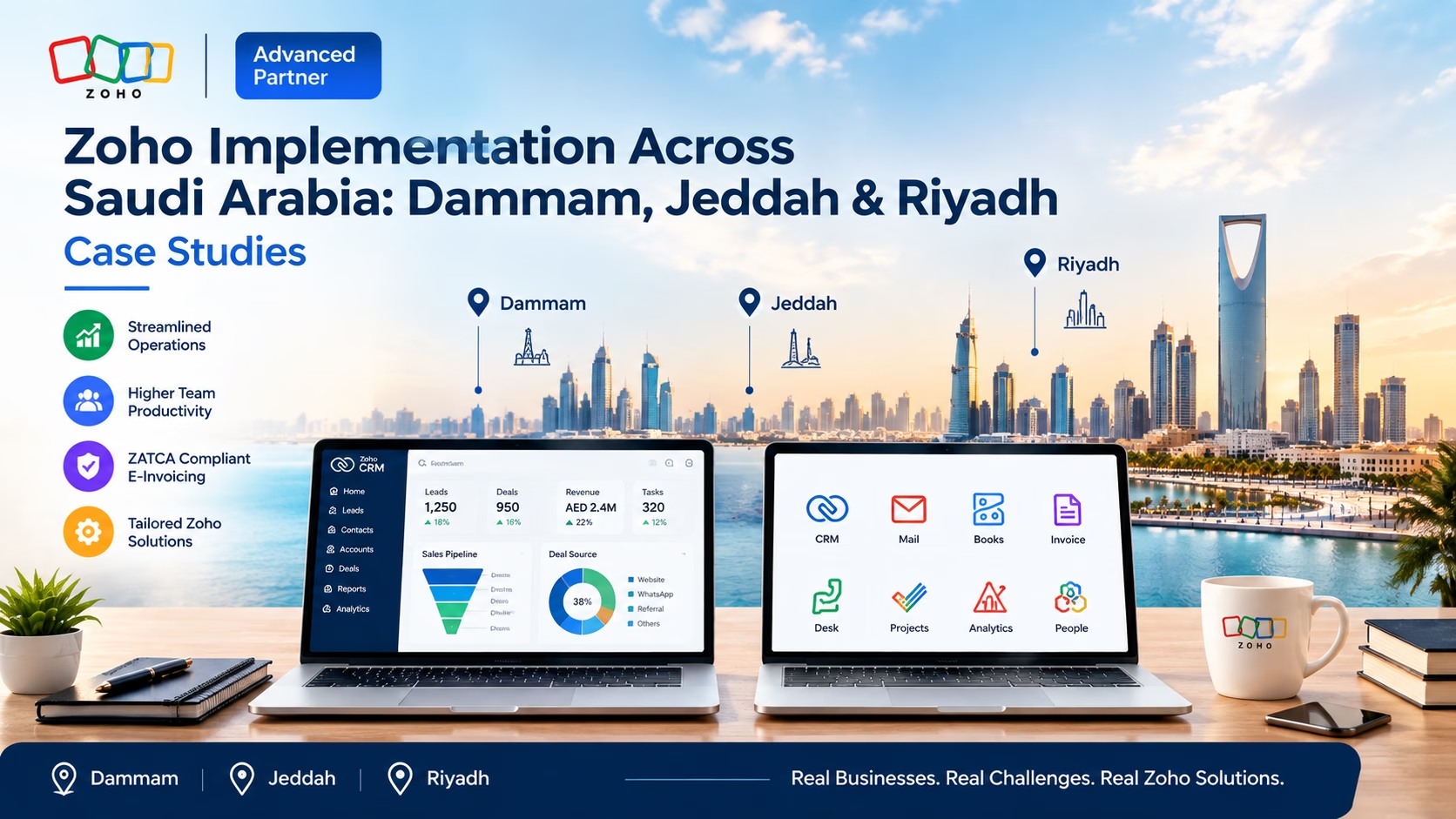
Saudi Arabia’s business landscape is changing fast. Under Vision 2030, companies in every major city are under pressure to digitize, automate, and compete on efficiency, not just relationships. This runs from the industrial hubs of Dammam, to the trading corridors of Jeddah, to the corporate core of Riyadh. For many of these companies, Zoho implementation Dammam Jeddah has become the practical starting point for that transformation.
This guide walks through how three real business profiles in Dammam, Jeddah, and Riyadh approached Zoho implementation. It covers the operational problems each was solving, and the outcomes that followed — built from our own delivery experience running these projects across Saudi Arabia and the wider GCC.
For the underlying methodology referenced throughout these case studies, see our full Zoho implementation guide, and browse more examples across other industries in our case studies library.
| Key TakeawaysAcross Dammam, Jeddah, and Riyadh, the businesses that got the most out of Zoho implementation started with the single manual process causing the most daily friction — not a company-wide rollout on day one. Clean data migration up front, not a fresh start, was the difference between projects that got adopted quickly and ones that stalled. ZATCA-compliant, bilingual (Arabic/English) invoicing in Zoho Books came up as a requirement in every single case study, regardless of industry. The module mix that worked for a Dammam distributor, a Jeddah retail group, and a Riyadh consulting firm were all different — Zoho implementation is not one template applied three times. |
What You’re Actually Comparing: One Template, or a Tailored Rollout?
A common assumption is that “Zoho implementation” means the same rollout regardless of business type — connect the CRM, import contacts, done. The three case studies below show why that assumption costs businesses time and adoption. A distributor, a retail group, and a consulting firm each needed a different combination of Zoho apps, in a different order, to solve the process that was actually hurting them.
Case Study 1 — Zoho implementation Dammam Jeddah in Dammam: Unifying Sales and Inventory for an Industrial Supplier
Industry: Industrial equipment & spare parts distribution
Challenge: A Dammam-based distributor serving clients across the Eastern Province was running sales leads in one spreadsheet, stock levels in another, and invoicing through a separate accounting tool. Sales reps had no real-time visibility into stock. This led to overpromised delivery dates for clients in Khobar and Jubail.
What the Zoho implementation Dammam Jeddah involved:
- Migrating historical customer and deal data into Zoho CRM
- Connecting Zoho CRM to Zoho Inventory so reps could check live stock before confirming an order
- Setting up Zoho Books for ZATCA-compliant, bilingual e-invoicing
- Arabic/English quote and invoice templates for a mixed local and regional client base
Outcome: Order confirmation time dropped once reps could see stock without calling the warehouse. Late-delivery complaints from key accounts fell within the first quarter after go-live. Finance also stopped re-entering the same order data twice between CRM and accounting.
Case Study 2 — Jeddah: Streamlining Multi-Branch Retail Operations
Industry: Retail & trading (multi-branch)
Challenge: A Jeddah-based retail group with branches across the city and in Makkah had no single view of performance across locations. Each branch manager kept separate reports, and head office had no consolidated dashboard to compare branches or forecast demand.
What the Zoho implementation Dammam Jeddah involved:
- Rolling out Zoho CRM across all branches with branch-level sales pipelines
- Building consolidated dashboards in Zoho Analytics for head-office visibility
- Automating lead-assignment workflows so enquiries from any branch were routed instantly
- Integrating Zoho Desk for centralized customer support across every branch
Outcome: Head office gained a single, real-time view of performance across every branch instead of waiting on manual weekly reports. Lead response time improved sharply once assignment was automated. Management could finally compare branch-level conversion rates side by side to guide expansion decisions.
Case Study 3 — Zoho Implementation in Riyadh: Scaling a Professional Services Firm With Zoho One
Industry: Professional & consulting services
Challenge: A fast-growing Riyadh-based consulting firm had outgrown its manual onboarding, HR, and project-tracking processes. As headcount grew, HR and project managers were spending hours each week compiling status updates, timesheets, and client reports from disconnected documents.
What the Zoho implementation Dammam Jeddah involved:
- Deploying Zoho People for onboarding, leave, and attendance management
- Zoho Projects for client-facing project tracking and timesheets
- Zoho CRM integrated with Zoho Books for proposal-to-invoice workflows
- Custom approval workflows matched to the firm’s internal hierarchy
Outcome: New-hire onboarding time was cut significantly, and project status reporting became automatic instead of manually compiled. Finance began generating client invoices directly from approved timesheets — removing an entire manual reconciliation step each month.
What These Case Studies Have in Common
Looking at Dammam, Jeddah, and Riyadh together, a clear pattern emerges in successful Zoho implementations across Saudi Arabia:
- Data migration comes first. Every successful project started with a clean, structured migration of existing customer, inventory, or HR data — not a blank slate.
- Automation targets the biggest bottleneck, not every process at once. Each business picked the workflow causing the most daily friction and automated that first.
- Bilingual, ZATCA-ready finance setup is non-negotiable. Every case study required Arabic/English support and compliant invoicing from day one.
- Dashboards drive adoption. Once managers could see real-time data instead of waiting for reports, usage across teams increased on its own.
Is Zoho implementation Dammam Jeddah Right for Your Business?
Whether you’re running an industrial supply business in Dammam, a multi-branch retail operation in Jeddah, or a scaling services firm in Riyadh, the fundamentals are the same. Start with the process causing the most pain, migrate your data properly, and build automation around it rather than trying to digitize everything on day one.
- Start with Zoho CRM alone if: your core problem is disorganized sales data and follow-ups, with no urgent need for inventory, HR, or finance integration yet.
- Plan a multi-module rollout if: your sales, stock, or finance teams are already re-entering the same data across disconnected tools.
- Consider full Zoho One if: you’re scaling headcount and need CRM, HR, projects, and finance to share one system from the start.
What to Plan for When Implementing Zoho
- Data migration from spreadsheets or legacy systems: plan for a proper cleanup pass before import, not a direct dump of existing sheets.
- ZATCA e-invoicing setup in Zoho Books: straightforward with the right configuration, but worth having a specialist handle it the first time.
- Choosing the right module mix: this should be driven by which process is causing the most pain today, not a generic package.
- Team training and change management: budget a short adjustment period, since adoption depends on staff actually using the new workflows day to day.
How Al Fahad IT Consulting Helps Saudi Businesses Implement Zoho
Choosing which Zoho modules to implement is only the first decision. Getting the data migration, workflow automation, and bilingual finance setup right is where the real value sits. As a certified Zoho Partner across the UAE, Saudi Arabia, and Bahrain, we help businesses with:
- Process Assessment: reviewing your current workflows to recommend the right Zoho modules honestly — not a default package.
- Data Migration: moving customer, inventory, or HR data from spreadsheets or legacy systems with minimal disruption.
- Zoho One and Full-Suite Implementation: connecting CRM, Books, Inventory, People, and Projects as one system rather than isolated tools.
- Bilingual Setup and Training: Arabic and English configuration and onboarding support for your team.
- Ongoing Support: post-implementation support covered under a written SLA, not a verbal promise.
Frequently Asked Questions
How long does a Zoho implementation Dammam Jeddah take for a mid-sized Saudi business?
Most mid-sized implementations — CRM plus one or two additional modules such as Books or Inventory — take between 4 and 10 weeks. The exact timeline depends on data volume and the number of custom workflows required.
Does Zoho implementation Dammam Jeddah support ZATCA e-invoicing requirements?
Yes. Zoho Books can be configured for ZATCA-compliant e-invoicing (Fatoora). This is why finance setup is part of nearly every Zoho implementation in Saudi Arabia today.
Can Zoho be implemented in both Arabic and English?
Yes. Zoho supports bilingual templates, interfaces, and communication workflows. This is essential for teams operating across Dammam, Jeddah, Riyadh, and other Saudi cities.
Do all businesses need the same Zoho implementation Dammam Jeddah modules?
No. As these case studies show, the right module mix depends on the business model. Inventory-heavy distributors, multi-branch retailers, and services firms each need a different combination of Zoho apps.
Should we implement Zoho CRM alone, or the full Zoho One suite?
If your core problem is sales and follow-up tracking, CRM alone is the most cost-effective starting point. If sales, inventory, HR, or finance teams are already duplicating work across disconnected tools, a multi-module rollout or full Zoho One delivers more value through native integration.
Choose the Right Zoho Implementation Partner
Whether you’re running an industrial supply business in Dammam, a multi-branch retail operation in Jeddah, or a scaling services firm in Riyadh, the right Zoho implementation comes down to understanding your actual bottleneck before choosing your modules. Get that assessment right, and the rollout becomes straightforward.
Al Fahad IT Consulting is a certified Zoho Partner bringing over a decade of experience to Zoho implementations across the Eastern Province, the Western Region, and Riyadh.
Contact our team today for a free, no-obligation review of your business processes.
Related Reading on the Al Fahad IT Consulting Blog
This post is part of a broader series on Zoho implementation for GCC businesses. For related reading:
- Zoho Implementation Services in UAE, KSA & Bahrain
- Case Studies — Al Fahad IT Consulting
- Zoho One Consultants & Solution Partners in UAE, KSA & Bahrain
- Zoho Mail vs Google Workspace for UAE & Saudi SMEs
Disclaimer: This article is for informational purposes only and does not constitute professional legal, financial, or IT consulting advice. Outcomes described are illustrative of typical results and will vary by business. Always confirm current ZATCA compliance requirements and Zoho product capabilities directly with ZATCA or a qualified Zoho partner before making a decision.
Talk to a Zoho Implementation Specialist in Saudi Arabia
Al Fahad IT Consulting is a Zoho Premium Partner with active Zoho implementations across Dammam, Jeddah, Riyadh, and the wider UAE, Saudi Arabia, and Bahrain region.
We handle process assessment, data migration, workflow automation, and bilingual ZATCA-compliant finance setup aligned to your business — not a generic template.
Book a free Zoho consultation →
نتحدث العربية. تواصل معنا للحصول على استشارة مجانية حول تطبيق Zoho لشركتكم في الدمام وجدة والرياض
Al Fahad IT Consulting is a Zoho Premium Partner and Oracle Partner Network member, providing Zoho implementation services across UAE, Saudi Arabia, and Bahrain.


