
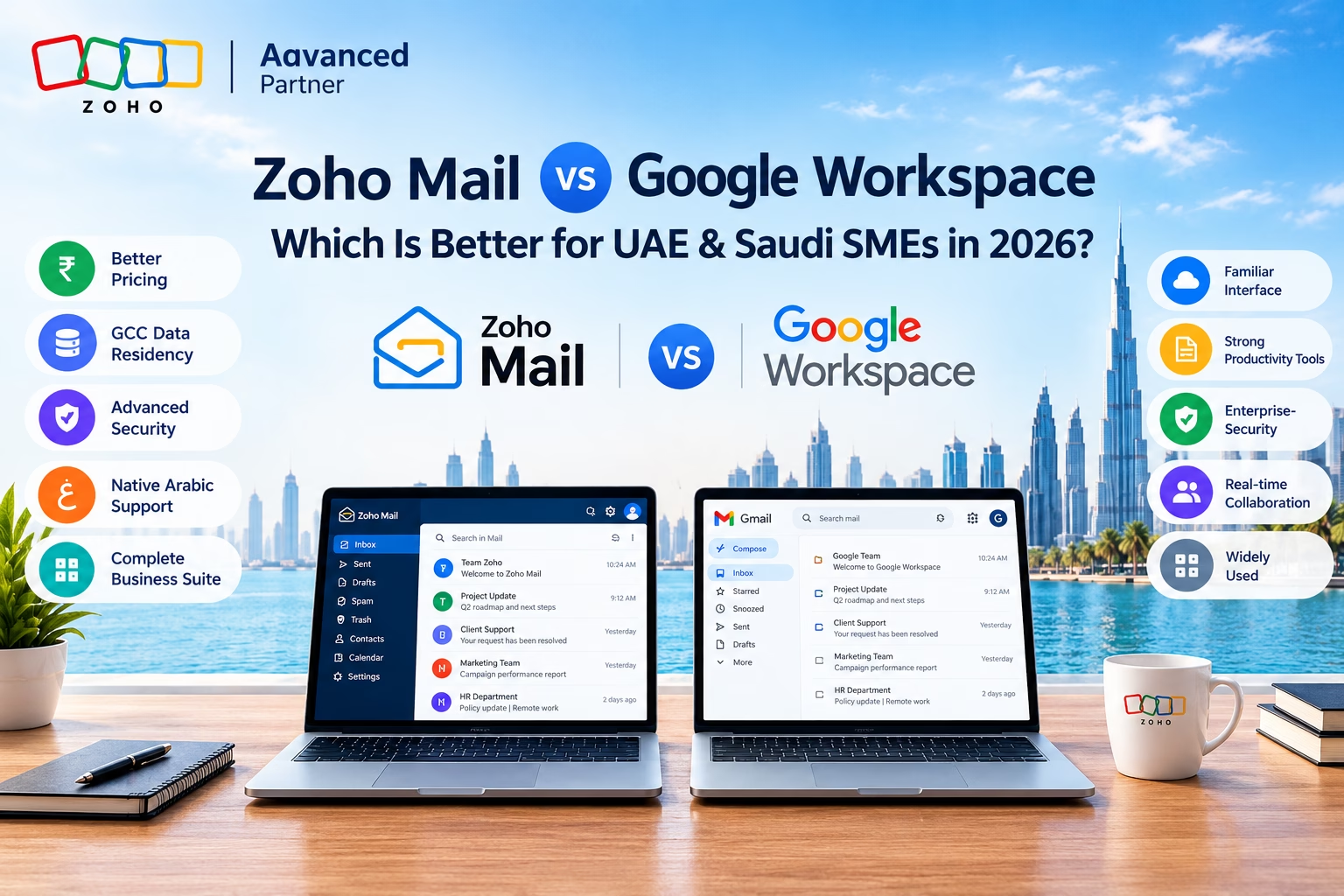
| Every SME in the UAE and Saudi Arabia eventually asks the same question: stick with the familiar Zoho-based Zoho Mail vs Google Workspace, ? This guide compares both platforms on pricing, storage, security, data residency, Arabic support, and long-term cost — so you can decide with real numbers instead of guesswork. |
Why This Comparison Matters for UAE & Saudi SMEs in 2026
Business email is not a minor IT decision. For most SMEs across the UAE, Saudi Arabia, and Bahrain, email is where contracts get negotiated, invoices get sent, and client trust is built or lost. Choosing the wrong platform means overpaying for storage you don’t need. It can also mean missing compliance requirements around data residency, or locking your team into a support model that doesn’t understand the region.
Google Workspace remains the default choice for many businesses simply because Gmail is familiar. But familiarity has a cost. Google Workspace pricing has increased steadily over the past few years, and its storage pooling model can quietly push growing teams into more expensive tiers. Zoho Mail, by contrast, has built a strong reputation in the GCC specifically because it is priced for SMEs. It offers dedicated GCC data centres and integrates directly into a much larger business suite through Zoho One — without forcing a costly jump between tiers.
| 💡 Pro Tip: Google’s 2025–2026 algorithm updates increasingly reward pages that compare real numbers rather than generic feature lists. This guide uses current, publicly listed pricing so you can verify every figure yourself before deciding. |
Zoho Mail vs Google Workspace: Quick Comparison Table
Here is the at-a-glance comparison most UAE and Saudi decision-makers ask for first. Full detail on each row follows below.
| Feature | Zoho Mail | Google Workspace |
| Entry-level plan | Free (up to 5 users, 5GB/user) | No free business tier |
| Cheapest paid plan | Mail Lite — from ~US$1/user/month | Business Starter — from ~US$7/user/month |
| Storage model | Per-user allocation, no pooling tax | Pooled storage, tiers jump fast at scale |
| Data residency in GCC | Dedicated UAE & KSA data centre options | Regional data residency add-on, limited GCC options |
| Ecosystem | Zoho One (55+ apps: CRM, Books, People, Desk) | Google Drive, Docs, Meet, Calendar |
| Arabic / RTL support | Full RTL interface across Mail & suite | Full RTL support in Gmail interface |
| Ad-free / privacy model | No ads, no data mining, ever | No ads on paid Workspace tiers |
| Local implementation partners | Established GCC partner network | Fewer dedicated GCC-focused resellers |
Zoho Mail vs Google Workspace Pricing Comparison: What You Actually Pay Per User
Sticker price rarely tells the full story. Zoho Mail’s paid plans start noticeably lower per user, and its free tier supports up to five users. That is enough for many early-stage businesses to run on real business email at zero cost while they grow. Google Workspace has no comparable free business tier. The entry point is Business Starter, and most SMEs quickly find themselves needing Business Standard for shared drives and larger attachments.
Because list prices change and often vary by billing region, always confirm current numbers directly on the Zoho Mail pricing page and the Google Workspace pricing page before budgeting.
| Plan Type | Zoho Mail / Zoho Workplace | Google Workspace |
| Free tier | Zoho Mail Free — up to 5 users | Not available |
| Entry paid tier | Mail Lite | Business Starter |
| Mid tier (with office suite) | Zoho Workplace Standard | Business Standard |
| Top SME tier | Zoho Workplace Professional | Business Plus |
| Full business suite | Zoho One (Mail + CRM + Books + HR + 50 more apps) | Not offered — Workspace stays email/productivity only |
Storage & Mailbox Limits: Zoho Mail vs Google Workspace
Storage is one of the biggest hidden-cost triggers for growing SMEs. Google Workspace pools storage across an organisation. That sounds generous until one department’s large attachments and Drive files eat into everyone else’s quota, forcing an early upgrade. Zoho Mail allocates storage per user on most plans, which is easier to forecast and budget for a 10–50 person SME.
For most SMEs sending contracts, invoices, and proposals rather than large media files, Zoho Mail’s per-user allocation is more than sufficient. It also avoids paying for pooled terabytes that a small team will never use.
| Plan Level | Zoho Mail Storage | Google Workspace Storage |
| Free / entry | 5GB per user (Free plan) | Not available (no free business tier) |
| Standard business tier | 30–50GB per user, no pooling | 2TB pooled per user (shared across org) |
| Top SME tier | 100GB per user | 5TB pooled per user |
Security & Data Residency for UAE and Saudi Businesses
Data residency has become a board-level concern for regulated industries in the UAE and Saudi Arabia — particularly finance, healthcare, government-adjacent contractors, and any business handling customer PII. This is where the two platforms diverge most clearly.
- Zoho operates dedicated data centres serving the UAE and broader Middle East region, giving businesses a documented path to keeping regional data within the GCC.
- Google Workspace offers data residency as an add-on for larger Enterprise tiers. True regional hosting options for smaller Business tiers are more limited and often require an upgrade.
- Both platforms offer two-factor authentication, encryption in transit and at rest, and admin-level audit logs. Security fundamentals are comparable.
- Zoho Mail includes built-in e-signature, encryption, and a no-ads-ever privacy policy across every plan, including free.
| 💡 Pro Tip: If your business handles government tenders, healthcare records, or financial data in Saudi Arabia or the UAE, ask any vendor directly which physical data centre region your mailbox data will sit in — not just which country your invoice is billed from. This single question eliminates most non-compliant options immediately. |
Arabic Language, RTL Support, and Regional Fit
Both platforms support Arabic and right-to-left (RTL) rendering in their core mail interfaces, so this is not a deciding factor on its own. The real difference shows up in the surrounding business suite. Zoho’s regional ecosystem — through Zoho Workplace and Zoho One — extends Arabic and RTL support across CRM, invoicing, and HR modules commonly used by SMEs across the UAE, KSA, and Bahrain. Google Workspace’s ecosystem (Docs, Sheets, Meet) supports Arabic well, but it stops at productivity tools. There is no equivalent built-in CRM, accounting, or HR suite.
Migration Ease: Moving From Your Current Provider
Both providers offer migration tools for moving from an existing mail server, Microsoft 365, or between each other. In practice, migration complexity depends less on the destination platform. It depends more on mailbox volume, custom domain configuration (SPF, DKIM, DMARC), and whether shared calendars and distribution lists need to be preserved.
- Zoho Mail provides a guided migration wizard plus IMAP-based migration for bulk mailbox moves, commonly handled by a certified partner for anything above 10 users.
- Google Workspace provides its own Data Migration Service, well suited to moving directly from Microsoft Exchange or another Gmail account.
- For SMEs in the UAE or Saudi Arabia running 15+ mailboxes, a supported migration through a local implementation partner reduces downtime risk regardless of which platform you choose.
Beyond Email: Ecosystem and Long-Term Cost of Ownership
This is where the comparison shifts from “which inbox do I prefer” to “which platform grows with my business.” Google Workspace is, and will likely remain, a productivity and email suite. Zoho takes a different approach: Zoho Mail and Zoho Workplace sit inside a much larger ecosystem, Zoho One, which bundles CRM, accounting, HR, helpdesk, and 50+ other business applications under a single per-employee licence.
For an SME that will eventually need a CRM, invoicing software, or an HR system — which is nearly every growing business in the UAE and KSA — starting on Zoho Mail creates a lower-friction path to that full suite later. There is no second migration project or second vendor relationship needed.
Local Support in the UAE and Saudi Arabia
Platform features matter less when something breaks at 5pm on a Thursday before a long weekend. Google Workspace support for Business tiers is largely routed through global support queues, with limited region-specific escalation for smaller plans. Zoho’s SME-focused pricing has attracted a stronger network of certified, GCC-based implementation partners. They provide local, Arabic-speaking support and can be engaged directly for setup, migration, and ongoing administration.
If you already have a Zoho Partner covering the UAE, KSA, and Bahrain, mailbox setup, domain verification, and user onboarding can typically be completed within days rather than weeks. For larger rollouts, working with a partner experienced in Zoho Implementation avoids the most common configuration mistakes — misconfigured SPF/DKIM records, incomplete DMARC policies, and mailbox limits set incorrectly at rollout.
Which One Should You Choose? A Decision Table by Business Type
| If Your Business Is… | Recommended Platform | Why |
| A 1–5 person startup on a tight budget | Zoho Mail (Free plan) | Full business email at zero cost, no card required |
| A regulated business needing GCC data residency | Zoho Mail / Zoho Workplace | Dedicated regional data centre options |
| Heavy Google Docs / Google Meet users already | Google Workspace | Avoids retraining staff on a new productivity suite |
| Planning to add CRM, HR, or accounting within 12 months | Zoho One | One licence, one vendor, no second migration |
| Large team needing 2TB+ shared storage per user | Google Workspace | Pooled storage tiers suit heavy file/media use |
| SME prioritising lowest total cost of ownership | Zoho Mail / Zoho Workplace | Lower per-user pricing across every comparable tier |
Frequently Asked Questions: Zoho Mail vs Google Workspace
Is Zoho Mail cheaper than Google Workspace for a small business?
Yes, in almost every comparable tier. Zoho Mail’s free plan supports up to 5 users, and its paid plans start well below Google Workspace’s Business Starter price. For a 10-person SME, the annual saving is typically enough to fund several months of an implementation partner’s ongoing support.
Can Zoho Mail handle a business domain email like Google Workspace does?
Yes. Zoho Mail supports fully custom domain email (name@yourcompany.com), with the same DNS-based verification process (MX, SPF, DKIM, DMARC) used by Google Workspace. Once verified, the setup and daily user experience are functionally equivalent.
Does Zoho Mail support Outlook and mobile apps?
Yes. Zoho Mail works with Outlook, Apple Mail, and any standard IMAP/POP client, plus dedicated iOS and Android apps. It is not limited to Zoho’s own web interface.
Is my data safer with Google Workspace or Zoho Mail in the UAE and Saudi Arabia?
Both platforms meet standard enterprise security practices — encryption, 2FA, and audit logging. The meaningful difference for GCC businesses is data residency. Zoho offers dedicated data centre options serving the region on lower-cost tiers, while Google Workspace typically requires an Enterprise-level plan for equivalent regional data residency guarantees.
Can I migrate from Google Workspace to Zoho Mail without losing email history?
Yes. Zoho Mail’s migration tools import existing mailbox history, contacts, and folder structures from Google Workspace via IMAP-based migration. For businesses with more than 10–15 mailboxes, running this through a certified partner avoids downtime during the DNS cutover window.
Which platform is better for a business planning to scale across the UAE, KSA, and Bahrain?
Zoho Mail has an edge for multi-country GCC operations. This comes from its regional data centre presence and its established network of local implementation partners covering the UAE, KSA, and Bahrain — useful when different entities need country-specific support and compliance handling.
Zoho Mail or Google Workspace: The Bottom Line for 2026
There is no universally “better” platform — only the better fit for your business stage, budget, and compliance needs. Businesses that are cost-conscious, plan to add CRM or HR tools later, or need GCC data residency will generally find Zoho Mail and the wider Zoho One suite the stronger long-term choice. Businesses deeply embedded in Google Docs, Sheets, and Meet — with no near-term need for a broader business suite — may find staying on Google Workspace the path of least resistance.
Either way, the decision is easier with current numbers in front of you rather than assumptions carried over from a few years ago. Pricing, storage tiers, and regional data centre availability on both platforms have all changed meaningfully since 2023.
Whether you are in Dubai, Abu Dhabi, Sharjah, Riyadh, or Manama, Al Fahad IT Consulting can assess your current setup and recommend the right platform — with real pricing for your exact user count. Contact our team today for a free, obligation-free email platform consultation.
Disclaimer: This article is for informational purposes only and does not constitute professional legal, financial, or IT consulting advice. Pricing and platform features are subject to change. Always verify current figures directly with Zoho or Google before making a decision.
Talk to a Zoho Mail Migration Specialist
Al Fahad IT Consulting is a Zoho Premium Partner with active Zoho Mail and Zoho One implementations across UAE, Saudi Arabia, and Bahrain.
We handle domain verification, DNS records, mailbox migration, and data residency setup aligned to your compliance needs — not a generic template.
Book a free Zoho consultation →
نتحدث العربية. تواصل معنا للحصول على استشارة مجانية حول ترحيل بريدكم الإلكتروني إلى Zoho Mail
Al Fahad IT Consulting is a Zoho Premium Partner and Oracle Partner Network member, providing Zoho implementation services across UAE, Saudi Arabia, and Bahrain.


