
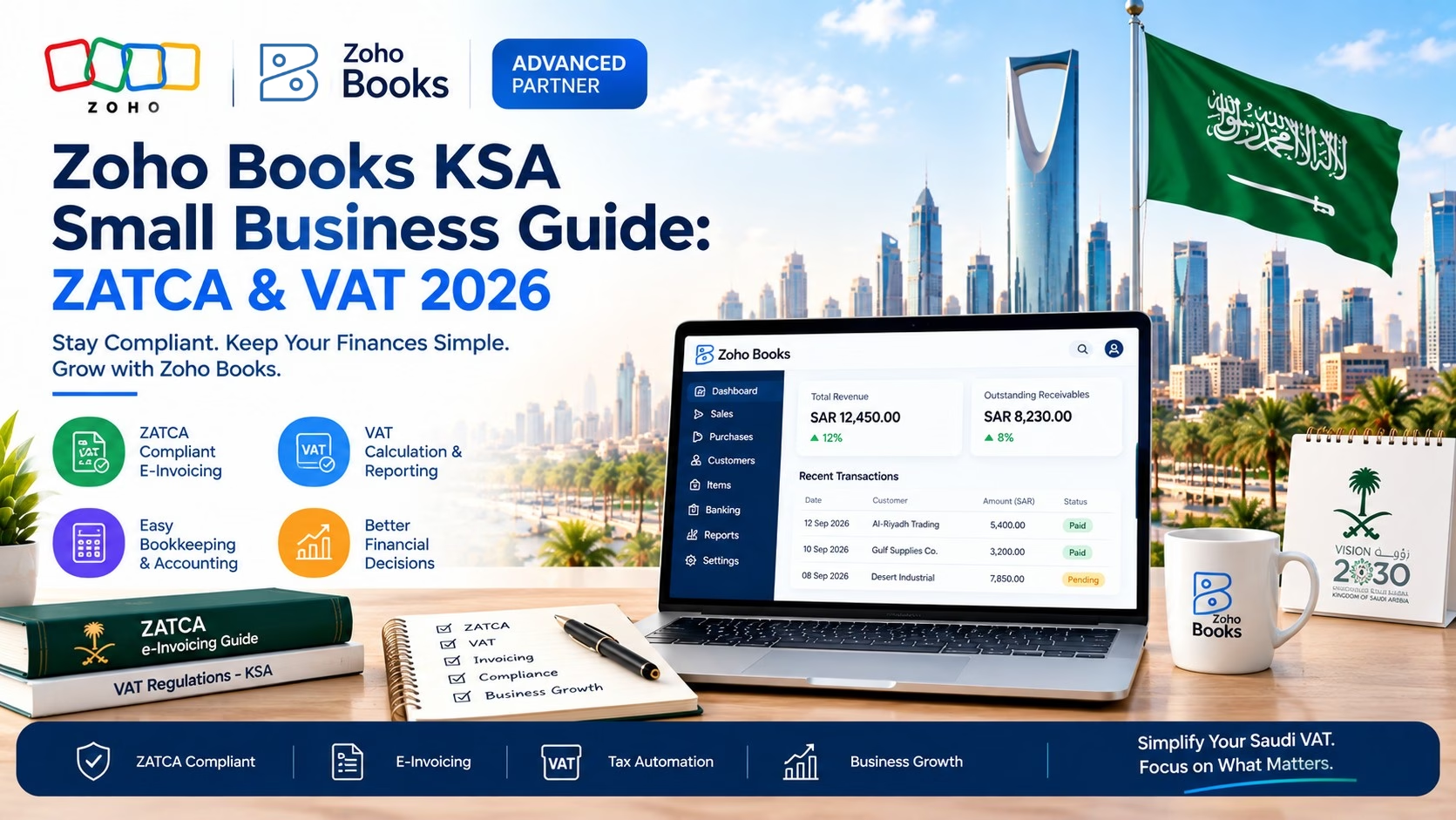
Running Zoho Books KSA small business in Saudi Arabia in 2026 means managing three compliance obligations at once: 15% VAT, ZATCA Phase 2 e-invoicing, and Zakat. All this while still finding time to actually run the business. Most Saudi SMEs handle these through a combination of Excel, a local accountant, and a manual Fatoora submission process that consumes hours every month.
The risk is real. ZATCA’s penalty waiver expired on 30 June 2026. After that date, non-compliant invoices carry penalties of SAR 5,000 to SAR 50,000 per violation. For a business issuing 50 invoices a month, a single misconfigured invoice template is a significant financial exposure.
Zoho Books KSA is ZATCA-approved, Phase 2 certified, and built with a full Arabic interface. It handles bookkeeping, VAT, Fatoora e-invoicing, and Zakat reporting from a single cloud platform. This guide is written for Zoho Books KSA small business owners in Riyadh, Jeddah, Dammam, and beyond, explaining exactly how it works and why it is the right choice.
KSA Financial Compliance in 2026: What Every SME Must Know
| Critical: ZATCA’s penalty waiver initiative ended 30 June 2026. From July 2026, full penalties apply to every non-compliant invoice, regardless of business size. There is no SME exemption. |
| Key Fact | Detail for KSA SMEs |
| VAT Rate | 15% standard rate on most goods and services |
| VAT Registration Threshold | SAR 375,000 annual taxable revenue — mandatory registration |
| Voluntary Registration | SAR 187,500 — optional registration to recover input tax |
| ZATCA Phase 1 | Mandatory from 4 December 2021 — all VAT-registered businesses |
| ZATCA Phase 2 (Fatoora) | Wave-based rollout — applies to virtually all VAT-registered businesses by 2026 |
| Phase 2 Penalty (non-compliance) | SAR 5,000 to SAR 50,000 per violation — ZATCA enforcement active |
| Penalty Waiver | Ended 30 June 2026 — full penalties now apply |
| Zakat (Saudi nationals) | 2.5% on net assets — applicable to Saudi-owned and GCC-owned entities |
| Corporate Tax | 20% on non-Saudi/non-GCC shareholder profit portions |
| Data Residency | Zoho Books KSA edition — data stored in Riyadh & Jeddah data centres |
| Zoho Books Pricing (KSA) | From approximately SAR 56/month (USD 15) — KSA VAT Edition |
| ZATCA Certification | Zoho Books is ZATCA-approved Phase 2 compliant — official Fatoora integration |
What Is Zoho Books KSA small business — And Why Does It Exist?
A Dedicated KSA Edition — Not a Global Product Adapted
Zoho Books KSA small business is not a single global accounting platform with a Saudi Arabia checkbox in settings. The Zoho Books KSA edition is a dedicated configuration built specifically for the Saudi market. It includes ZATCA Phase 2 Fatoora integration, an Arabic RTL interface, 15% VAT calculation, Zakat-relevant reporting, and data stored in Zoho’s local data centres in Riyadh and Jeddah. This matters for Saudi businesses that need data residency compliance under PDPL (Personal Data Protection Law).
Zoho Books KSA small business is listed on Zoho’s official ZATCA-approved software list, verified by the Zakat, Tax and Customs Authority as a compliant Phase 2 e-invoicing solution. For Saudi SMEs, this is the baseline requirement before evaluating any other feature.
Pricing That Works for Zoho Books KSA small business
For small businesses in Riyadh and Jeddah comparing accounting software costs, Zoho Books KSA starts at approximately SAR 56 per month (USD 15). This places it among the most affordable ZATCA-compliant platforms in the Saudi market. For businesses already using Zoho CRM, the integration is native and included — no additional connector cost, no middleware, no separate vendor.
ZATCA Phase 2 Fatoora: How Zoho Books Handles It Automatically
What Phase 2 Actually Requires — In Plain Business Terms
ZATCA Phase 2 goes beyond Phase 1’s requirement to issue electronic invoices. Phase 2 requires real-time integration with the Fatoora portal — meaning B2B invoices must be submitted to ZATCA and cleared before they can be issued to a buyer. B2C simplified invoices must be reported to ZATCA within 24 hours.
Every Phase 2 invoice must include a UUID (unique identifier), a cryptographic digital stamp, a QR code, and conform to ZATCA’s XML technical standard. A PDF of a Word document or an Excel-generated invoice is not compliant, regardless of how many correct fields it contains.
The Zoho Books KSA small business ZATCA Phase 2 Workflow
Every step from invoice creation to Fatoora submission is handled automatically by Zoho Books. The business owner or accountant raises the invoice, and Zoho handles the entire ZATCA compliance workflow in the background.
| Stage | What Happens | Detail | Manual Effort |
| Step 1 | Invoice raised in Zoho Books | UUID, timestamp, and QR code auto-generated | Automatic |
| Step 2 | Cryptographic stamp applied | Digital signature applied per ZATCA standard | Automatic |
| Step 3 | B2B: Clearance submission | Invoice sent to Fatoora portal for real-time clearance before issuance | Automatic |
| Step 4 | B2C: Reporting mode | Simplified invoices batched and reported within 24hrs | Automatic |
| Step 5 | Invoice sent to customer | Arabic/bilingual PDF with QR code delivered by email | One click |
| Step 6 | VAT return compilation | All transactions compiled into ZATCA return format | Automatic |
B2B vs B2C: Separate Invoice Templates Configured Correctly
One of the most common ZATCA Phase 2 errors for Saudi SMEs is using the wrong invoice type code for B2B versus B2C transactions. Standard tax invoices (B2B, above SAR 1,000) use a different ZATCA invoice type code than simplified invoices (B2C).
Zoho Books configures separate invoice templates for B2B and B2C customers. The correct ZATCA invoice type code is automatically applied based on the customer type. This eliminates the systematic rejection error that catches many manually managed businesses during ZATCA audits.
VAT Management for Saudi SMEs: 15% Done Right
Automatic VAT Calculation on Every Transaction
Zoho Books applies 15% VAT automatically to every sales invoice, purchase bill, credit note, and debit note, based on the tax configuration set during implementation. For Saudi SMEs dealing with mixed supplies — standard-rated products, zero-rated exports, and exempt categories — Zoho Books applies the correct rate at the line-item level, not just as a blanket invoice total.
Input Tax Recovery — Maximising Your VAT Position
Every SAR of recoverable input VAT your business fails to claim is money left on the table. For a small business spending SAR 50,000 per month on business expenses, the recoverable input VAT at 15% is SAR 7,500 — SAR 90,000 per year. Zoho Books records VAT on every purchase bill automatically, and the VAT return report shows exactly how much input tax is recoverable in each period.
- Supplier invoices: VAT on all supplier bills is captured and categorised automatically.
- Business expenses: Employee expense claims via Zoho Expense post VAT entries directly into Zoho Books.
- Import VAT (RCM): Reverse Charge Mechanism for imported goods is handled with automatic dual-entry posting — output and input VAT both recorded correctly.
VAT Return Filing — From Weeks to Minutes
Saudi VAT returns are filed monthly for larger taxpayers and quarterly for smaller ones. Compiling the return manually — standard-rated supplies, zero-rated, exempt, imports, and recoverable input tax — from multiple spreadsheets is the task most Saudi SME accountants dread most.
Zoho Books KSA small business produces the VAT return report automatically. All transaction categories are compiled from recorded transactions and mapped to ZATCA’s return format. What previously took an accountant two days of manual compilation now takes under 30 minutes in Zoho Books.
Zakat: What Saudi SMEs Need to Know and How Zoho Books Helps
Who Pays Zakat in Saudi Arabia?
Zakat at 2.5% on net zakatable assets applies to Saudi national-owned and GCC-owned businesses. Non-Saudi shareholders’ profit portions are subject to 20% corporate income tax instead. For mixed-ownership businesses, both obligations apply to their respective shareholder portions — creating a calculation complexity that catches many SMEs unprepared at year-end.
How Zoho Books Supports Zakat Calculation
Zoho Books does not automate Zakat calculation directly. This remains a calculation that requires a qualified Saudi accountant or tax advisor, given its complexity around asset classification, deductions, and business-specific adjustments. However, Zoho Books provides every financial report a Zakat advisor needs to perform the calculation accurately:
- Balance sheet: Net assets, liabilities, and equity — the foundation of Zakat base calculation.
- Fixed asset register: Asset values, depreciation, and book value — Zakat-exempt fixed assets are separated from Zakat-liable working capital.
- Accounts receivable ageing: Outstanding customer debts that form part of the Zakat base.
- Inventory valuation: Stock value at year-end — typically included in the Zakat calculation base.
- Profit and loss statement: Net profit figures required for corporate tax calculation on non-Saudi shareholder portions.
Al Fahad IT Consulting works with certified Saudi tax advisors who use Zoho Books financial reports to produce accurate Zakat calculations for SME clients in Riyadh, Jeddah, and Dammam. Zoho Books ensures the underlying financial data is accurate and audit-ready. The Zakat calculation itself is then performed by a qualified professional.
Zoho Books KSA small business vs Competitors: Honest Comparison for Saudi SMEs
For Saudi SMEs already using or planning to use Zoho CRM for sales and customer management, Zoho Books is the clear choice. The native CRM-to-Books integration alone eliminates significant manual work and reduces VAT errors from the sales-to-invoice process. For SMEs that only need accounting and ZATCA compliance without any broader system integration, Qoyod and Wafeq are strong Arabic-first alternatives worth evaluating.
| Feature | Zoho Books | Qoyod | Wafeq | QuickBooks | Xero |
| ZATCA Phase 2 | ✓ Certified | ✓ Certified | ✓ Certified | ✗ No | ✗ No |
| Arabic Native | ✓ Full RTL | ✓ Arabic-first | ✓ Arabic-first | ✗ None | ✗ None |
| Starting Price | ~SAR 56/mo | ~SAR 99/mo | ~SAR 49/mo | ~SAR 165/mo | ~SAR 165/mo |
| Ecosystem | 40+ Zoho apps | Standalone | Standalone | Limited | Limited |
| CRM Integration | ✓ Native | ✗ 3rd party | ✗ 3rd party | ✓ Native | ✗ 3rd party |
| KSA Data Centre | ✓ Riyadh/Jeddah | ✓ KSA | ✓ KSA | ✗ US | ✗ EU |
| Zakat Support | ✓ Via reports | Limited | Limited | ✗ No | ✗ No |
| Best For | SME + ecosystem | Arabic-first SME | Retail/POS | Enterprise | Global SME |
The Zoho Ecosystem Advantage for Saudi SMEs
Zoho CRM + Zoho Books: Sales to Invoice Without Re-Keying
For Saudi trading companies, distributors, and professional services firms, the connection between sales and finance is where the most manual work — and the most errors — occurs. A sales order confirmed in Zoho CRM flows directly into a ZATCA-compliant draft invoice in Zoho Books. Customer name, VAT number, line items, and 15% VAT are all pre-populated. One click submits it to Fatoora — no re-keying, no wrong VAT rate applied manually.
Zoho Expense: Input VAT Recovery on Every Riyal Spent
Zoho Expense connects to Zoho Books to capture employee receipts digitally — receipt scanning, VAT extraction, approval workflow, and automatic posting as recoverable input tax in Zoho Books. For Saudi SMEs with sales teams, field staff, or regular business travel, this closes the single biggest gap in most manual expense processes: the receipts that never make it to the accountant.
Zoho Inventory: Stock and Finance in One System
For Saudi SMEs in trading, retail, or distribution, Zoho Inventory connects natively to Zoho Books. Goods receipts update inventory valuation and post the purchase entry simultaneously. Sales invoices deduct from stock and post revenue, and VAT on purchases and sales is captured at every transaction. There is no end-of-month reconciliation between a stock system and an accounting system, because they are the same system.
5 Signs Your Saudi SME’s Bookkeeping Setup Is a ZATCA Risk Right Now
- Sign #1: You are still generating invoices in Word, Excel, or non-ZATCA-certified software. Every invoice issued since your Phase 2 wave deadline is potentially non-compliant.
- Sign #2: Your accountant manually compiles your VAT return from multiple sources every quarter. The risk of a missed or miscategorised transaction compounds with every filing.
- Sign #3: You cannot tell, right now, how much input VAT is recoverable in the current period — meaning you are likely filing without claiming everything you are entitled to.
- Sign #4: Your B2B and B2C invoices use the same template — a ZATCA Phase 2 violation that causes systematic invoice rejection at the Fatoora portal.
- Sign #5: Your accounting data is stored on a local computer or a non-KSA server, creating both data loss risk and potential PDPL compliance exposure.
Any two of these represent an immediate, actionable compliance risk — not a theoretical future concern. ZATCA enforcement is active, penalties are real, and the waiver period ended on 30 June 2026.
Frequently Asked Questions
Is Zoho Books KSA small business officially ZATCA-approved for Phase 2 in Saudi Arabia?
Yes. Zoho Books is an officially ZATCA-approved Phase 2 e-invoicing solution, verified by the Zakat, Tax and Customs Authority. It handles the full Fatoora integration workflow — UUID generation, cryptographic stamping, QR codes, real-time clearance for B2B invoices, and reporting mode for B2C simplified invoices. Zoho’s official Saudi Arabia page confirms the certification.
Does Zoho Books KSA small business store Saudi business data inside the Kingdom?
Yes. The Zoho Books KSA edition stores user data in Zoho’s local data centres in Riyadh and Jeddah. This satisfies Saudi Arabia’s PDPL data residency requirements for businesses that must keep customer and financial data within the Kingdom. This is a significant advantage over global accounting platforms like QuickBooks and Xero, which store data in US or EU data centres by default.
Can Zoho Books KSA small business handle both VAT and Zakat for a mixed-ownership Saudi business?
Zoho Books handles VAT calculation, ZATCA e-invoicing, and VAT return reporting fully automatically. For Zakat, Zoho Books provides all the financial reports — balance sheet, asset register, AR ageing, inventory valuation — that a qualified Saudi tax advisor needs to calculate the Zakat base accurately. Al Fahad IT Consulting coordinates with certified tax advisors for clients who require Zakat filing support alongside their Zoho Books implementation.
How long does Zoho Books KSA small business implementation take for a Saudi SME?
A standard Zoho Books implementation for a Saudi SME — including ZATCA Phase 2 configuration, chart of accounts setup, VAT configuration, opening balances, and team training — takes 2 to 4 weeks with Al Fahad IT Consulting. Businesses requiring Zoho CRM integration, Zoho Inventory, or Zoho Expense alongside Books typically go live within 6 to 8 weeks. We handle the full ZATCA Fatoora integration and test it before your go-live date.
My business received a ZATCA Phase 2 wave notification. How quickly can we go live on Zoho Books?
For businesses with an active ZATCA deadline, Al Fahad IT Consulting offers an accelerated Zoho Books KSA implementation. We prioritise ZATCA Phase 2 configuration and Fatoora integration as the first deliverable, with full bookkeeping setup following in parallel. Businesses have gone live on ZATCA-compliant invoicing within 10 to 14 days in urgent cases. Contact our team immediately if you have a near-term ZATCA deadline — do not wait.
Ready to Get ZATCA-Compliant and Simplify Your Saudi Business Bookkeeping?
The ZATCA penalty waiver ended on 30 June 2026. Every VAT-registered Saudi business is now fully in scope — there is no grace period, no SME exemption, and no benefit in waiting. The cost of non-compliance now significantly exceeds the cost of implementing a ZATCA-certified accounting platform.
Zoho Books KSA handles bookkeeping, 15% VAT, ZATCA Phase 2 Fatoora integration, and Zakat-ready financial reporting — all in one platform, in Arabic, with your data stored in the Kingdom. For businesses already on Zoho CRM, it connects natively, eliminating the manual work between sales and finance entirely.
Al Fahad IT Consulting is a certified Zoho Premium Partner with 10+ years of experience and 300+ implementations across UAE, Saudi Arabia, and Bahrain. We configure Zoho Books for full ZATCA Phase 2 compliance, handle the Fatoora integration, and ensure your VAT and bookkeeping setup is correct from day one. We also work with certified Saudi tax advisors for clients who need Zakat filing support. See our detailed ZATCA Phase 2 guide for the full technical breakdown.
Contact our team today for a free Zoho Books KSA consultation — and find out how quickly your business can be fully ZATCA-compliant.
Disclaimer: This article is for informational purposes only and does not constitute professional tax, accounting, or legal advice. ZATCA regulations and Zakat requirements are subject to change. Always verify current obligations directly with ZATCA at zatca.gov.sa or consult a qualified Saudi tax advisor before making compliance decisions.
Talk to a Zoho Books ZATCA Compliance Specialist
Al Fahad IT Consulting is a Zoho Premium Partner with active Zoho Books ZATCA Phase 2 implementations across Riyadh, Jeddah, Dammam, and the wider UAE, Saudi Arabia, and Bahrain region.
We handle Fatoora integration, VAT configuration, chart of accounts setup, and Zakat-ready reporting aligned to your business — not a generic template.
Book a free Zoho consultation →
نتحدث العربية. تواصل معنا للحصول على استشارة مجانية حول تطبيق Zoho Books والامتثال لمتطلبات فاتورة في الرياض وجدة والدمام
Al Fahad IT Consulting is a Zoho Premium Partner and Oracle Partner Network member, providing Zoho Books and ZATCA compliance implementation services across UAE, Saudi Arabia, and Bahrain.


