
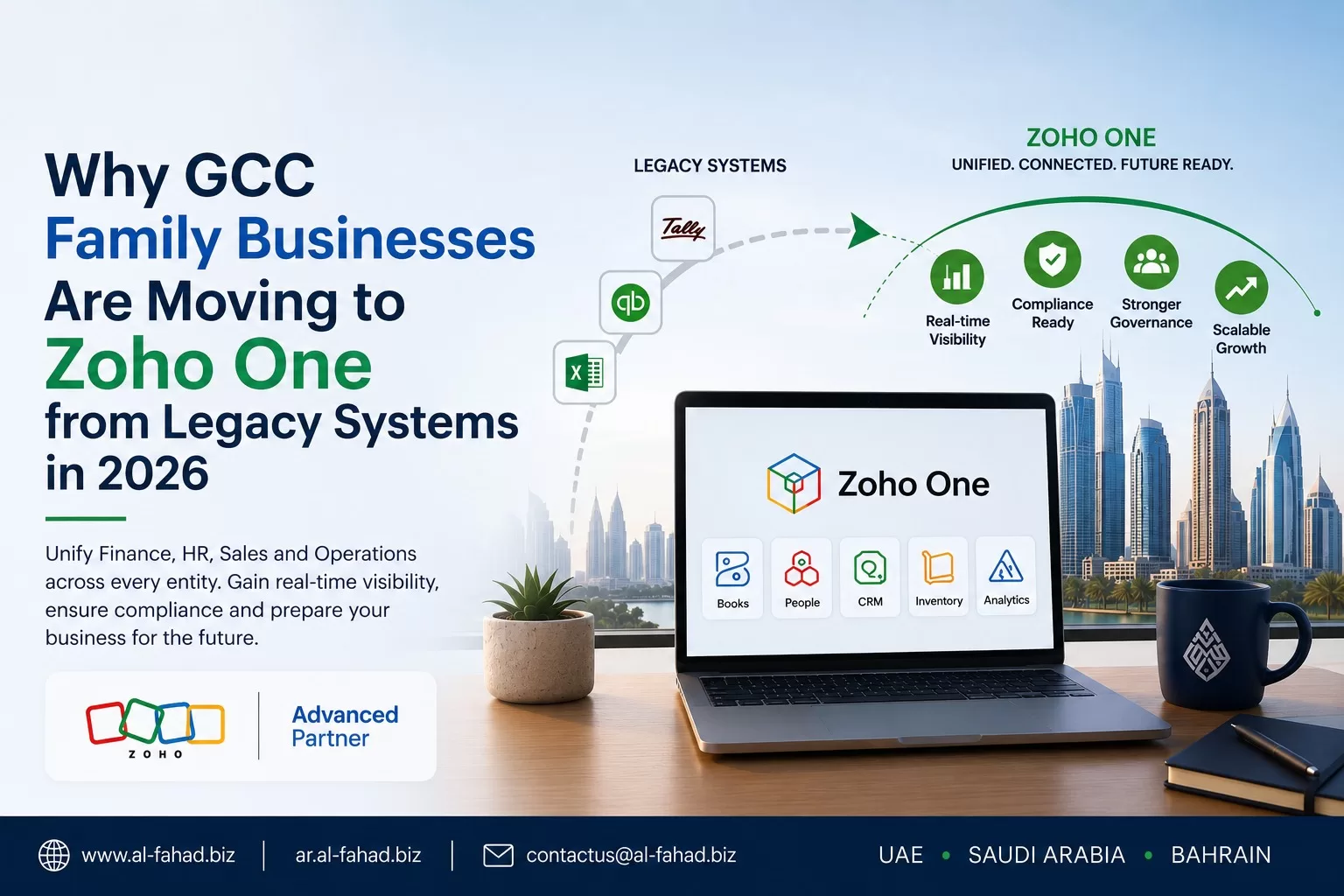
Most GCC family businesses were not built as a single company — they were built as a group. A trading arm, a real estate portfolio, a retail chain, a logistics unit, and a services company, all owned by the same family, all reporting to the same founder or the same second-generation leadership, and all running on whatever system was convenient the year each entity was set up. That is precisely the problem in 2026. A Tally installation from one decade, a QuickBooks Desktop license from another, three Excel trackers rebuilt every quarter, and a standalone HR spreadsheet do not become one business just because the same family owns them.
UAE corporate tax, Saudi Zakat and VAT obligations, and Bahrain’s expanding VAT base now demand consolidated, entity-level financial visibility that legacy point solutions were never designed to deliver. At the same time, a generational handover is underway across a large share of GCC family enterprises, and the incoming generation expects real-time dashboards, not month-end spreadsheet exports assembled by an overworked accountant. The businesses that get this right are not necessarily the largest ones — they are the ones that unify their operations onto a single platform before the next audit, the next expansion, or the next handover forces the issue.
This guide explains why legacy systems are breaking down for multi-entity GCC family businesses in 2026, what governance and compliance pressures are accelerating the shift, and how Zoho One — implemented correctly — replaces a patchwork of disconnected tools with one unified system spanning finance, HR, sales, and operations across every company the family owns.
Legacy Systems vs Zoho One: What Changes for a GCC Family Business
| Key Area | Legacy Setup (Tally, QuickBooks Desktop, Excel, Standalone Tools) | Zoho One (Unified Suite) |
| Multi-entity visibility | Each company keeps its own file; consolidation is a manual, month-end exercise | Single dashboard across every entity, branch, and industry the family operates |
| Finance & tax readiness | Desktop software with limited or no UAE Corporate Tax, KSA Zakat, or Bahrain VAT support | Zoho Books and Zoho Finance Plus built for GCC corporate tax, VAT, and Zakat filing |
| HR & payroll across countries | Separate spreadsheets or local software per country, reconciled manually | Zoho People and Zoho Payroll apply country-specific rules automatically across the UAE, KSA, and Bahrain |
| Data ownership | Files live on individual laptops, USB backups, or a single accountant’s machine | Cloud-based, role-based access with a full audit trail retained centrally |
| Cost of ownership | Multiple software licenses, IT maintenance, and manual reconciliation labour per entity | One subscription covering 45+ integrated applications across the group |
| Reporting for the family council or board | Static spreadsheet exports, often weeks out of date | Live dashboards and Zoho Analytics reports available on demand |
| Scalability for new entities | A new company means a new software setup from scratch | A new entity is added inside the same Zoho One organization in days |
Note: Corporate tax, VAT, and Zakat rules continue to evolve across the GCC. Family businesses should confirm current thresholds and filing requirements with the UAE Federal Tax Authority, Saudi Arabia’s ZATCA, or Bahrain’s National Bureau for Revenue before finalising any tax configuration.
Why Legacy Systems Are Breaking Down for GCC Family Conglomerates in 2026
A single-entity SME can often survive on Excel and a desktop accounting package for years. A family business rarely can, because it is not really one business — it is several, under one ownership structure, frequently spanning more than one GCC country. The systems that were adequate when the group had one or two companies start to fail once a third, fourth, or fifth entity is added, and by 2026, the compliance environment has made that failure visible in ways it was not five years ago.
▌ One Family, Five Companies, Twelve Disconnected Systems
It is common for a mid-sized GCC family group to be running a different accounting file for every trading entity, a separate HR spreadsheet for every branch, and a CRM — if one exists at all — that only one of the companies actually uses. Sales data from the retail arm never reaches the finance team managing the real estate portfolio. An employee who transfers between two family-owned companies is treated as a brand-new hire in the HR system, losing their service history for end-of-service benefit calculations. None of this is a single dramatic failure; it is a slow accumulation of blind spots that surfaces at the worst possible moment — during an audit, a bank facility review, or a due-diligence exercise ahead of a family investment.
▌ Corporate Tax, VAT and Regulatory Reporting Legacy Tools Were Never Built For
Since UAE Corporate Tax took effect under Federal Decree-Law No. 47 of 2021, every group entity above the revenue threshold must file a return that reflects its actual, entity-level financial position — and related-party transactions between family-owned companies fall under transfer pricing scrutiny. Desktop accounting software bought a decade ago was never built for this. It was built to record transactions, not to produce the consolidated, entity-level, tax-ready reporting that the Federal Tax Authority, ZATCA in Saudi Arabia, or Bahrain’s National Bureau for Revenue now expects. A spreadsheet-based group cannot easily prove, on demand, which entity a transaction belongs to, what its related-party exposure is, or how its numbers reconcile with the group total — and increasingly, that is exactly what gets asked for.
The Generational Pressure Point: Handover, Governance and Digital Trust
Legacy systems are a technology problem, but for most GCC family businesses, the deeper driver of change in 2026 is generational. Saudi Arabia’s Family Business Governance Regulations and the UAE’s growing set of family-business governance frameworks are pushing founder-led groups toward formal structures — family councils, boards, documented charters — and those structures cannot function on data that only one long-serving accountant fully understands.
▌ When the Next Generation Takes Over, Spreadsheets Don’t Scale
Second- and third-generation family members stepping into leadership roles have typically worked inside modern, cloud-based systems elsewhere before joining the family business. They expect to open a dashboard and see live numbers across every company the family owns — not to wait for a finance manager to consolidate five separate files at month-end. When that expectation collides with a legacy Excel-and-Tally environment, the result is either a rushed, poorly planned system migration during a leadership transition, or a next generation that quietly loses confidence in the numbers they are handed.
▌ Board and Family Council Reporting Needs Real-Time Numbers, Not Month-End Exports
As GCC family businesses formalise governance — appointing independent board members, setting up family councils, documenting a family charter — those bodies need financial and operational reporting that is accurate the day it is requested, not reconstructed for a quarterly meeting. A unified platform that produces the same numbers whether the family council asks for them in January or June builds a level of institutional trust that a spreadsheet, however carefully maintained, cannot replicate.
What Zoho One Actually Replaces in a Typical GCC Family Business
Zoho One is not a single application — it is a suite of 45+ integrated apps covering finance, HR, sales, marketing, projects, and operations, licensed once across the entire organization. For a family business running multiple entities, that structure maps directly onto how the group actually operates.
▌ From Tally and QuickBooks Desktop to Zoho Books and Zoho Finance Plus
Each family-owned entity gets its own organization inside Zoho Books, with its own chart of accounts, VAT or corporate tax configuration, and audit trail — while Zoho Finance Plus and Zoho Analytics roll the numbers up into a single, group-level view whenever ownership needs it. Inter-company transactions between family entities are recorded consistently rather than reconstructed manually at year-end.
▌ From Excel HR Trackers to Zoho People and Zoho Payroll
Employees who move between family-owned entities carry their service history with them instead of resetting it, which matters directly for end-of-service gratuity calculations under UAE, Saudi, and Bahrain labour law. Zoho Payroll applies the correct country-specific WPS, GOSI, SIO, and gratuity rules automatically, replacing the separate local spreadsheets each entity previously maintained on its own.
▌ From Disconnected Sales Registers to Zoho CRM Plus
Instead of each business unit tracking customers in its own way — or not tracking them at all — Zoho CRM Plus gives the family a single, group-wide view of leads, accounts, and customer history, with the option to keep each entity’s pipeline separate while ownership still sees the combined picture.
Signs Your Family Business Has Outgrown Its Legacy Systems
- Sign #1: Closing the books for the group takes more than a week because every entity’s numbers arrive in a different format.
- Sign #2: An employee’s service history resets when they transfer between two companies the family owns.
- Sign #3: The finance team cannot produce an entity-level, tax-ready report without rebuilding it manually from several files.
- Sign #4: Only one or two long-serving staff members fully understand how the current systems fit together.
- Sign #5: The next generation has already raised concerns about visibility, reporting speed, or data reliability.
If two or more of these apply, it is worth reviewing how your group’s systems are structured before the next audit, expansion, or leadership transition — not after one exposes the gap.
How Al Fahad IT Consulting Helps GCC Family Businesses Migrate to Zoho One
Al Fahad IT Consulting is a certified Zoho Premium Partner with offices in Dubai and Dammam, and more than a decade of experience implementing Zoho across the UAE, Saudi Arabia, and Bahrain. We understand that a family business is not one company to migrate — it is a group of entities, each with its own history, staff, and habits, that need to move onto one platform without disrupting daily operations.
- Multi-Entity Structure Mapping: We map every company, branch, and business line the family operates before designing how they sit inside a single Zoho One organization.
- Legacy Data Migration: We migrate historical data out of Tally, QuickBooks Desktop, and Excel trackers into Zoho Books and Zoho Finance Plus without losing transaction history.
- Corporate Tax, VAT & Zakat Configuration: We configure each entity for its current UAE Corporate Tax, KSA VAT/Zakat, or Bahrain VAT obligations from day one.
- Governance-Ready Reporting: We build Zoho Analytics dashboards designed for family council and board reporting, so the numbers are accurate on demand, not reconstructed for each meeting.
- Arabic + English Training: Full training for finance, HR, and operations teams across every GCC location, delivered locally, with ongoing post-go-live support.
Contact our team today for a free Zoho One consultation tailored to your family business — whether you operate in Dubai, Abu Dhabi, Riyadh, or Manama.
Frequently Asked Questions
Q1: Why are GCC family businesses specifically moving to Zoho One rather than a single accounting upgrade?
Because the underlying problem is rarely a single company’s accounting software — it is the lack of a shared platform across every entity the family owns. Zoho One licenses the entire suite once for the whole organization, which fits a multi-entity family structure better than upgrading each company’s software separately.
Q2: Can each family-owned entity keep its own separate books inside Zoho One?
Yes. Each entity operates as its own organization inside Zoho Books with its own chart of accounts, VAT or corporate tax configuration, and records, while ownership can still view consolidated, group-level reporting through Zoho Analytics and Zoho Finance Plus.
Q3: Does Zoho One help with UAE Corporate Tax and Saudi Zakat compliance?
Zoho Books and Zoho Finance Plus are configured to support UAE Corporate Tax, VAT, Saudi Zakat and VAT, and Bahrain VAT reporting at the entity level, which is essential for a family group filing separately for each company it owns. Businesses should still confirm current requirements with the relevant tax authority for each jurisdiction.
Q4: How long does a legacy-to-Zoho One migration typically take for a multi-entity family business?
It depends on the number of entities, the state of existing data, and how many countries are involved, but a phased migration — starting with one or two entities before rolling out across the group — is the most reliable approach for a family business that cannot pause daily operations during the switch.
Q5: Is Zoho One suitable for a family business that is still run largely by the founding generation?
Yes. Zoho One works for founder-led groups just as it does for businesses already going through generational transition — the difference is usually how much governance and reporting structure is configured on top of it. Many family businesses migrate to Zoho One specifically to build that structure ahead of a planned handover, rather than during one.
Ready to Move Your Family Business to Zoho One?
Legacy systems that worked for a single company rarely work for a group of family-owned entities operating across the UAE, Saudi Arabia, and Bahrain in 2026 — and the gap shows up exactly when it matters most: at tax filing, during an audit, or at the point of generational handover. Zoho One replaces that patchwork with one platform, covering finance, HR, sales, and operations across every entity the family runs, without asking any single company to give up its own books or its own way of working.
Whether you are based in Dubai, Abu Dhabi, Riyadh, or Manama, Al Fahad IT Consulting brings the multi-entity Zoho implementation experience to move your family business off legacy systems the right way. Contact our team today for a free, obligation-free Zoho One consultation.
Disclaimer: This article is for informational purposes only and does not constitute professional tax, legal, or governance advice. Corporate tax, VAT, and Zakat rules continue to evolve across the GCC. Always verify current requirements with the relevant tax authority or a qualified advisor before making compliance decisions.
Talk to a Zoho One Family Business Specialist
Al Fahad IT Consulting is a Zoho Premium Partner with active multi-entity Zoho One implementations for family businesses across UAE, Saudi Arabia, and Bahrain.
We map your group structure, migrate legacy data, and configure governance-ready reporting aligned to how your family business actually operates: not a generic template.
Book a free Zoho consultation →
نتحدث العربية. تواصل معنا للحصول على استشارة مجانية حول نقل أعمال عائلتك إلى نظام Zoho One الموحد
Al Fahad IT Consulting is a Zoho Premium Partner and Oracle Partner Network member, providing Zoho implementation services across UAE, Saudi Arabia, and Bahrain.


