
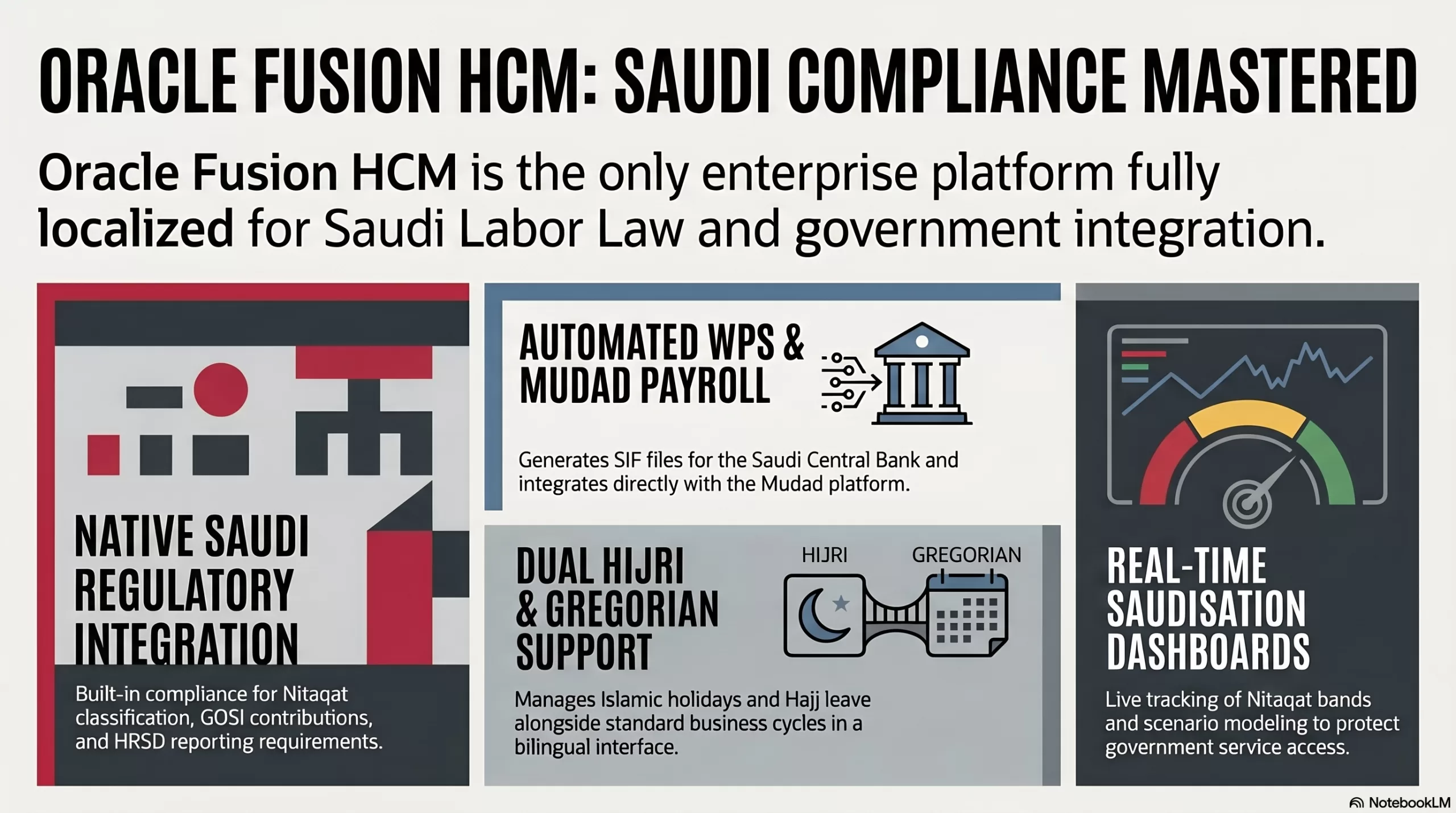
If you manage HR in Saudi Arabia, you already know that local workforce compliance is not simple.
Nitaqat bands. GOSI contributions. Saudi Wage Protection System. Hijri calendar leave. HRSD reporting. Qiwa labour contracts. Each one requires a specific system configuration. Each one carries penalties when it is wrong.
Standard HR software does not handle any of this well. Oracle Fusion HCM modules in Saudi Arabia are built for exactly this kind of complexity. They work as intended only when configured correctly for the Saudi market.
This guide explains every Oracle Fusion HCM module, what it does, and why it matters specifically for HR teams in Saudi Arabia.
Why Saudi Arabia Needs a Different HCM Approach
Most HR software is designed for Western employment markets. It handles leave, payroll, and performance reviews.
Saudi Arabia demands more. Vision 2030 has accelerated the formalisation of the private sector. Businesses must now track Saudisation percentages, report to government platforms, and manage a workforce split between Saudi nationals and expatriates. Each group has different payroll rules, leave entitlements, and compliance obligations.
Oracle HCM Saudi Arabia is the enterprise platform that covers all of this in one system. The difference between a standard Oracle HCM deployment and a properly configured Saudi one is significant.
Here is what changes when the system is built for Saudi Arabia:
- Nitaqat (Saudisation) classification bands configured per activity sector
- GOSI contribution calculations for Saudi nationals and expatriates
- Saudi WPS Mudad integration for compliant wage transfer
- Hijri calendar support for Islamic public holidays and leave accruals
- Qiwa platform integration for Saudi labour contract management
- HRSD reporting output aligned to the Ministry of Human Resources requirements
- Arabic-first interface with bilingual English support
The Oracle Fusion HCM Module Map
Oracle Fusion HCM is not a single application. It is a suite of interconnected modules that cover specific parts of the workforce lifecycle.
| Module | What It Covers |
| Core HR | Employee records, organisation structures, positions |
| Payroll | Salary processing, WPS, GOSI, EOSB calculations |
| Absence Management | Leave policies, Hijri calendar, and accrual rules |
| Talent Management | Performance, succession, competency frameworks |
| Workforce Planning | Headcount modelling, Saudisation targets |
| Recruiting | Vacancy management, candidate tracking, and onboarding |
| Learning | Training records, development programmes |
| HR Analytics | Dashboards, compliance reports, workforce insights |
Each module connects to the others. A hire in Recruiting creates a record in Core HR. That record feeds Payroll. Absence data flows into Payroll calculations. Performance data informs Workforce Planning. The system works as a whole, not as separate tools.
Core HR: Your Workforce Foundation
Core HR is where every employee’s data lives. Get this wrong, and every other module suffers.
Oracle HCM modules in Core HR cover:
- Employee master records: personal data, employment history, contract type
- Organisation structure: legal entities, business units, departments, positions
- Grade and salary band configuration aligned to the Saudi labour market structures
- Document management: iqama tracking, labour card renewals, passport expiry alerts
- Contract type management: Saudi fixed-term and indefinite contract configurations
- Localised fields for Saudi national ID, iqama number, and sponsor details
Why This Matters for Saudi HR Teams
Saudi Arabia’s workforce is split between nationals and expatriates. Each group has different legal entitlements, different ID documentation requirements, and different payroll treatment.
Core HR in Oracle HCM Riyadh and Jeddah deployments must reflect this split from the first day of configuration. Building it correctly at the start prevents costly data corrections later.
Payroll: Saudi Compliance Built In
Payroll is the highest-stakes module in any Saudi HR system. Get it wrong, and employees do not get paid correctly. Get the WPS file wrong, and the business faces Central Bank sanctions.
Oracle Payroll Saudi Arabia configuration covers every compliance layer:
Saudi Wage Protection System (WPS)
- WPS Mudad platform integration for compliant wage transfer
- SIF file generation in the format required by the Saudi Central Bank
- Automated submission tracking with confirmation status from Mudad
- Payroll calendar alignment to Saudi pay cycle requirements
GOSI Contributions
- GOSI (General Organisation for Social Insurance) contribution calculation for Saudi nationals: 9% employee, 9% employer on base salary and housing allowance
- GOSI contribution for expatriates: 2% employer only, on basic salary
- Automated GOSI file generation for monthly submission
- GOSI payment reconciliation against payroll ledger entries
End of Service Benefits
- EOSB (End of Service Benefit) calculation aligned to Saudi Labour Law
- Accrual tracking for both Saudi nationals and expatriate employees
- Resignation versus termination calculation differences are handled automatically
- EOSB provision entries connected to Oracle Financials for accurate liability reporting
Allowance Structures
Saudi Labour Law defines minimum allowance requirements. The Oracle payroll module handles:
- Housing allowance configuration at market-standard percentages
- Transport allowance setup
- Allowance structures aligned to collective agreements in specific sectors
- Allowance treatment in GOSI base salary calculations
Absence Management: Hijri Calendar and Beyond
Leave management in Saudi Arabia is more complex than in most countries. Two calendar systems. Distinct leave types. Religious observance entitlements. Public holidays that shift each year.
Oracle HCM Cloud Absence Management handles all of this:
Dual Calendar Support
- Gregorian calendar for standard business reporting and payroll cycles
- Arabic Hijri calendar for Islamic public holidays and Hajj leave
- Dual calendar display for managers and employees in self-service
- Automatic public holiday updates for Saudi Arabia each year
Leave Types Configured for Saudi Labour Law
| Leave Type | Saudi Labour Law Entitlement |
| Annual Leave | 21 days (first 5 years), 30 days thereafter |
| Sick Leave | 30 days full pay, 60 days half pay, 30 days unpaid |
| Maternity Leave | 10 weeks full pay |
| Paternity Leave | 3 days paid |
| Hajj Leave | Once per employment, paid, for Saudi nationals |
| Bereavement Leave | 3 days (spouse or child), up to 3 days for other family members |
| Examination Leave | For approved educational programmes |
Accrual Rules and Proration
- Leave accrual calculated on the Gregorian or Hijri calendar per policy
- Proration for joiners and leavers mid-period
- Encashment calculations at the end of service are connected to EOSB module
- Manager and employee self-service approval workflows in Arabic and English
Talent Management: Performance and Succession
Saudi Arabia’s Vision 2030 workforce strategy is not just about headcount numbers. It is about building Saudi national capability in private-sector roles previously dominated by expatriates.
Oracle talent management gives HR directors and business leaders the tools to manage that transition systematically.
Performance Management
- Appraisal cycle configuration with Arabic and English review forms
- Competency frameworks aligned to Saudi sector requirements
- Goal-setting connected to business unit objectives and Vision 2030 targets
- Continuous feedback tools for year-round performance conversations
- Ratings calibration workflows to ensure consistency across business units
Succession Planning
- Bench strength mapping for leadership and critical roles
- High-potential employee identification and tracking
- Saudi national succession pipelines to support Saudisation progression
- Career development plans linked to Nitaqat band improvement targets
Learning and Development
- Training record management for mandatory and developmental programmes
- Completion tracking for compliance training linked to regulatory requirements
- Learning paths tied to career development and succession plans
- Arabic-language course content support
Workforce Planning: Saudisation and Nitaqat
This is the module that matters most for businesses operating in Saudi Arabia right now.
Nitaqat is Saudi Arabia’s Saudisation programme. It assigns businesses a classification band: Platinum, Green, Yellow, or Red. The band is based on the percentage of Saudi nationals in the workforce. The band determines which government services the business can access, including visa renewals and new-hire permits.
Oracle Human Capital Management Workforce Planning gives HR directors and compliance teams real-time visibility into Nitaqat status.
What Oracle Workforce Planning Covers for Nitaqat
- Nitaqat classification band configuration per activity sector and business size
- Real-time Saudisation percentage dashboard by legal entity and department
- Automated alerts when a planned hire or departure changes the Nitaqat band
- Variance reporting: actual Saudisation versus target band threshold
- Scenario modelling: what happens to the Nitaqat band if we hire 10 expatriates this quarter?
- HRSD submission-ready reports for Ministry of Human Resources filings
Qiwa Platform Integration
Qiwa is Saudi Arabia’s government digital platform for labour contract management. Oracle HCM integrates with Qiwa for:
- Saudi labour contract creation and digital submission
- Contract amendment and renewal tracking
- Employee transfer requests between entities
- Labour dispute management workflows
For Oracle HCM Dammam and Eastern Province businesses in the petrochemical and industrial sectors, Qiwa integration is particularly critical given the volume of contractor and seasonal workforce management involved.
Recruiting: Hiring for Saudisation Targets
Every hire in Saudi Arabia has Nitaqat implications. Recruiting the wrong ratio of nationalities can push a business into a lower Nitaqat band.
Oracle Recruiting Cloud connects talent acquisition directly to Oracle Fusion HCM modules and Saudi Arabia workforce planning data, so hiring managers can see the Nitaqat impact of each open vacancy before they post it.
Oracle Recruiting Capabilities for Saudi Arabia
- Arabic and English job posting with bilingual candidate communication
- Taqat platform integration for Saudi national candidate sourcing
- Nationality-aware vacancy management showing Nitaqat impact of each hire
- Offer management with Saudi Labour Law-compliant contract terms
- Onboarding workflows connected to Core HR for immediate Nitaqat count update
HR Analytics: Visibility Across the Workforce
Data that sits in HR systems but never reaches decision-makers is wasted.
Oracle HCM Cloud Analytics converts your workforce data into dashboards and reports that HR directors, CFOs, and business leaders can use to make decisions.
Key Analytics Capabilities for Saudi HR Teams
- Saudisation percentage by department, legal entity, and activity sector
- GOSI contribution liability reporting connected to finance systems
- Headcount trend analysis by nationality, grade, and business unit
- Attrition analysis: who is leaving, from which departments, and why
- Payroll cost per employee and per department
- Leave balance liability reporting for end-of-service financial provisioning
- Vision 2030 workforce KPI dashboards for board-level reporting
Oracle HCM Jeddah businesses in trading and hospitality use attrition and seasonal headcount analytics more than almost any other dashboard feature, given the high workforce turnover in these sectors.
Oracle Fusion HCM Modules in Practice: Saudi Industry Context
Different industries in Saudi Arabia use Oracle HCM modules in different ways. Here is how the most active sectors apply the platform:
| Industry | Primary Modules Used | Key Saudi Requirement |
| Construction and Contracting | Core HR, Payroll, Absence, Workforce Planning | Nitaqat tracking across multiple project sites and subcontractors |
| Financial Services (Riyadh) | Core HR, Payroll, Talent, Analytics | CBB and SAMA compliance, high-value employee succession planning |
| Hospitality and Tourism | Absence, Payroll, Recruiting | Seasonal headcount, Hajj and Umrah staffing cycles |
| Oil and Gas Supply Chain (Dammam) | Core HR, Workforce Planning, Payroll | Contractor management, Nitaqat exemptions, multi-site operations |
| Retail and Distribution | Recruiting, Absence, Payroll | High turnover, bilingual workforce, WPS compliance at scale |
| Government and Semi-Government | Core HR, Analytics, Talent | Saudisation leadership pipeline, HRSD reporting |
Getting Oracle HCM Right in Saudi Arabia
The modules are only as good as the configuration behind them.
An Oracle HCM Saudi Arabia deployment configured without Saudi labour law expertise results in a system that looks like Oracle HCM but behaves like a generic HR tool. The Nitaqat dashboards show wrong numbers. The WPS files fail validation. The Hijri calendar leave accruals are calculated incorrectly.
Correct configuration requires consultants who understand both the Oracle platform and Saudi Arabia’s regulatory environment from direct project experience.
Al Fahad IT Consulting delivers Oracle HCM cloud implementation across Saudi Arabia, the UAE, and Bahrain. Our Saudi HCM practice covers every module in this guide, configured to the compliance and operational requirements described above.
Every project follows the structured Oracle ERP implementation methodology that governs all Al Fahad Oracle engagements, from Discovery through to AMS support.
Frequently Asked Questions
Which Oracle Fusion HCM module handles Saudisation compliance?
Workforce Planning is the primary module for Saudisation and Nitaqat compliance. It provides real-time Saudisation dashboards, automated band-status alerts, and HRSD-ready reporting outputs. The Recruiting module also helps by showing Nitaqat’s impact before each hire. Oracle Fusion HCM modules in Saudi Arabia are specifically configured to reflect your activity sector’s Nitaqat classification requirements.
Does Oracle HCM integrate with the Saudi WPS Mudad platform?
Yes. The Oracle Payroll module integrates with Saudi WPS Mudad for compliant wage transfer. The integration generates the required SIF file, submits it to Mudad, and tracks confirmation status. This is a dedicated configuration workstream in every Oracle HCM Saudi Arabia implementation at Al Fahad, not an optional add-on.
How does Oracle HCM handle the Hijri calendar in Saudi Arabia?
The Absence Management module supports both Gregorian and Hijri calendars simultaneously. Hijri calendar configuration covers Islamic public holidays, Hajj leave entitlements, and leave accrual rules tied to the Islamic calendar. HR teams and employees can view leave balances in either calendar format through the self-service portal.
Can Oracle HCM handle both Saudi national and expatriate payroll in one system?
Oracle HCM Cloud supports separate payroll rules for Saudi nationals and expatriates within the same system instance. GOSI contribution rates differ between the two groups. EOSB calculations differ. Allowance structures differ. Oracle Payroll handles all of these differences within a unified payroll run, with separate reporting streams for compliance purposes.
How long does an Oracle HCM implementation take for a Saudi business?
A Saudi Oracle HCM implementation covering Core HR, Payroll, and Absence Management typically takes four to six months. Adding Talent Management, Workforce Planning, and Recruiting extends the timeline to seven to ten months.
A detailed breakdown of what this means for your budget is available in our guide on Oracle ERP system cost in the UAE. The cost principles apply equally to Saudi Arabia HCM projects.
Is Oracle HCM used across other GCC markets beyond Saudi Arabia?
Oracle HCM deployments are common across Dubai, Abu Dhabi, and the UAE’s free zones. The primary compliance drivers there are Emiratisation, UAE Labour Law, EOSB, and WPS SIF file generation. Each requires a specific Oracle Payroll and HCM configuration that differs meaningfully from the Saudi Arabia compliance framework described in this guide.
Oracle HCM Bahrain projects in Manama’s financial district focus on SIO contributions, Bahrainisation tracking, and CBB-aligned HR governance. The modules are the same across all markets. The compliance configuration within each module changes.
Schedule an Oracle HCM Demo for Your Saudi Arabia Business
Seeing the modules in action is different from reading about them.
Understanding Oracle Fusion HCM modules in practice in Saudi Arabia means watching Nitaqat dashboards update in real time. Seeing them configured for your industry, your Nitaqat band, and your workforce structure is another.
Al Fahad IT Consulting provides Oracle HCM demonstrations tailored to Saudi Arabian businesses. The demo uses GCC-specific data, Saudi compliance scenarios, and your actual organisation structure. No generic global templates.
Working with a certified Oracle partner network in the UAE and Saudi Arabia means your implementation is backed by Oracle’s own certification programme.
نتحدث العربية. تواصل معنا عبر واتساب لجدولة عرض توضيحي لنظام أوراكل HCM
Al Fahad IT Consulting is an Oracle Partner Network member and Zoho Premium Partner, providing Oracle Fusion implementation services across the UAE, Saudi Arabia, and Bahrain.


