
Your Oracle Fusion system is live. Now the real question begins.
How does it talk to your Saudi WPS payroll platform? Your ZATCA e-invoicing portal? Your 3PL warehouse system in JAFZA? Your UAE bank for automated reconciliation?
Oracle ERP does not operate in isolation. Every GCC business runs Oracle alongside a stack of local systems, government portals, and third-party applications. Getting these systems to exchange data cleanly, without manual rekeying, errors, or breaks when someone updates a field, is what Oracle Cloud Integration solves.
This guide explains how Oracle Integration Cloud works, what it connects to, and what a real integration project looks like in UAE, Saudi Arabia, and Bahrain.
What Is Oracle Integration Cloud?
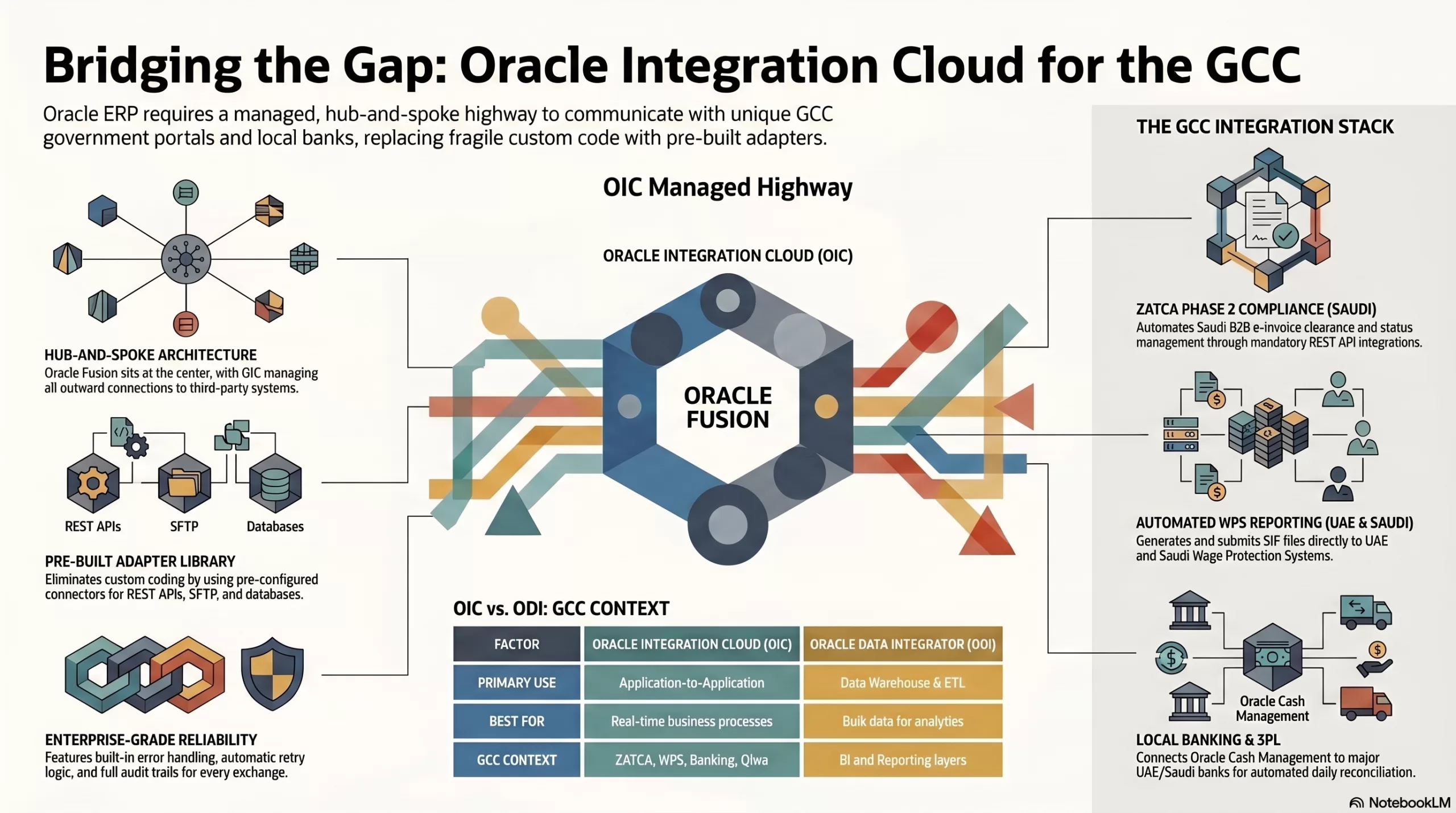
OIC stands for Oracle Integration Cloud. It is Oracle’s dedicated platform for connecting Oracle Fusion to other systems. Oracle Integration Cloud gives IT teams a structured, managed way to handle every integration, rather than building and maintaining point-to-point connections independently.
Think of OIC as a managed highway between Oracle and the rest of your technology stack.
Data travels in both directions:
- Orders flow from Oracle Order Management to your 3PL
- Payroll data flows from Oracle HCM to your WPS provider
- Invoice data flows from Oracle Financials to the ZATCA Fatoorah portal
- ZATCA clearance status flows back into Oracle
OIC is not a custom development tool. It is a managed platform with:
- Pre-built adapters for hundreds of common applications and services
- Visual workflow design tools for mapping data between systems
- Built-in monitoring and error handling
- Automatic retry logic when connections fail
- Audit trails showing every data exchange
For IT managers in Oracle integration in UAE and Saudi Arabia businesses, OIC eliminates the fragile point-to-point integrations that accumulate over the years and eventually break at the worst possible moment.
Why GCC Businesses Need Oracle Integration More Than Most
Standard Oracle documentation covers global integration patterns. It does not cover the integrations that GCC businesses actually need.
The GCC Integration Stack
Every serious Oracle deployment in UAE, Saudi Arabia, or Bahrain sits alongside a set of local systems that do not exist in Western markets:
| Local System | Country | What It Does |
| ZATCA Fatoorah Portal | Saudi Arabia | B2B e-invoice generation, submission, and clearance |
| Saudi WPS Mudad | Saudi Arabia | Wage transfer validation and compliance reporting |
| Qiwa Platform | Saudi Arabia | Labour contract management and Saudisation tracking |
| UAE Central Bank WPS | UAE | Wage Protection System SIF file submission |
| FTA Portal | UAE | VAT return filing and tax compliance reporting |
| CBB Regulatory Reporting | Bahrain | Central Bank of Bahrain compliance submissions |
| Local Banking Platforms | All Markets | Payment file generation and bank reconciliation feeds |
| 3PL and WMS Systems | All Markets | Logistics, warehouse, and freight management |
None of these are in Oracle’s standard global integration library. Building connections to each one requires GCC-specific technical knowledge that most Oracle partners do not carry.
How Oracle Integration Cloud Works
Oracle Integration Cloud Service operates on a hub-and-spoke architecture. Oracle Fusion sits at the centre. OIC manages connections outward to other systems.
The Three Core Integration Patterns
Here are the three core integration patterns every Oracle Partner knows.
1. Real-Time Integration
A transaction in Oracle triggers an immediate action in another system. An approved purchase order in Oracle Procurement automatically creates a supplier order in your vendor’s portal. A new hire in Oracle HCM immediately submits a labour contract to Qiwa. There is no batch delay.
2. Batch Integration
Data is collected and transferred on a schedule. The daily WPS payroll file is generated at midnight and submitted to Mudad. The weekly 3PL inventory reconciliation runs every Sunday. Batch integration is suited to high-volume, non-time-sensitive data flows.
3. Event-Driven Integration
A specific event in Oracle triggers a workflow. A ZATCA clearance status returning “rejected” triggers an alert to the finance team and creates a correction task in Oracle Financials. A stock level falling below the reorder point triggers a purchase requisition. The system responds to what happens, not to a clock.
Oracle Pre-Built Adapters
One of the strongest arguments for Oracle integration tools over custom development is the pre-built adapter library.
Rather than writing custom code to connect Oracle to a common platform, OIC provides a pre-configured connector that handles authentication, data mapping, and error management out of the box.
Commonly Used OIC Adapters in GCC
| Adapter | Use Case in GCC |
| Oracle ERP Cloud Adapter | Connects Oracle Fusion modules to each other and to EBS environments |
| Oracle HCM Cloud Adapter | Syncs HR data between Oracle HCM and payroll or benefits providers |
| REST Adapter | Connects to any system with a REST API: ZATCA Fatoorah, Qiwa, UAE banking platforms |
| SOAP Adapter | Connects to legacy systems using older web service protocols |
| FTP/SFTP Adapter | File-based integration for WPS SIF files, bank statement imports, EDI feeds |
| Database Adapter | Direct database-level integration with on-premise systems or legacy ERPs |
| Email Adapter | Automated notifications, approval requests, and alert routing |
Oracle integration projects in Saudi Arabia rely most heavily on the REST Adapter. ZATCA Fatoorah, Qiwa, and Saudi WPS Mudad all expose REST APIs. OIC’s REST Adapter handles authentication tokens, payload formatting, and error response management that would otherwise require custom code development.
ZATCA Integration: The Most Critical GCC Connection
If your business operates in Saudi Arabia, the ZATCA Phase 2 e-invoicing integration is mandatory. It is a compliance requirement.
Oracle integration projects in Riyadh and across broader Saudi Arabia must include a ZATCA integration workstream. Here is what that involves:
What ZATCA Integration Requires
Let’s look at the prerequisites of ZATCA integration.
Invoice Generation
Oracle Financials must generate invoices in the UBL 2.1 XML format required by ZATCA. The invoice must include QR codes, cryptographic stamps, and all mandatory fields defined in the ZATCA technical standard.
Clearance Submission
B2B invoices above the threshold must be submitted to the ZATCA Fatoorah portal for clearance before they are sent to the buyer. OIC handles this submission via the ZATCA REST API.
Status Management
ZATCA returns a clearance status: approved, conditionally approved, or rejected. OIC captures this status and updates the Oracle Financials invoice record. Rejected invoices trigger a workflow for correction and resubmission.
Reporting Invoices
B2C invoices are reported to ZATCA in batch at intervals defined by the compliance schedule. OIC manages the batch generation, submission, and acknowledgement cycle.
Common ZATCA Integration Mistakes
Many businesses build ZATCA integration as a one-time project and assume it is done. It is not done. ZATCA technical standards are updated regularly. Each update requires the integration to be tested and adjusted.
An integration partner without active Saudi Arabia delivery experience will build the connection for the current ZATCA standard and move on. A partner with ongoing GCC delivery capability maintains ZATCA integrations as part of AMS support. That is what Al Fahad provides.
UAE WPS and Banking Integration
Oracle integration UAE projects must address two payment-related integrations that do not exist in global Oracle documentation.
UAE WPS SIF File Integration
The UAE Central Bank requires all private sector employers to pay salaries through the Wage Protection System. Oracle HCM Payroll must generate a SIF (Salary Information File) in the exact format the Central Bank specifies.
OIC integration handles:
- SIF file generation from Oracle Payroll run output
- Automated delivery to the employer’s WPS banking channel
- Confirmation status retrieval and Oracle HCM record update
- Exception alerts when SIF files are rejected by the bank
UAE Banking Platform Integration
Oracle integration Dubai projects for businesses banking with major UAE institutions — Emirates NBD, ADCB, FAB, and Mashreq — require custom bank reconciliation feed integrations.
OIC connects Oracle Cash Management to each bank’s electronic statement format. Bank transactions are automatically imported, matched to Oracle records, and flagged for manual review when no match is found. Month-end bank reconciliation is a review task, not a data-entry exercise.
Oracle Data Integrator vs Oracle Integration Cloud
IT managers evaluating Oracle integration tools often encounter both Oracle Integration Cloud (OIC) and Oracle Data Integrator (ODI). They solve different problems.
| Factor | Oracle Integration Cloud (OIC) | Oracle Data Integrator (ODI) |
| Primary Use | Application-to-application integration | Data warehouse and ETL (Extract, Transform, Load) |
| Best For | Real-time and near-real-time business process integration | Bulk data movement and transformation for analytics |
| Architecture | Cloud-native, managed service | Can be on-premise or cloud |
| Typical GCC Use Case | ZATCA, WPS, banking, 3PL, Qiwa connections in UAE and Saudi Arabia | Loading Oracle data into a data warehouse for BI and reporting |
| Development Approach | Visual, low-code configuration | Technical, SQL-heavy transformation logic |
| Oracle Fusion Fit | Primary integration layer for Oracle Fusion Cloud | Secondary layer for analytics data movement |
The majority of Oracle implementation projects in the GCC require OIC. A standalone analytics data warehouse project may only need ODI.
The two tools serve entirely different purposes and should not be treated as interchangeable. Oracle integration Dubai and Saudi Arabia deployments almost always include at least five OIC integration points. Projects that also involve Oracle Analytics Cloud or a standalone BI platform will additionally require ODI for the data warehouse layer.
OIC vs Custom REST APIs: Which Is Right?
Some IT managers ask whether building custom REST API connections is better than using OIC.
The honest answer depends on what you are connecting and how many connections you need.
| Consideration | OIC | Custom REST API |
| Setup time | Faster: pre-built adapters, visual mapping | Slower: code from scratch |
| Ongoing maintenance | Oracle manages the platform | Your team manages the code |
| Error handling | Built in | You build it |
| Monitoring | Built-in dashboards | You build it |
| Cost | OIC subscription fee | Developer time + infrastructure |
| Best for | Multiple integrations, enterprise scale | Single, highly specific connection |
A business running Oracle Fusion applications across Finance, HCM, and SCM with five or more integration points — ZATCA, WPS, banking, 3PL, Qiwa — gets better long-term economics from OIC than from five separate custom integrations, each maintained independently.
What an Oracle Integration Project Actually Involves
Every integration project at Al Fahad follows a defined process when deploying Oracle Applications Cloud Connections. There are no shortcuts that do not create problems later.
Integration Discovery
The project starts with an integration inventory. Every data flow between Oracle and another system is documented:
- Source system and target system
- Data being exchanged: what fields, in what format
- Frequency: real-time, batch, event-driven
- Volume: how many records per run
- Error handling: what happens when the connection fails
This inventory becomes the integration design document. Nothing gets built without it.
Integration Design
Each integration is designed before development starts. The design covers:
- Adapter selection and authentication method
- Field mapping between source and target data models
- Transformation logic: currency conversion, code translation, field concatenation
- Error routing: where failed records go and who gets alerted
- Testing criteria: what “working” looks like in UAT
Integration Build and Test
OIC integrations are built in a development environment first. Testing covers unit testing each integration in isolation, followed by end-to-end testing of the full flow.
Oracle integration Bahrain and UAE projects include live validation against actual government portal APIs: ZATCA Fatoorah, UAE Central Bank WPS, and CBB systems. Mock environments alone are not sufficient.
Handover and Documentation
Every integration Al Fahad delivers includes operational runbooks. Your IT team knows what each integration does, how to monitor it, and what to do when an error occurs.
This is not standard practice across Oracle partners. Many deliver integrations without documentation, leaving IT teams to manage black boxes.
Frequently Asked Questions
What is Oracle Integration Cloud (OIC)?
Oracle Integration Cloud is Oracle’s managed platform for connecting Oracle Fusion applications to third-party systems. It provides pre-built adapters, visual workflow design, built-in monitoring, and error handling. OIC eliminates the need for custom point-to-point code between Oracle and each external system.
Does Oracle Integration Cloud support ZATCA Phase 2 in Saudi Arabia?
OIC supports ZATCA Phase 2 integration through the REST Adapter, which connects Oracle Financials to the ZATCA Fatoorah portal. Oracle integration projects in Saudi Arabia at Al Fahad include ZATCA integration as a dedicated workstream, covering invoice generation, clearance submission, status management, and ongoing compliance updates as ZATCA standards evolve.
How is OIC different from Oracle Data Integrator?
OIC handles application-to-application integration: real-time business process connections between Oracle Fusion and systems like ZATCA, WPS, banking platforms, and 3PLs. Oracle Data Integrator handles data warehouse ETL: bulk data movement for analytics and reporting. Most GCC Oracle projects need OIC. Projects with advanced BI requirements may also need ODI for the analytics data layer.
Can Oracle Integration Cloud connect to local UAE and Saudi banking systems?
Al Fahad’s technical team has delivered bank reconciliation feed integrations with major UAE and Saudi banking platforms. Oracle integration in Dubai uses OIC’s REST and SFTP adapters to link Oracle Cash Management to bank statement formats and automate the daily reconciliation process.
What does an Oracle integration project cost?
Integration project costs depend on the number of integrations, the complexity of each connection, and whether government portal APIs (ZATCA, WPS, Qiwa) are involved. Our guide on Oracle ERP system cost UAE covers integration cost ranges within the broader Oracle project budget framework.
Discuss Your Oracle Integration Requirements
Oracle Cloud Integration is one of the most technically demanding components of an Oracle Fusion deployment. Getting it right requires a partner with both Oracle OIC expertise and direct GCC systems knowledge.
Our technical consultants have delivered Oracle Fusion implementation services, including OIC integration workstreams across UAE, Saudi Arabia, and Bahrain. ZATCA, WPS, Qiwa, banking, and 3PL integrations have been built and maintained on live GCC projects.
The starting point is the same regardless of scope: a structured discovery of your integration requirements. This applies whether the need is integration as part of a new Oracle HCM cloud implementation, a module addition to an existing Oracle ERP system services environment, or a standalone OIC project.
Every engagement follows the Oracle ERP implementation methodology that governs all Al Fahad Oracle projects. Working with a certified Oracle partner network UAE member means your integration is backed by Oracle’s own certification framework.
Discuss your integration requirements →
نتحدث العربية. تواصل معنا عبر واتساب للحصول على استشارة مجانية في تكامل أوراكل
Al Fahad IT Consulting is an Oracle Partner Network member and Zoho Premium Partner, providing Oracle Integration Cloud and ERP implementation services across UAE, Saudi Arabia, and Bahrain.


