
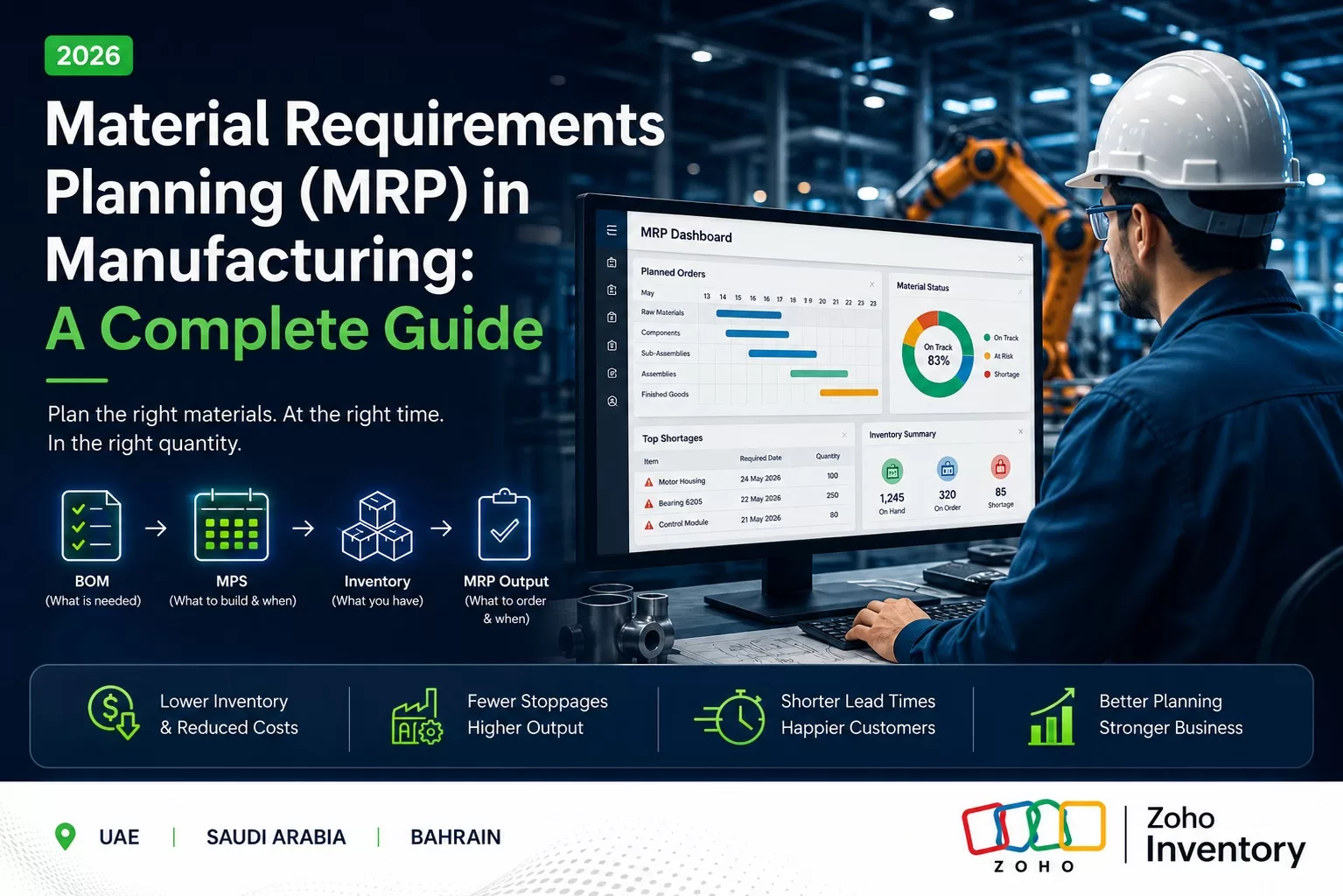
Every manufacturer in the UAE, Saudi Arabia, and Bahrain has lived the same bad week. A production line stops because one component never arrived. Meanwhile, a warehouse fills up with parts that nobody will need for another three months. Both problems share a single root cause: nobody calculated exactly what was needed, in what quantity, and by when, across every product, every open order, and every supplier lead time.
Material Requirements Planning (MRP) is the system that replaces this guesswork with arithmetic. It is a time-phased calculation that tells a manufacturer what to order, how much, and when — so production runs without stoppages and without excess stock sitting idle on shelves. This complete guide explains what MRP is, how it works, the benefits it delivers, how it differs from ERP, where implementations go wrong, and how GCC manufacturers can get it right.
What Is Material Requirements Planning (MRP)?
At its core, MRP answers three questions for every material in your factory: What do we need, how much, and by when? The complication is that modern products are deep — a mid-sized appliance has hundreds of components, a vehicle tens of thousands. Calculating requirements by hand or spreadsheet breaks down somewhere between a few dozen and a few hundred SKUs. That is exactly why MRP software exists.
Why Manufacturers Outgrow Spreadsheets
Before MRP, manufacturers planned with rough forecasts and reorder points, and errors compounded at every level of the product. MRP removes that compounding error by exploding demand down through the full product structure, then matching it against what you already own. The working capital this frees up is the single biggest reason manufacturers adopt it.
MRP in the GCC Manufacturing Context
For manufacturers scaling across Dubai, Riyadh, and Manama, imported components and long supplier lead times make planning even less forgiving — a two-week delay on a single part can idle an entire line. A cloud-based system such as Zoho Inventory brings bill-of-materials support, order management, and real-time stock visibility into one place: the foundation every MRP process depends on.
How MRP Works: The Three Core Inputs
An MRP engine takes three inputs and turns them into a time-phased action plan. The inputs are simple in concept and unforgiving in practice — get any one of them wrong and the entire plan becomes unreliable.
1. The Bill of Materials (BOM)
The BOM is the recipe. For every finished product it lists every sub-assembly, component, and raw material, along with the quantity of each. It is hierarchical: a product contains sub-assemblies, which contain components, which contain raw materials. MRP uses it to translate an instruction like “build 500 pumps” into a precise shopping list of 500 motors, 1,000 brackets, and 8,000 fasteners.
2. The Master Production Schedule (MPS)
The MPS is the build plan — what the factory will produce and when, across the planning horizon. It sits between the sales forecast (what you expect to sell) and MRP (what you need to make it), reconciling demand with the plant’s actual capacity and converting intention into commitment.
3. Inventory Records
Inventory records are the reality check. MRP needs to know what is already on the shelf, what is already on order, and what is already promised to other builds. Without accurate records, the system will recommend buying things you already own — or skip ordering things you do not have.
With these three inputs, MRP runs the same calculation repeatedly: it explodes each scheduled build through its BOM to find gross requirements, subtracts existing stock and open orders to find net requirements, then offsets each requirement by its lead time to produce a planned order date. A 14-day lead time on a motor needed for 1 March assembly produces a purchase order recommendation for 15 February. Do that for every part at every level, and the output is the full purchase-and-work-order schedule the plant runs on.
| MRP Input | What It Answers | Risk If Inaccurate |
| Bill of Materials (BOM) | Which parts and quantities each product needs | Ordering the wrong components confidently |
| Master Production Schedule | What to build and when | Plans that ignore real factory capacity |
| Inventory Records | What you already own and have on order | Buying duplicates or running short |
The Key Benefits of MRP for Manufacturers
The benefits of MRP are easy to list and harder to capture in practice. Done well, the returns are consistent and well documented across industry benchmarks. Done poorly, none of them appear.
Lower Inventory and Freed-Up Cash
A clean MRP implementation typically reduces raw material and component inventory by around 20% in the first year. Most of that comes from eliminating the safety stock manufacturers hold against uncertainty that is not actually uncertain — because MRP knows exactly when each part is needed. Since carrying costs run roughly 20–30% of inventory value every year, that reduction translates into a permanent, recurring saving, not a one-off cash bump.
Fewer Production Stoppages, Higher Output
When materials are reliably available at the start of each build, line stoppages from shortages drop sharply. Industry benchmarks attribute shop-floor productivity gains of roughly 10–20% to MRP alone — larger figures from vendor case studies usually reflect parallel improvements such as lean adoption, not the software itself.
Shorter Lead Times and Happier Customers
On make-to-order and assemble-to-order products, reliable material availability means the plant no longer loses days waiting for stragglers to arrive. Quotes get faster, delivery promises get kept, and the sales team stops losing deals on lead time.
A mid-sized fabrication firm in Sharjah cut raw-material stockouts by more than half within two quarters of moving from spreadsheet planning to a structured MRP process — and freed up significant working capital that had been tied up in slow-moving components.
MRP vs. ERP: Which Does Your Business Need?
This is the question every manufacturing executive asks. The clean answer: MRP is a planning method focused on materials, while ERP (Enterprise Resource Planning) is an integrated platform that runs the whole business — finance, HR, CRM, procurement, supply chain, and materials planning — on one database. MRP is a module inside ERP. Every modern ERP contains it, but not every manufacturer needs full ERP.
| Your Situation | Best Fit | Why |
| Under ~200 SKUs, single product line | Inventory tool with BOM + reorder logic | Full MRP is over-scaled at this stage |
| Multi-product, 200–5,000 SKUs | Standalone MRP / MRP-in-inventory | The planning sweet spot; fast payback |
| Multi-plant, multi-entity, regulated | Full ERP with embedded MRP | Integration across functions is the bigger problem |
| Volatile demand, deep BOMs (any size) | Evaluate Demand-Driven MRP (DDMRP) | Buffers replenish from real consumption, not forecast |
For most GCC SMB manufacturers, the right starting point is a connected, cloud-first stack rather than a heavy enterprise rollout. Comparing options early helps — see Zoho Inventory vs Odoo for a practical look at usability, integrations, and cost.
Common MRP Challenges (and How to Avoid Them)
Most MRP implementations that disappoint do not fail because the software is bad. They fail because the conditions around the software are not right. Four issues account for the majority of underperforming deployments.
Inaccurate Data
MRP does exactly what its inputs tell it to. The Class A benchmark widely used in the industry expects around 95% inventory accuracy, 98% BOM accuracy, and 95% routing accuracy. Many struggling operations run at 70–85% — enough to make every plan the system produces suspect. A cycle-counting program and a BOM audit are non-negotiable before go-live.
Unrealistic Lead Times
Lead times are the quiet killer. Planners pad them against shortages, buyers add buffer days, and old numbers get copied over and never revisited. Stacked together, these adjustments distort the whole plan: inflated lead times bloat inventory, while underestimated ones cause chronic shortages. Reset lead times from actual receipt-versus-need data, not habit.
Weak Demand Forecasting
MRP is a push system — it schedules from forecast demand. When forecasts are poor, it confidently orders the wrong parts in the wrong quantities. For businesses with seasonal demand or long import lead times (common across the GCC), it is worth evaluating Demand-Driven MRP, which replenishes strategic buffers from actual consumption instead of forecast.
Poor System Integration
When the planning engine does not cleanly exchange data with finance, purchasing, and the warehouse, planners waste hours reconciling numbers that do not match. This is the strongest argument for a single connected platform. Syncing MRP with Zoho Books for accounting keeps stock, purchasing, and finance on one source of truth — no double entry, no month-end surprises.
A consumer-goods producer in Riyadh had planners spending nearly a full day each week reconciling stock between two disconnected tools. Consolidating onto one integrated system eliminated the reconciliation and gave management real-time visibility for the first time.
Best Practices for a Successful MRP Implementation
A well-run MRP rollout follows a pattern refined across thousands of deployments. The specifics vary by industry, but the principles do not.
- Start with data, not software. Audit your BOMs, run a cycle count to push inventory accuracy above 95%, and reset lead times from real data — before you choose a system.
- Match the system to your stage. Do not buy enterprise ERP to solve a materials problem. Scale the tool to your SKU count, revenue, and complexity.
- Invest in change management. Process redesign, training, and adoption typically account for 60–70% of total program cost. Under-investing here produces a system that works technically and fails operationally.
- Phase the rollout. Prove the model on one product family or one site, then replicate. Big-bang implementations carry a well-documented failure rate.
- Measure what matters. Track inventory turns, on-time-in-full delivery, MPS adherence, and material availability at production start — and publish the numbers.
Why Zoho Is the Right Choice for GCC Manufacturers
- BOM and order management built in: Zoho Inventory supports bills of materials, multi-warehouse stock control, and end-to-end order tracking — the operational backbone of any MRP process.
- Native accounting integration: seamless two-way sync with Zoho Books keeps stock, purchasing, and finance perfectly aligned.
- A full operating system when you scale: Zoho One bundles 45+ apps across operations, finance, HR, and CRM — so MRP plugs into the wider business as you grow.
- Built for the region: full Arabic interface, GCC tax compliance, and a cloud-first design suited to multi-location operations across the UAE, Saudi Arabia, and Bahrain.
- Flexible, affordable pricing: a fraction of the cost of heavyweight enterprise ERP, with room to expand only as you need to.
Frequently Asked Questions
Q1. What is MRP in simple terms?
MRP is a planning method that calculates exactly which materials a manufacturer needs, in what quantities, and by when — using the bill of materials, the master production schedule, and current inventory records to generate purchase and work order schedules automatically. The goal is no stoppages and no excess stock.
Q2. What is the difference between MRP and ERP?
MRP is focused on materials planning. ERP is a broader integrated platform that runs finance, HR, CRM, procurement, and operations on one database — with MRP as one module inside it. Smaller, single-site manufacturers usually need MRP; large, multi-entity operations benefit from full ERP.
Q3. Is Zoho Inventory suitable for manufacturing in the UAE?
Yes. With bill-of-materials support, multi-warehouse tracking, order management, and native integration with Zoho Books, Zoho Inventory gives GCC manufacturers the foundation for disciplined materials planning — with an Arabic interface and local compliance built in.
Q4. How long does an MRP implementation take?
A focused implementation for a small-to-mid-sized manufacturer typically runs a few weeks to a few months, with payback inside 18 months. Larger, multi-plant ERP rollouts take longer. A certified partner significantly shortens timelines and reduces risk.
Ready to Bring MRP Discipline to Your Manufacturing Operation?
Al Fahad IT Consulting is a certified Zoho Premium Partner with 10+ years of experience implementing inventory, manufacturing, and planning systems across the UAE, Saudi Arabia, and Bahrain. We start with your data, configure the system around your real production process, train your team, and support you long after go-live. Contact our team today for a free consultation, or explore our Zoho Inventory consulting services.
Disclaimer: This article is for informational purposes only and does not constitute professional manufacturing or operational advice. Always evaluate your specific business requirements and consult with a qualified Zoho implementation partner before making software decisions.
Talk to a Zoho Manufacturing Specialist
Al Fahad IT Consulting is a Zoho Premium Partner with active Zoho Inventory and manufacturing implementations across UAE, Saudi Arabia, and Bahrain.
We configure MRP and inventory workflows aligned to your production process, BOM structure, and operational scale: not a generic template.
Book a free Zoho consultation →
نتحدث العربية. تواصل معنا للحصول على استشارة مجانية في تخطيط المواد والتصنيع
Al Fahad IT Consulting is a Zoho Premium Partner and Oracle Partner Network member, providing Zoho implementation services across UAE, Saudi Arabia, and Bahrain.


