
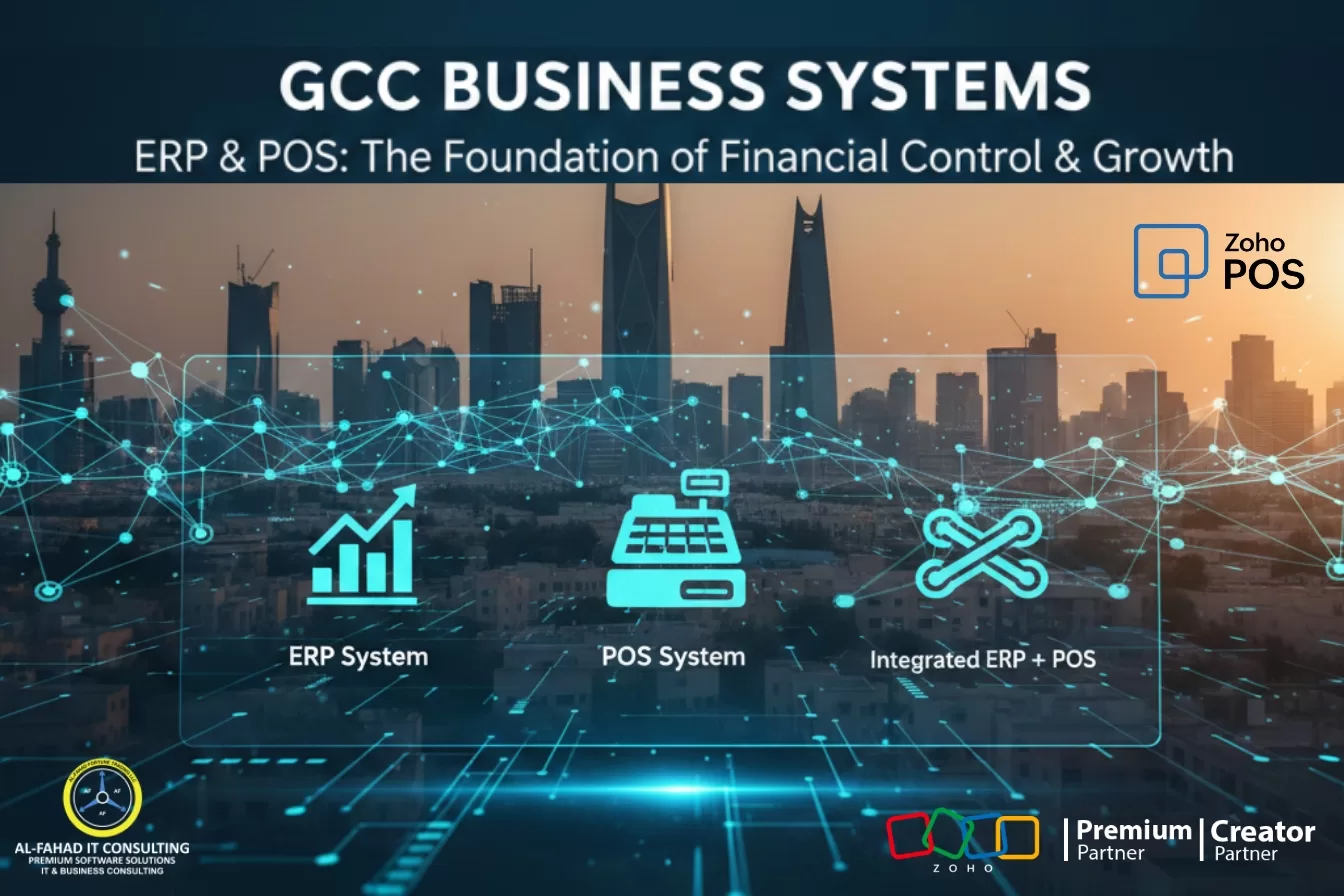
ERP and POS systems underpin financial control, regulatory compliance, and operational visibility across GCC businesses. In Saudi Arabia, the UAE, and Bahrain, these platforms directly affect reporting reliability, risk management, and growth planning. Poor decisions around alignment, integration, and governance lead to reporting gaps, compliance exposure, and operational friction that intensify over time.
The purpose of this guide is to help decision-makers evaluate ERP and POS platforms as long-term business systems rather than short-term technology deployments.
Why ERP and POS Decisions Matter More in the GCC Today
ERP and POS platforms now determine financial control, regulatory confidence, and management visibility across GCC organizations.
Regulatory requirements such as VAT, ZATCA e-invoicing, and audit readiness have increased the cost of poor system design. Multi-entity and multi-location operations further amplify the impact of fragmented systems.
Therefore, ERP and POS platforms should be evaluated based on their ability to sustain compliance, scale operations, and support dependable decision-making.
Common Risks of Choosing the Wrong ERP or POS System
The most common failures observed across GCC organizations are structural rather than technical.
- Fragmented reporting across finance, sales, and inventory
- Low user adoption caused by poor process fit
- Compliance exposure due to manual workarounds
- Escalating customization and support costs
These issues rarely appear at go-live. They typically emerge once leadership expects operational clarity and receives inconsistent data instead.
Understanding ERP Systems in Saudi Arabia and the GCC Context
ERP platforms in the GCC must support regulatory compliance, operational scale, and cross-entity visibility without system fragmentation.
What an ERP System Should Actually Solve for GCC Businesses
An ERP system should function as the operational backbone of the organization.
In the GCC context, this includes:
- Financial control supported by clear audit trails
- Real-time inventory and procurement visibility
- Alignment between sales operations and finance reporting
- Consistent data definitions across entities and locations
ERP platforms implemented as isolated tools often devolve into accounting systems rather than management systems. Decision-makers lose confidence in their ability to rely on them for planning and control.
ERP System Expectations in Saudi Arabia vs UAE & Bahrain
Regional expectations differ despite shared core requirements.
- Saudi Arabia: Strong emphasis on ZATCA compliance, e-invoicing accuracy, and audit readiness
- UAE: Multi-entity consolidation, VAT reporting, and integration with external systems
- Bahrain: Cost control, scalability, and reporting consistency
A viable ERP architecture must accommodate these differences while maintaining a unified system landscape.
POS Systems in Saudi Arabia: Beyond Billing and Receipts
POS platforms now influence inventory accuracy, financial reporting, and operational visibility across retail and F&B environments.
What Modern POS Systems Must Handle in KSA
POS systems in Saudi Arabia are expected to support more than transaction processing.
Minimum operational requirements include:
- ZATCA-compliant invoicing and receipts
- Integration with inventory and finance systems
- Centralized control across multiple outlets
Retail and F&B operators increasingly rely on POS data to inform purchasing, pricing, and staffing decisions. Isolated POS deployments remove this visibility.
POS System Limitations That Hurt Retail and F&B Operators
Traditional Standalone POS deployments frequently create operational friction.
Common consequences include:
- Manual reconciliation between POS and finance systems
- Inventory mismatches across outlets
- Delayed month-end closing
- Inconsistent management reporting
These limitations intensify as the number of outlets increases.
ERP and POS Integration: Where Most Implementations Fail
Integration design determines whether leadership receives a single source of truth or fragmented operational data.
Why ERP–POS Integration Is a Decision-Stage Concern
ERP and POS integration directly affects financial accuracy and reporting reliability.
Poor integration typically results in:
- Inaccurate revenue recognition
- Inventory discrepancies
- Delayed financial reporting
At the decision stage, integration architecture matters more than individual system features.
Signs You Need a Unified ERP and POS Architecture
Organizations typically reach a critical point when operational strain becomes visible.
Common indicators include:
- Duplicate data entry across systems
- Reconciliation errors during closing cycles
- Unreliable or delayed management reports
At this stage, integration becomes a control requirement rather than a technical enhancement.
Choosing the Right ERP & POS Partner in Saudi Arabia, UAE & Bahrain
Partner capability directly determines system adoption, governance quality, and long-term value realization.
What to Look for in an ERP Implementation Partner
A credible ERP and POS partner demonstrates consulting discipline rather than product focus.
Key indicators include:
- Process-led discovery before configuration
- Clear understanding of regional compliance requirements
- Defined post-go-live support and governance model
Implementation quality has a greater impact on long-term system performance than platform selection.
Red Flags When Evaluating IT Companies in Riyadh and Jeddah
Certain behaviors consistently signal elevated delivery risk.
Common red flags include:
- License-first sales conversations
- Promised speed without validation checkpoints
- Absence of adoption, training, or documentation plans
These indicators often correlate with short-term delivery and long-term operational issues.
ERP, POS, and Cloud Readiness in Saudi Arabia
Cloud architecture influences availability, security, and reporting performance across ERP and POS environments.
Role of Cloud Infrastructure in ERP and POS Performance
Cloud deployment affects system reliability and access consistency.
Effective cloud architectures support:
- High availability across locations
- Secure, role-based access control
- Centralized reporting without latency
Saudi Cloud Considerations for Regulated Businesses
Regulated organizations must evaluate cloud decisions through a governance lens.
Key considerations include:
- Data residency and hosting models
- Audit visibility and traceability
- Vendor accountability and support frameworks
Cloud risk emerges from poor governance rather than the deployment model itself.
When Is the Right Time to Reevaluate Your ERP or POS System?
System reevaluation typically follows operational strain rather than planned technology cycles.
Organizations reassess ERP and POS platforms when:
- Business growth exceeds system capability
- Regulatory requirements evolve
- Reporting accuracy deteriorates
- User adoption declines
These indicators point to structural limitations rather than behavioral issues.
ERP vs POS vs Integrated ERP+POS: Comparison Table
The table below summarizes operational differences that matter at the decision stage.
| Decision Area | Standalone ERP | Standalone POS | Integrated ERP + POS |
| Financial visibility | Partial | Limited | Centralized and consistent |
| Inventory accuracy | Medium | Outlet-level only | Real-time across entities |
| Compliance readiness (KSA/GCC) | Depends on configuration | Often limited | Designed into workflows |
| Reporting and decision-making | Delayed | Operational only | Real-time, cross-functional |
| Scalability across GCC | Requires rework | Poor | Built for expansion |
How Al Fahad IT Consulting Approaches ERP and POS Decisions Differently
Consulting discipline and governance focus define Al Fahad IT Consulting’s engagement model.
Consulting-Led ERP and POS Assessment
Each engagement begins with a structured assessment aligned to business reality.
Assessment areas include:
- Core business processes and workflows
- Reporting, control, and compliance gaps
- Integration and operational risk exposure
Technology decisions remain secondary to operational clarity.
Implementation Discipline and Long-Term Governance
Delivery methodology emphasizes control and sustainability.
Key elements include:
- Validated configuration
- Controlled rollout phases
- Ongoing optimization and governance
The objective centers on system reliability and sustained adoption.
Next Step: ERP and POS System Review for GCC Businesses
A structured system review provides clarity before commitment.
A typical review covers:
- Current-state process and system evaluation
- Compliance and operational risk assessment
- Improvement roadmap with defined priorities
The outcome focuses on informed decision-making rather than immediate change.
Frequently Asked Questions (FAQs)
The following questions address common decision-stage concerns raised by GCC business leaders.
What is the difference between ERP and POS systems in Saudi Arabia?
ERP systems manage end-to-end operations, while POS systems handle transaction execution at the point of sale.
Do Saudi businesses need ERP and POS systems to be integrated?
Integrated systems are essential for maintaining data accuracy, compliance, and reporting consistency across outlets.
How do ERP systems support ZATCA and VAT compliance?
ERP platforms enforce compliant invoicing workflows and maintain audit-ready financial records.
Is cloud-based ERP suitable for regulated businesses in Saudi Arabia?
Cloud-based ERP is suitable when governance, access control, and hosting models meet regulatory expectations.


Leave a Reply