
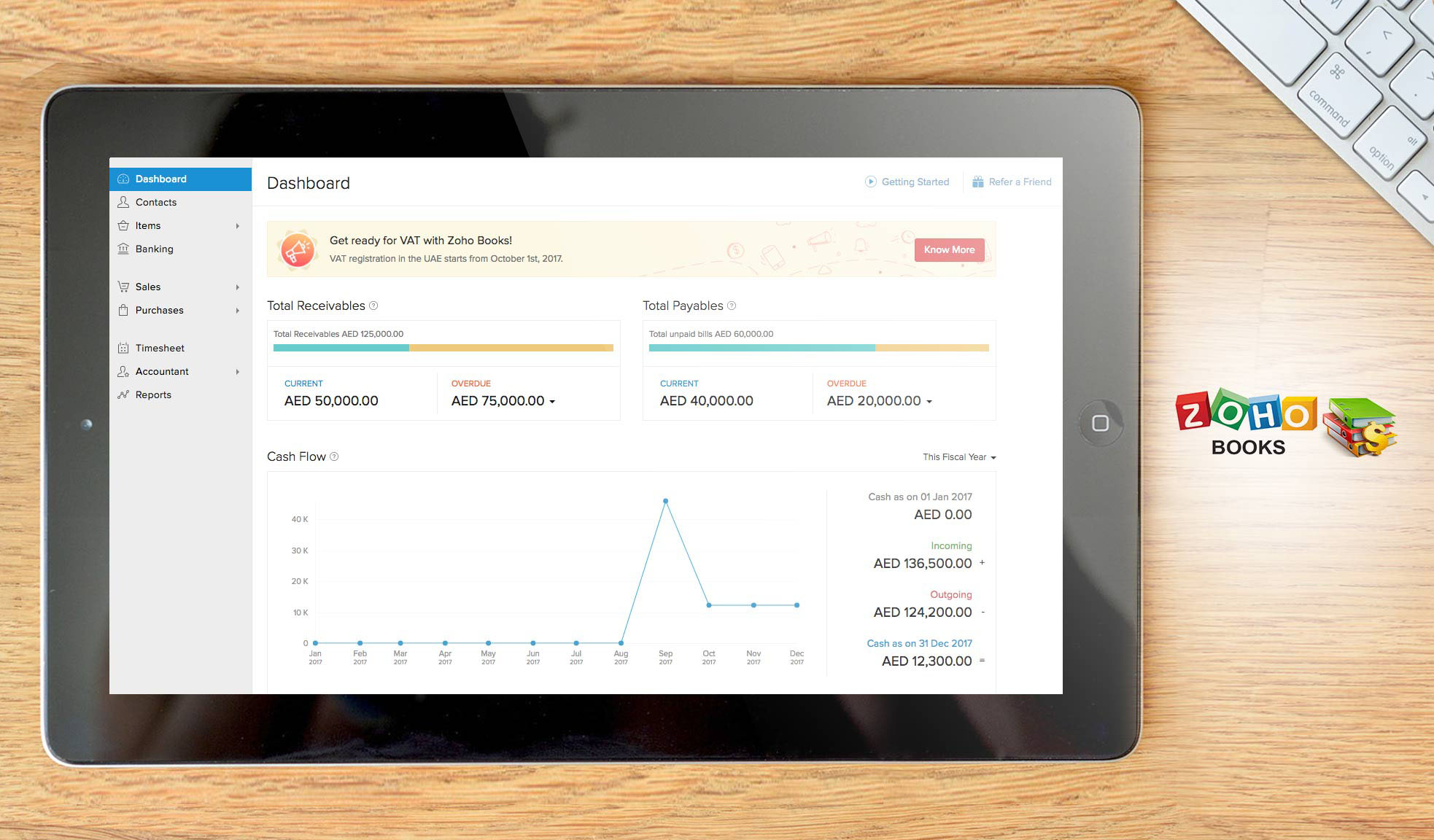
Zoho Books is frequently positioned as a practical accounting platform for growing businesses. The real question for decision-makers in the UAE and Saudi Arabia is more specific: Does Zoho Books meet the operational, regulatory, and governance requirements of businesses operating at scale in the GCC?
This article answers that question through a structured, list-based evaluation. Each point addresses a real financial control concern faced by CFOs, finance heads, and operational leaders responsible for implementation decisions, not just software selection.
Why This Question Matters in the GCC Context
Financial management in the UAE and Saudi Arabia involves more than bookkeeping. VAT compliance, multi-entity reporting, audit readiness, and cash-flow control create daily operational pressure. Many organizations also struggle to align accounting systems with real operational workflows, leading to manual workarounds and delayed reporting.
The right financial management software should reduce operational risk, not introduce complexity. That expectation frames the evaluation below.
10 Critical Reasons Businesses in UAE & Saudi Arabia Choose Zoho Books
The following section highlights 10 major reasons why businesses in the UAE and Saudi Arabia should implement Zoho Books from a trusted Zoho Premium Partner like Al Fahad IT Consulting.
1. Built for Regulatory Compliance in the UAE and Saudi Arabia
Zoho Books supports VAT structures relevant to both the UAE and KSA, including configurable tax rates, VAT returns, and audit-ready reporting. Regulatory alignment reduces dependency on external corrections at month-end and supports predictable compliance cycles.
Financial leaders often evaluate financial reporting tools based on audit readiness rather than interface design. Zoho Books aligns well with this expectation when configured correctly.
2. Practical Financial Management Without Over-Engineering
Complex ERP systems often overwhelm mid-market teams. Zoho Books focuses on clarity, enabling finance teams to manage receivables, payables, and general ledger activities without excessive customization.
Clear process alignment strengthens financial management tools by ensuring consistent day-to-day use across teams.
3. Strong Foundation for Financial Asset Management
Asset tracking, depreciation schedules, and capital expense visibility are built into Zoho Books. Fixed assets can be monitored across locations, supporting both operational oversight and statutory reporting.
Organizations evaluating financial asset management capabilities often find Zoho Books sufficient when asset complexity remains within mid-market thresholds.
4. Scalable Structure for Growing Organizations
Zoho Books supports multi-currency transactions and expanding transaction volumes without degrading performance. Growing organizations benefit from predictable scalability without forced system migration.
Scalability matters when selecting financial management software intended to support multi-year growth plans.
5. Reliable Financial Analysis and Decision Support
Built-in reports support cash-flow analysis, profitability tracking, and expense categorization. Financial leaders gain faster access to insights without exporting data into spreadsheets.
Integrated financial analysis tools reduce reporting latency and improve decision confidence.
6. Financial Planning Support Through Data Accuracy
Accurate historical data enables better forecasting. Zoho Books feeds clean data into broader planning environments, supporting budgeting and scenario analysis.
Strategic teams comparing the best financial planning software options often prioritize data integrity over advanced modeling features.
7. Structured Financial Risk Management
Risk often emerges from delayed visibility. Zoho Books supports early identification of overdue receivables, vendor concentration risks, and cash-flow gaps.
Consistent reporting strengthens financial risk management tools by making exposure visible rather than reactive.
8. Integrated Ecosystem for End-to-End Control
Zoho Books integrates natively with CRM, inventory, payroll, and analytics applications within the Zoho ecosystem. Integration eliminates duplicate data entry and reduces reconciliation errors.
Unified platforms typically outperform fragmented financial management tools when governance is a priority.
9. Suitable for Professional Advisory Environments
Accounting firms and internal finance teams benefit from structured access controls and audit trails. Zoho Books supports collaboration without compromising data ownership.
Advisory firms evaluating the best financial advisors’ workflows often prefer platforms that simplify oversight rather than complicate reviews, such as Zoho Books.
10. Cost-Effective Without Sacrificing Governance
Zoho Books offers predictable licensing costs without hidden complexity. Cost control matters when evaluating long-term ownership rather than initial deployment.
Cost efficiency remains a deciding factor when comparing financial planning tools and accounting platforms in competitive markets.
Where Zoho Books Fits Best — and Where It Does Not
Zoho Books works best for:
- Mid-market organizations
- Service-driven and trading businesses
- Regional subsidiaries
- Finance teams seeking structured control without ERP overhead
Large enterprises with complex consolidation requirements may require complementary systems. Financial consolidation across dozens of entities often extends beyond Zoho Books, though integration with analytics platforms such as Zoho Analytics can help bridge this gap.
Zoho Books vs Market Expectations in the GCC
Decision-makers comparing Zoho Books with alternatives often focus on three dimensions:
- Operational fit: Strong
- Compliance alignment: Strong
- Customization depth: Moderate
These characteristics position Zoho Books favorably among financial consolidation tools for mid-market use cases.
Why Implementation Quality Matters More Than Software Choice
Most finance system failures in the GCC result from poor implementation rather than platform limitations. Misaligned chart of accounts, weak approval workflows, and a lack of governance reduce adoption.
A structured approach ensures Zoho Books functions as a business system, not a digital ledger. That’s why it’s essential to gather all the facts about the financial software before you implement it in your workflow.
Why Choose Al Fahad IT Consulting
Al Fahad IT Consulting operates as a consulting-led Zoho implementation partner across the UAE and Saudi Arabia. The firm focuses on execution quality, governance, and long-term adoption rather than software deployment alone.
Implementation Discipline
Every Zoho Books engagement begins with financial process mapping, compliance review, and analysis of reporting requirements. Configuration follows business logic rather than default templates.
Regional Compliance Expertise
Deep understanding of VAT structures, audit expectations, and regulatory norms across the UAE and KSA reduces compliance risk.
Process-First Configuration
Systems are aligned to how finance teams actually operate, improving adoption and reducing manual workarounds.
Integrated Financial Visibility
Zoho Books is integrated into a wider ecosystem, ensuring consistent reporting across sales, operations, and finance.
Ongoing Governance and Support
Post-go-live support, documentation, and optimization ensure the system remains reliable as the business evolves.
Organizations seeking dependable financial reporting tools benefit from this structured approach.
Who Should Consider Zoho Books with Al Fahad IT Consulting
- CFOs seeking visibility and control
- COOs requiring operational alignment
- Founders scaling regional operations
- Finance teams replacing spreadsheet-driven workflows
A system review or implementation consultation provides clarity before commitment.
Final Takeaway
Zoho Books delivers strong value to UAE and Saudi Arabia businesses seeking structured financial management without the complexity of ERP. The platform performs best when implemented with discipline, governance, and regional expertise.
Organizations evaluating best financial planning software and accounting platforms should focus less on feature lists and more on execution quality.
A structured system review with Al Fahad IT Consulting provides a practical starting point for informed decision-making.
Frequently Asked Questions
Is Zoho Books suitable for UAE VAT and Saudi ZATCA requirements?
Zoho Books supports VAT compliance in both regions when configured correctly. Regulatory accuracy depends on proper setup and ongoing governance.
Can Zoho Books handle multi-entity reporting?
Zoho Books supports multi-organization structures. Complex consolidation may require analytics integration depending on scale.
How does Zoho Books compare to other financial management software?
Zoho Books prioritizes clarity, cost control, and integration. Larger ERPs may offer deeper customization but at a higher operational cost.
Does Zoho Books support financial planning and forecasting?
Zoho Books provides accurate historical data that feeds budgeting and planning systems, indirectly supporting the best financial planning apps.
Why involve a Zoho implementation partner instead of self-setup?
Implementation partners ensure process alignment, compliance accuracy, and adoption. Poor setup often leads to underutilized systems.


