
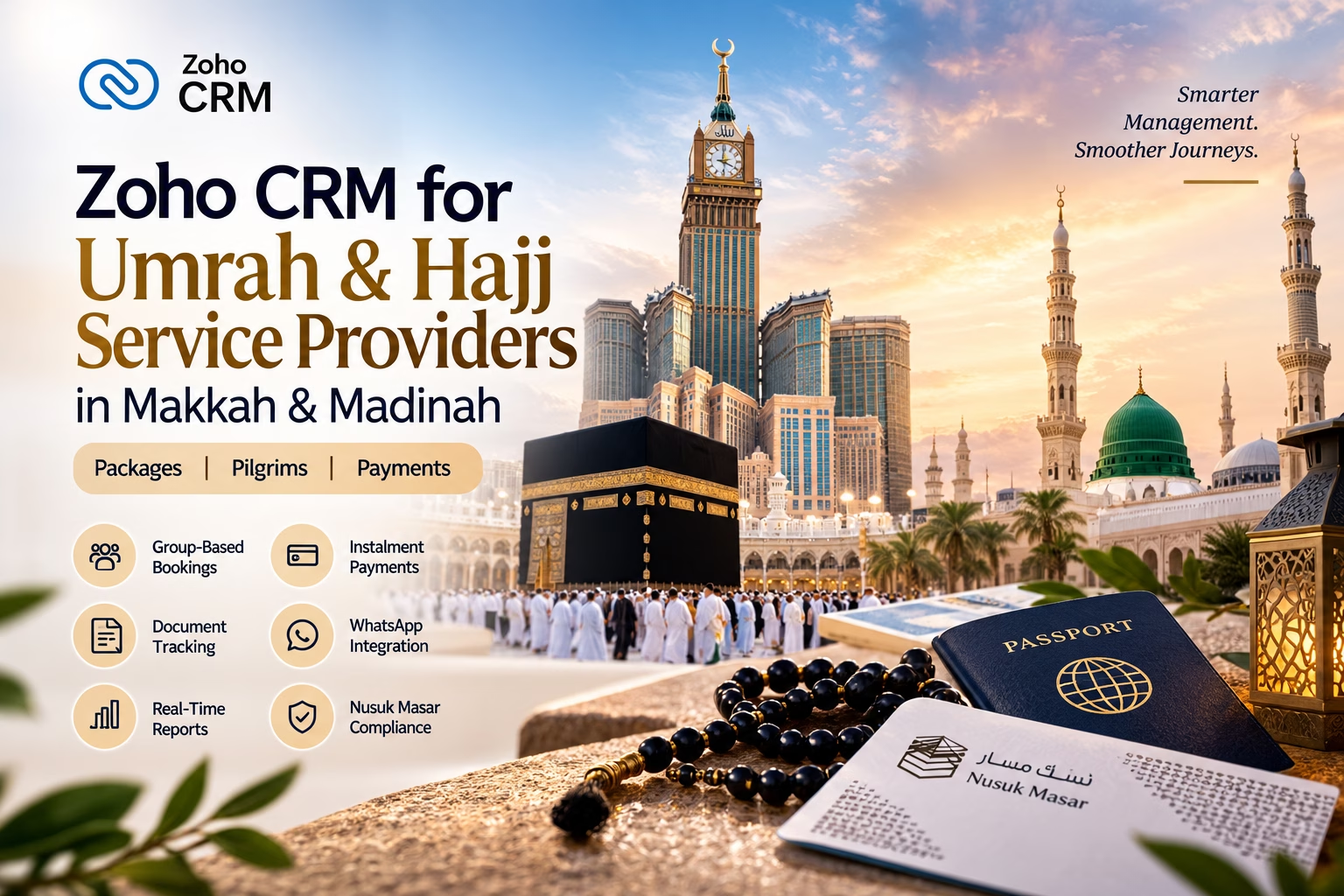
Umrah and Hajj service providers in Makkah and Madinah rarely struggle to fill their packages. Demand is usually not the problem. Instead, staff lose hours every season tracking who is on each group, who has paid the final instalment, and whose passport copy is still missing. Once bookings outgrow a spreadsheet, one coordinator can no longer hold all of that in their head. A proper CRM for Umrah companies solves exactly that. It doesn’t replace the relationship-driven way these businesses sell. Rather, it stops those relationships from depending on one person’s memory and a growing stack of WhatsApp threads.
What This Guide Covers
This guide explains what umrah management software must handle for a Makkah or Madinah-based operator. It also shows how Zoho CRM for travel agencies in Saudi Arabia is typically configured for packages, pilgrims, and payments. Finally, it covers where Saudi pilgrimage regulations change what the system needs to track.
For platform details, see our Zoho CRM page. You can also visit our Zoho Creator page for custom app work, and our Zoho Books page for instalments and invoicing.
| Key Takeaways The recurring bottleneck for Umrah and Hajj service providers isn’t selling packages. It’s tracking which pilgrim is on which package, in which WhatsApp group, with which instalment still outstanding, once volume passes a few dozen bookings a season. A CRM for Umrah companies must handle group-based bookings, not just individual deals. One package often covers a family or tour group with shared travel dates, but each pilgrim has individually tracked documents and payments. Since June 2025, Umrah service providers must document pilgrim accommodation contracts through the Nusuk Masar platform before a visa is issued. Therefore, accurate per-pilgrim record-keeping is now a compliance requirement, not just an operational nicety. Zoho CRM, extended with a custom Zoho Creator app and connected to Zoho Books, covers package management, pilgrim records, and instalment payments in one system rather than three. |
The Excel + WhatsApp Problem Every Umrah Operator Recognizes
Almost every Umrah and Hajj operator we talk to in Makkah and Madinah describes the same setup. They keep a master spreadsheet per departure, coordinate pilgrims in WhatsApp groups, and track payments separately from both. It works until a staff member is away. It also breaks when a group grows too large, or when two coordinators update the same sheet at once and something gets overwritten.
| The Excel + WhatsApp Problem | What a Proper Umrah CRM Does Instead |
| Pilgrim lists live in spreadsheets, one tab per group or departure date | Each pilgrim is a record linked to their package, group, and departure — searchable instantly, not buried in a tab |
| Payment status tracked by memory or a separate payment sheet | Instalment schedules and payment status appear on the pilgrim’s own record, synced with accounting |
| Group coordination happens over WhatsApp with no record in any system | WhatsApp conversations log against the pilgrim or group record, so handoffs between staff don’t lose history |
| Document collection (passport copies, photos) chased manually by phone or message | Document checklists and upload status tracked per pilgrim, with automated reminders for missing items |
| No visibility into which packages are selling and which are lagging | Dashboards show bookings, payment status, and group fill rates by package and departure date |
What a CRM for Umrah Companies Actually Needs to Handle
A generic CRM for Umrah Companies, used as-is, doesn’t fit how Umrah and Hajj businesses operate. The package, not the individual, is usually the unit of sale. A single package can involve a dozen or more pilgrims who travel together on one departure date. However, each pilgrim has individually tracked documents, rooming, and payments. A proper hajj and umrah CRM setup must therefore cover four areas:
- Package-level and pilgrim-level records: a departure record holds shared details such as dates, hotel, and transport. It links to individual pilgrim records for documents, rooming preference, and payment status.
- Instalment-based payments: most pilgrims pay in instalments rather than upfront. So payment schedules must show per pilgrim and reconcile against accounting, not sit in a side spreadsheet.
- Document and checklist tracking: passport copies, photos, and other required documents are tracked per pilgrim. Automated reminders chase anything outstanding before a deadline.
- Group communication history: a record of WhatsApp or call communication ties to the pilgrim or group. As a result, a staff member picking up mid-season doesn’t start from zero.
Saudi-Specific Considerations: Nusuk and Pilgrim Documentation
Saudi Arabia’s Ministry of Hajj and Umrah operates the Nusuk platform for visa issuance, package listings, and permits. Licensed Umrah companies must enter pilgrim and group movement data into the ministry’s systems directly. Since June 2025, a further requirement applies through the Nusuk Masar platform. Umrah service providers must document pilgrim accommodation contracts with Ministry of Tourism-licensed hotels before a visa can be issued.
This matters operationally. A licensed company’s internal pilgrim records and its Nusuk filings must stay aligned. A mismatch between internal bookings and Nusuk Masar documentation can delay or block a visa. A CRM that holds clean, per-pilgrim records makes that alignment realistic to maintain. A shared spreadsheet, however, makes it much easier for the two to drift apart.
How a CRM for Umrah Companies Works With Zoho CRM, Creator, and Books
Zoho CRM: The Pilgrim and Package Pipeline
Zoho CRM forms the core. Leads and enquiries come in and convert into bookings, and each booking links to a departure and package. We extend the standard fields to capture pilgrim-specific details instead of forcing everything into a generic “Deal” structure.
Zoho Creator: Custom Pilgrim and Group Management
Pilgrim-group relationships, rooming arrangements, and document checklists are too specific for standard CRM modules. So we typically build a custom Zoho Creator app alongside CRM. It includes a Pilgrim module, a Group/Departure module, and document-tracking screens tailored to how the operator runs its seasons. See our Zoho Creator page for how we scope custom apps and automation.
Zoho Books: Instalments and Invoicing
Package pricing, instalment schedules, and VAT-compliant invoicing run through Zoho Books. It connects to the pilgrim and package records in CRM and Creator. As a result, a payment recorded in Books shows immediately on that pilgrim’s record, with no manual reconciliation. See our Zoho Books page for instalment and invoicing setup.
Example Scenario (Illustrative)
This is a representative scenario based on patterns we commonly see among Umrah and Hajj service providers in Saudi Arabia. It does not describe a specific named client, and readers should not infer any figures from it.
Situation: A Makkah-based Umrah operator runs multiple departures each season. Pilgrim lists sit in separate spreadsheets per group, and payment follow-up happens through WhatsApp. As simultaneous departures grow, staff spend more time cross-checking who has paid and which documents are outstanding. They also struggle to match each WhatsApp thread to a spreadsheet row.
Typical approach: We model package and departure data in Zoho CRM. A custom Zoho Creator app handles pilgrim records, rooming, and document checklists, while Zoho Books manages instalment schedules and invoicing. WhatsApp conversations log against the relevant pilgrim or group record, so any staff member sees the full history.
Typical outcome: Staff work from one pilgrim and payment record instead of cross-referencing spreadsheets and chat threads. Management also sees booking and payment status by departure without compiling it manually. Actual results vary by operator size, season volume, and how manual the previous process was.
How Al Fahad IT Consulting Builds CRM Systems for Umrah and Hajj Operators
Umrah and Hajj operations have specific requirements, so a generic CRM template rarely fits. As a certified Zoho Partner across the UAE, Saudi Arabia, and Bahrain, we help Makkah and Madinah-based operators with:
- Package and Pilgrim Data Modeling: we structure CRM and Zoho Creator around how your business actually sells and manages groups.
- Instalment and Payment Setup: we connect Zoho Books so payment status shows against each pilgrim’s record, not in a separate sheet.
- Document and Checklist Automation: automated reminders chase outstanding passport copies, photos, and other required documents.
- WhatsApp and Communication Logging: we keep group and pilgrim communication history attached to the right record.
- Migration From Spreadsheets: we move existing pilgrim and payment data into the new system without losing season history.
Frequently Asked Questions About CRM for Umrah Companies
Q1: Is Zoho CRM suitable for travel agencies, or does it need heavy customization for Umrah operators?
Zoho CRM provides a solid base for lead and booking management. However, Umrah-specific needs such as pilgrim-group relationships, rooming, and document checklists typically require a custom Zoho Creator app alongside it. Standard CRM modules alone rarely cover them.
Q2: Can a CRM help with Nusuk-related pilgrim documentation requirements?
A CRM doesn’t replace Nusuk or Nusuk Masar filings. However, clean, per-pilgrim records make it far easier to keep those filings aligned with what you have actually booked. That reduces the risk of mismatches that can delay visa issuance.
Q3: How does instalment-based payment tracking work for Umrah packages in Zoho?
We typically set up payment schedules in Zoho Books and link them to the pilgrim or package record in CRM. So instalment status is visible without switching systems or keeping a separate payment spreadsheet.
Q4: Can WhatsApp conversations with pilgrims be tracked inside the CRM?
Yes. WhatsApp integration logs conversations directly against the relevant pilgrim or group record. As a result, communication history survives even if a staff member is unavailable or a conversation needs a handoff.
Q5: How long does it take to set up a CRM system for an Umrah or Hajj operator?
A focused setup typically takes a few weeks. It covers CRM configuration, a basic custom pilgrim module, and Zoho Books integration. A fuller system with detailed document tracking and multi-group automation takes longer. The number of departures and pilgrims per season drives the timeline.
Bring Packages, Pilgrims, and Payments Into One System
The Umrah and Hajj operators who get the most relief from a CRM aren’t the ones with the most bookings. Instead, they’re the ones who stop losing track of a pilgrim, a payment, or a missing document between a spreadsheet and a WhatsApp thread. Zoho CRM, extended with a custom Zoho Creator app and connected to Zoho Books, makes that the default for Makkah and Madinah-based operators.
Al Fahad IT Consulting is a certified Zoho Partner helping Umrah and Hajj service providers manage packages, pilgrims, and payments in one connected system.
Contact our team today for a free review of your current pilgrim and package management setup.
Related Reading on the Al Fahad IT Consulting Blog
- Zoho CRM — Setup, Customization & Support
- Zoho Creator — Custom Apps & Automation
- Zoho Books — Accounting Software Setup & Support
- Zoho Premium Partner in UAE, KSA & Bahrain
- Zoho CRM Plus for Real Estate Developers and Brokerages in Riyadh
Sources and Further Reading
- Saudi Ministry of Hajj and Umrah — Nusuk platform (nusuk.sa) and general obligations for licensed Umrah companies
- Saudi Ministry of Hajj and Umrah — Nusuk Masar accommodation documentation requirement, effective June 2025
Talk to a Zoho CRM Specialist for Umrah and Hajj Operators
Al Fahad IT Consulting is a Zoho Premium Partner delivering Zoho CRM, Creator, and Books projects across the UAE, Saudi Arabia, and Bahrain.
We model your packages and pilgrims, connect your payments and WhatsApp, and test everything before go-live — not from a generic template.
Book a free Zoho consultation →
Al Fahad IT Consulting is a Zoho Premium Partner and Oracle Partner Network member, providing Zoho implementation services across UAE, Saudi Arabia, and Bahrain.


