
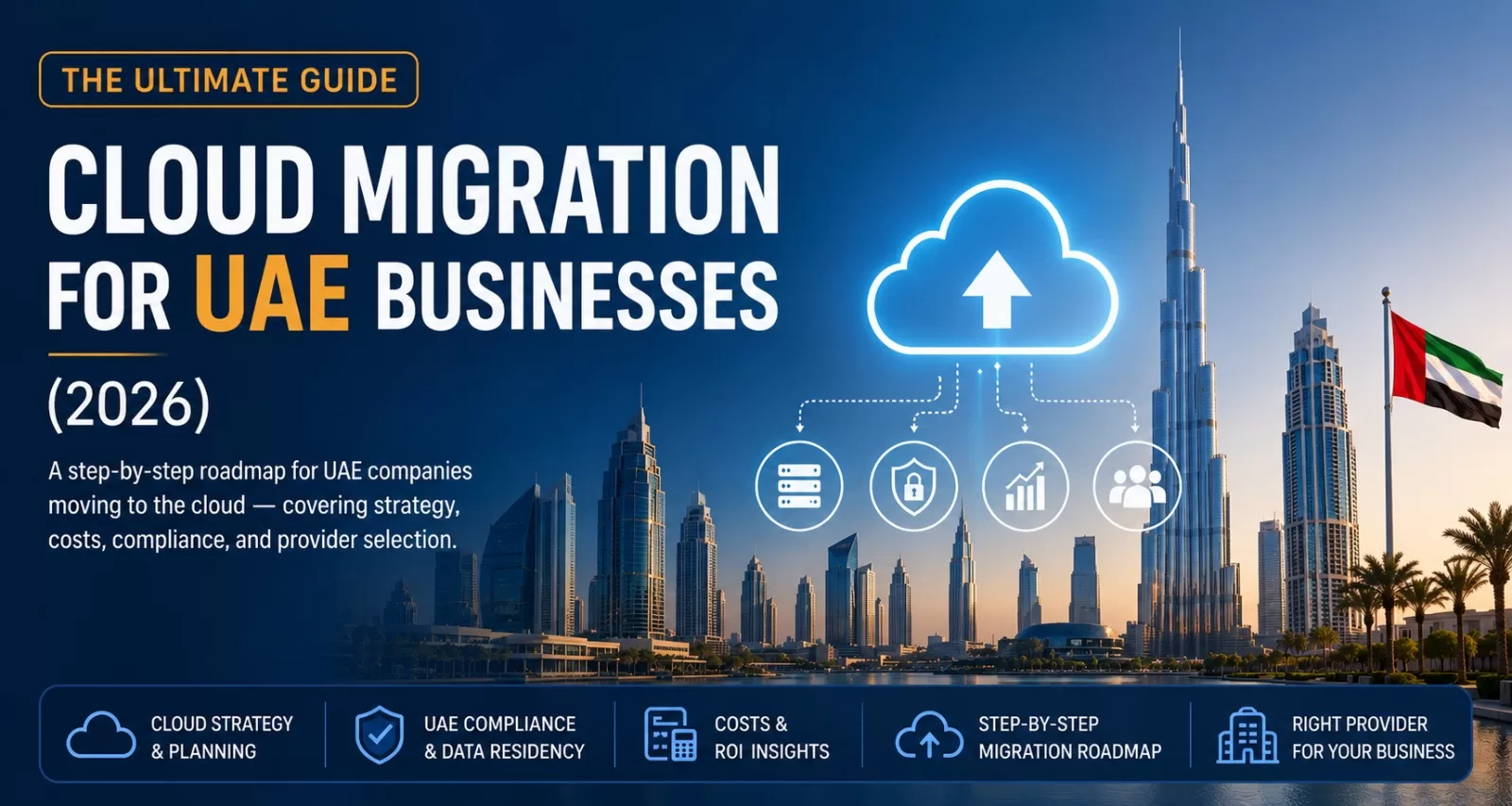
Digital transformation is no longer optional in the UAE. The government is pushing toward a smart, paperless economy, and global competition keeps intensifying. Moving your business infrastructure to the cloud is one of the most impactful decisions you can make in 2026.This cloud migration UAE guide covers what cloud migration means, how to plan it, what it costs, and which provider fits your needs. If you want expert planning and implementation, Al Fahad IT Consulting is a UAE-based technology consulting firm that works on cloud transformation, digital infrastructure, and managed IT services.
| Key Takeaways A cloud migration moves data, applications, and workloads from on-premise servers to public, private, or hybrid cloud. A six-phase plan keeps it controlled: assess, choose a strategy, design, pilot, migrate in waves, then optimise. Check data residency and cross-border transfer rules for your sector before you sign any provider contract. UAE PDPL applies to personal data, and some sectors add stricter rules. Budget for more than the migration itself. Training, change management, and monthly cloud spend all matter. |
What Is Cloud Migration — And Why Does It Matter for UAE Businesses?
Defining Cloud Migration
Cloud migration is the process of moving business data, applications, and IT workloads from on-premise servers to a cloud environment. That environment can be public cloud (AWS, Azure, Google Cloud), private cloud, or a hybrid of both.
Why UAE Businesses Are Accelerating Cloud Migration
The UAE’s cloud-first approach pushes government entities to prioritise cloud solutions. Private businesses follow for five key reasons:
- Cost Efficiency: you cut capital expenditure on hardware, maintenance, and data centre space.
- Business Agility: you scale infrastructure up or down within minutes, not months.
- Remote Workforce Support: distributed teams get secure access across the GCC and beyond.
- Regulatory Readiness: cloud platforms help you meet UAE PDPL and sector-specific compliance standards.
- Disaster Recovery: cloud backup typically outperforms traditional tape or on-site backup.
Understanding the Cloud Migration Landscape in the UAE
Key Cloud Providers Operating in the UAE
| Cloud Provider | UAE Presence | Best For | Pricing Model |
| Microsoft Azure | Abu Dhabi & Dubai regions | Enterprise, Microsoft-heavy organisations | Pay-as-you-go, with reserved options |
| Amazon AWS | UAE Region (launched 2022) | Startups, scalable workloads | Pay-as-you-go; free tier available |
| Google Cloud | Confirm current regional availability | Data analytics, AI/ML | Pay-as-you-go |
| Huawei Cloud | Confirm current regional availability | Telecom, manufacturing | Custom enterprise pricing |
| Alibaba Cloud | UAE (Dubai) region | Trade, e-commerce, GCC | Pay-as-you-go, with SME pricing |
Regions and pricing change often. Confirm current availability and rates with each provider before you decide.
UAE-Specific Compliance Requirements for Cloud Migration
- UAE PDPL (Federal Decree-Law No. 45 of 2021): governs personal data processing and cross-border transfer.
- DIFC Data Protection Law: applies to businesses in the Dubai International Financial Centre.
- ADGM Data Protection Regulations: apply to Abu Dhabi Global Market entities.
- UAE information security standards: national cybersecurity and information assurance requirements apply to critical infrastructure.
- UAE ICT Health Law: sets health data storage and transfer restrictions for healthcare providers.
Key rule: check data residency and cross-border transfer requirements for your sector before you sign any contract. Some sectors require data to stay inside the UAE. Azure and AWS both operate UAE regions, so confirm which region will hold your data.
The 6-Phase Cloud Migration Framework for UAE Businesses
Phase 1: Discovery and Assessment (Weeks 1–3)
Create a complete inventory of your IT environment. Map all apps and workloads, identify system dependencies, and classify data by sensitivity. Then assess infrastructure costs and define the business outcomes you want. Useful tools include Azure Migrate, AWS Application Discovery Service, and Movere.
Phase 2: Strategy Selection (Weeks 3–4)
Use the 6 R’s framework to categorise each workload:
| Strategy | Name | What It Means | Best For |
| Rehost | Lift & Shift | Move as-is to a cloud VM | Quick wins, legacy apps |
| Replatform | Lift, Tinker & Shift | Minor optimisation before moving | Mid-complexity apps |
| Refactor | Re-architect | Rebuild for cloud-native | Strategic, high-ROI apps |
| Repurchase | Replace | Switch to a SaaS alternative | CRM, ERP, HR systems |
| Retain | Keep On-Premise | Too complex or risky to move | Regulated legacy systems |
| Retire | Decommission | Shut down unused systems | Redundant apps |
The “Repurchase” route often suits business systems. For example, many UAE businesses replace legacy CRM, accounting, and HR tools with a cloud suite such as Zoho One.
Phase 3: Cloud Architecture Design (Weeks 4–6)
Design the target environment. This covers the virtual network topology, IAM roles and MFA, and data encryption. It also covers your backup and DR strategy and cost governance policies.
Phase 4: Pilot Migration (Weeks 6–10)
Start with non-critical workloads, such as dev environments, archival data, and internal HR tools. This validates the process before you touch production systems.
Phase 5: Full Migration Execution (Weeks 10–24)
Migrate in waves, with lower-risk workloads first and mission-critical ones last. Each wave includes pre-migration testing and a scheduled migration window. A parallel running period follows, then cut-over and legacy decommissioning.
Phase 6: Optimisation and Governance (Ongoing)
After migration, many businesses cut spend further through right-sizing and reserved instances. Establish a Cloud Centre of Excellence (CCoE) to keep governance consistent.
Cloud Migration Costs: What UAE Businesses Should Budget
Cost Components
The ranges below are indicative estimates. Actual costs depend on your environment, the provider, and the scope of work, so treat them as a starting point for budgeting.
| Cost Component | Indicative Range (AED) | Notes |
| Assessment & Planning | 15,000 – 50,000 | One-time consulting fees |
| Architecture Design | 20,000 – 80,000 | Depends on complexity |
| Migration Execution | 50,000 – 300,000 | Per workload wave |
| Training & Change Management | 10,000 – 40,000 | Staff upskilling |
| Monthly Cloud Spend | 5,000 – 100,000+ per month | Based on workloads |
| Ongoing Management | 5,000 – 25,000 per month | Optional managed service |
ROI Expectations for Cloud Migration in the UAE
- You avoid hardware refresh cycles, which can cost hundreds of thousands of dirhams every three to five years.
- You reduce IT staff overhead, since cloud-managed services replace on-site server management.
- Disaster recovery often costs less than traditional DR.
- You gain productivity from remote access and improved uptime.
Illustrative example (hypothetical): Imagine a 100-person Dubai firm that migrates its ERP, file storage, and email to Azure. Suppose the migration costs AED 280,000 and saves AED 310,000 a year in hardware, support, and licensing. The payback period would then be under 11 months. Your own numbers will differ, so model your real costs first.
Choosing the Right Cloud Provider for Your UAE Cloud Migration
Microsoft Azure — Best for Enterprise
- Two UAE regions (Abu Dhabi and Dubai) support UAE data residency needs.
- It integrates deeply with Microsoft 365, Teams, and Dynamics.
- It holds major compliance certifications such as ISO 27001 and SOC 2.
- Confidential computing options exist for sensitive government and financial workloads.
Amazon AWS — Best for Scalability
- It offers the broadest service catalogue, with 200+ cloud services.
- It has a strong track record for high-scale, high-traffic workloads.
- Pricing is competitive for compute-intensive and storage-intensive applications.
- Startups and tech companies often prefer it for cloud-native applications.
Hybrid Cloud — Best for Regulated Industries
For financial services, healthcare, or government supply chains, hybrid cloud pairs private on-premise infrastructure with public cloud. It offers a strong balance of compliance, control, and scalability.
Industry-Specific Cloud Migration Considerations in the UAE
Financial Services and Banking
Central Bank of the UAE (CBUAE) rules set expectations for outsourcing, third-party risk, and data handling. Expect to document risk assessments and an exit strategy. Major providers publish compliance documentation, but confirm requirements with your regulator.
Healthcare and Clinics
The UAE ICT Health Law restricts storing and transferring patient data outside the country. Solutions must also integrate with emirate-level platforms such as DHA and DOH. Choose a provider and region that support these requirements.
Retail and E-Commerce
Cloud elasticity lets retailers scale during Ramadan and the Dubai Shopping Festival without over-provisioning all year. Auto-scaling on AWS or Azure handles traffic spikes effectively.
Construction and Real Estate
BIM collaboration, project management, and document management drive adoption. Microsoft SharePoint and Teams on Azure, and cloud ERPs such as Oracle NetSuite, are common choices.
Common Cloud Migration Mistakes UAE Businesses Make
- Migrating without assessment: undetected dependencies cause outages and budget overruns.
- Ignoring data residency: discovering compliance issues after migration is costly to reverse.
- Underestimating change management: people and process decide much of a migration’s success.
- Lift-and-shifting everything: you miss much of the cloud’s benefit, so refactor strategically.
- Skipping governance from day one: unmanaged cloud bills can grow fast in the first year.
- Choosing the cheapest vendor: low quotes rarely include genuine migration expertise.
Frequently Asked Questions About Cloud Migration in the UAE
Q1. How long does cloud migration take for a UAE business?
Simple migrations such as email and file storage take about 4–8 weeks. Mid-size businesses (50–200 users) typically take 3–6 months. Complex ERP or custom application migrations can take 6–12 months.
Q2. Is cloud migration safe for sensitive UAE business data?
Yes, when you do it correctly. Major providers hold certifications such as ISO 27001 and SOC 2. With proper encryption and a UAE-resident region, cloud can be more secure than many on-premise setups. Security is a shared responsibility: the provider secures the infrastructure, and you configure access and monitoring.
Q3. Do I need to comply with UAE PDPL for cloud migration?
Yes, if you process personal data. Federal Decree-Law No. 45 of 2021 governs personal data processing and cross-border transfer. Your plan should include data classification and a privacy impact assessment. Sector rules may add further requirements.
Q4. What is the difference between public, private, and hybrid cloud?
Public cloud (Azure, AWS) uses shared, logically isolated infrastructure and is usually the most cost-effective. Private cloud uses dedicated infrastructure, so it costs more but gives maximum control. Hybrid combines both: sensitive data stays private, while scalable workloads use public cloud. Many UAE enterprises are moving toward hybrid models.
Q5. Can a small business in the UAE afford cloud migration?
Yes. Microsoft 365 Business Basic has a list price of about $6 per user per month on annual billing, and it replaces separate email, file sharing, and chat tools. For 10 users, licences alone come to roughly AED 220 per month. Setup, migration help, and support add to that, so get a quote for the full scope.
Ready to Start Your Cloud Migration in the UAE?
Al Fahad IT Consulting is a UAE-based consulting firm and Zoho Premium Partner with 10+ years of experience across the UAE, Saudi Arabia, and Bahrain. We help businesses plan, execute, and optimise cloud migrations, with compliance in mind from day one.
Contact our team today for a free consultation on your cloud migration plan.
Related Reading on Cloud and Business Systems in the UAE
- Zoho One Consultants & Solution Partners in UAE, KSA & Bahrain
- Zoho Implementation Services in UAE, KSA & Bahrain
- Zoho Books Benefits for UAE E-Invoicing Readiness
- Zoho for Real Estate in the UAE
Sources and Further Reading
- UAE Federal Decree-Law No. 45 of 2021 on the Protection of Personal Data (PDPL)
- Microsoft Azure and AWS — UAE region and compliance documentation
- UAE Federal Law No. 2 of 2019 on the Use of ICT in Health Fields
Disclaimer: This article is for informational purposes only and does not constitute professional IT, legal, or compliance advice. Costs, regions, and regulations change. Always confirm current details with providers and the relevant UAE authority before making decisions.
Talk to a Cloud Migration Specialist in the UAE
Al Fahad IT Consulting is a Zoho Premium Partner and Oracle Partner Network member, delivering technology projects across the UAE, Saudi Arabia, and Bahrain.
We assess your environment, plan the migration in waves, and keep compliance on track, not a generic template.
نتحدث العربية. تواصل معنا للحصول على استشارة مجانية حول الانتقال إلى الحوسبة السحابية في الإمارات
Al Fahad IT Consulting is a Zoho Premium Partner and Oracle Partner Network member, providing implementation services across UAE, Saudi Arabia, and Bahrain.


